Tax Policy and the Economy, Volume 40
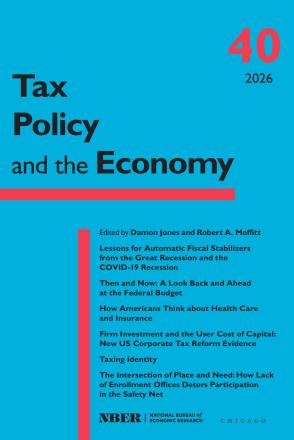
This volume presents new research on taxation, transfer programs, and related issues. Karen Dynan and Douglas Elmendorf examine the potential impact of automatic fiscal stabilizers on fiscal policy and economic activity. They find that a stabilizer providing direct payments could have produced faster unemployment decline after the Great Recession without raising inflation, and much lower inflation after COVID at the cost of a slower unemployment reduction. Alan J. Auerbach and William Gale review federal budget history and project the US debt-to-GDP ratio over the next 30 years, arguing that high projected debt could constrain future policy actions. They also explore possible fiscal consolidation policies. Beatrice Ferrario and Stefanie Stantcheva survey Americans' views of health care and insurance, finding broad agreement regarding costs, access, and efficiency, but partisan gaps in policy preferences stemming from fundamentally different views of government scope rather than contrasting efficiency or fairness beliefs. Jonathan Hartley, Kevin Hassett, and Joshua Rauh analyze the corporate investment response to the Tax Cut and Jobs Act of 2017, finding a larger response than a number of earlier studies of investment sensitivity would have suggested. Joel Slemrod reviews historical taxation based on racial, religious, and gender identity and examines how tax policies that are not conditioned on any of these attributes can nevertheless differentially impact families due to systemic differences in their economic circumstances. Finally, Marianne Bitler, Jason Cook, Chloe East, Sonya R. Porter, and Laura Tiehen analyze geographic proximity effects on Supplemental Nutrition Assistance Program (SNAP) participation, finding that when a SNAP office opens, participation increases by about 20 percent. When an office closes, they find that participation drops by about 8 percent in the next two years.
Related
Programs
More from the NBER
In addition to working papers, the NBER disseminates affiliates’ latest findings through a range of free periodicals—the NBER Reporter, the NBER Digest, the Bulletin on Health, the Bulletin on the Economics of Alzheimer's, and the Bulletin on Entrepreneurship—as well as research spotlights, lectures, and panel videos.


