Taxation and the Origins of the French Revolution
The French Revolution dismantled the ancien régime and redefined the relationship between state power and citizens. Historians have long emphasized the role of the monarchy's extractive and deeply unequal fiscal system in contributing to the revolutionary crisis. The pre-revolutionary tax system largely exempted the clergy and nobility, while the Third Estate, which included about 98 percent of the population, bore nearly all of the tax burden. By the 1780s, taxation absorbed between 25 and 30 percent of average income, and sharp disparities across regions meant that otherwise similar areas faced markedly different tax burdens.
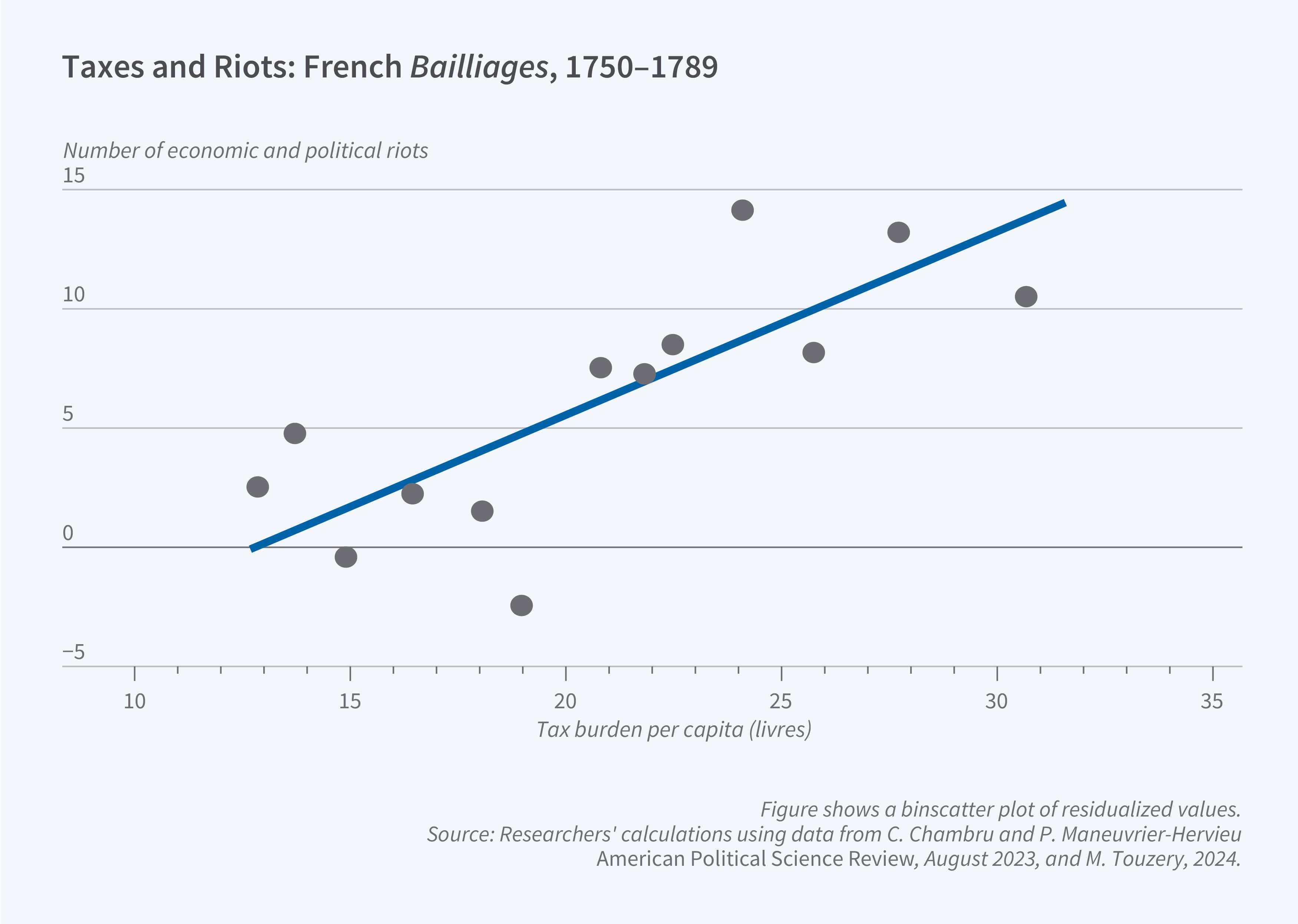
In Extractive Taxation and the French Revolution (NBER Working Paper 34816), Tommaso Giommoni, Gabriel Loumeau, and Marco Tabellini study how taxation shaped the emergence and the escalation of the French Revolution. They assemble a dataset covering per capita tax burdens across France's roughly 435 administrative districts (bailliages) around 1780 and document a strong cross-sectional relationship between tax burdens and unrest. They find roughly twice as many recorded riots between 1750 and 1789 in bailliages in the top quartile of the tax-burden distribution as in the bottom quartile. The difference in the per capita tax burden between these bailliages, on average, is about 9 livres.
Taxes under France’s ancien régime (1750–89) fueled the spread of revolutionary sentiment; more heavily taxed districts were more likely to experience economic and political riots.
Areas with heavier taxes also submitted significantly more complaints against taxation, known as the cahiers de doléances. This relationship was primarily driven by indirect taxes; there was no association between complaints and either direct or local taxes.
The researchers then exploit variation across otherwise similar municipalities that faced different tax burdens depending on their location relative to the collection zones of the salt tax and internal customs duties (traites), which together accounted for about 20 percent of royal revenues by 1780. They find that municipalities in the high-tax zone had roughly twice as many riots as those in the low-tax zone. The effects are concentrated in tax-related unrest, and the researchers do not find any differences in riots related to food, labor, or political issues.
The disparity between the two groups of municipalities emerged in the 1760s and peaked in the 1780s before disappearing after 1790, when the salt tax and the traites were abolished. Effects were stronger where fiscal disparities across municipal borders were larger and where Enlightenment ideas were more widespread—measured by local book sales and subscriptions to the Encyclopédie, a project aimed at compiling and disseminating human knowledge based on reason, science, and secular thought.
The researchers also find that unusually hot summers led to a disproportionate increase in riots in high-tax municipalities relative to their low-tax neighbors. A 10 percent rise in summer temperatures relative to the long-run mean increased riots roughly 10 percent more on the high-tax side. This interaction helps explain the sharp escalation of unrest in the 1780s, when subsistence crises compounded long-standing fiscal grievances.
Deputies from high-tax constituencies were about 70 percent more likely to deliver speeches on taxation, 60 percent more likely to criticize the ancien régime, and over 70 percent more likely to defend the revolutionary project in their fiscal speeches. At key political turning points, legislators from heavily taxed areas were more likely to demand institutional change, support the abolition of the monarchy, and vote for the king's execution.


