What Happens When the Flow of Immigrant Workers Suddenly Stops?
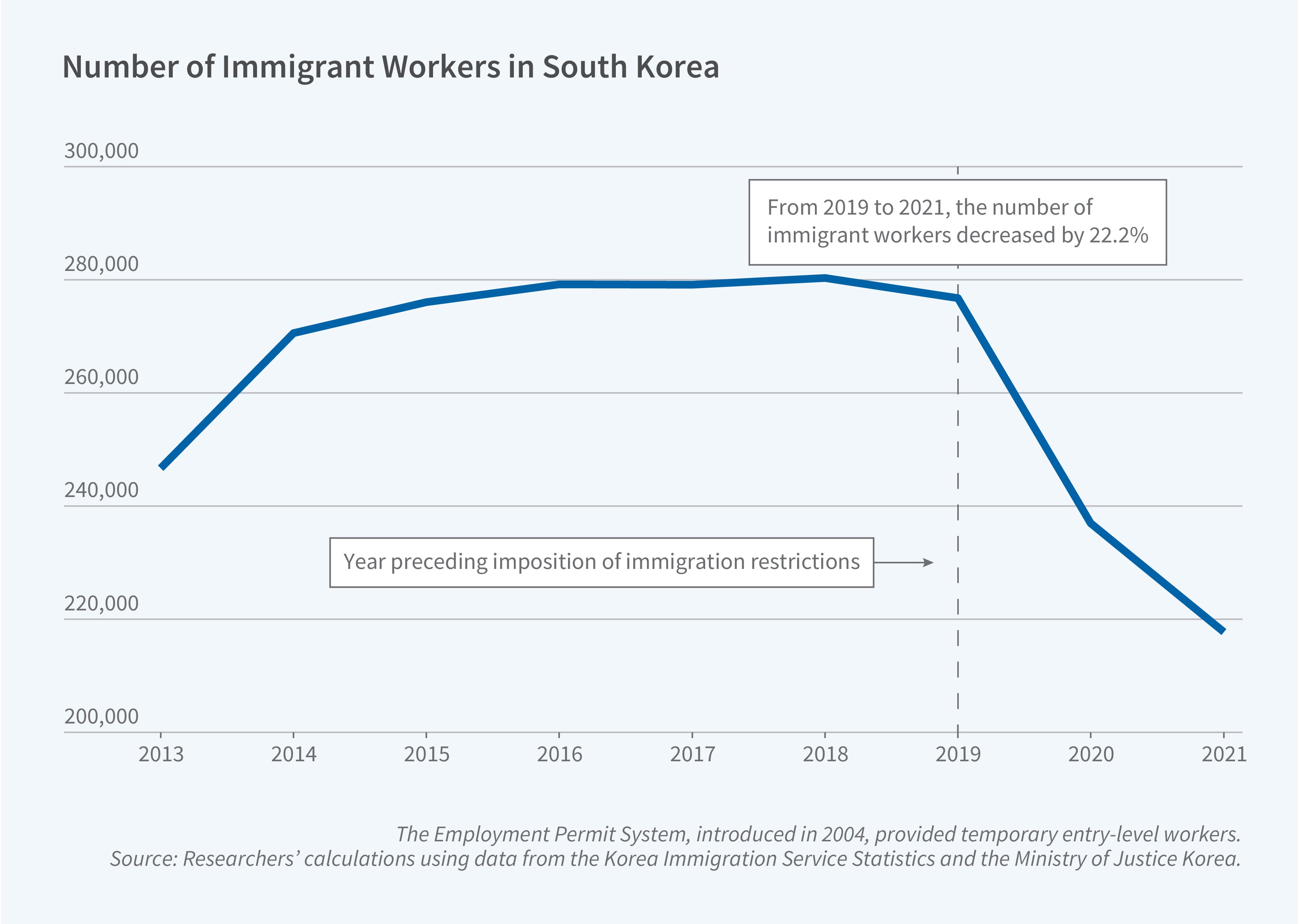
South Korea is one of the fastest-aging countries in the world. Its fertility rate, which has been below replacement level since the 1970s, dropped below one after 2020, producing a sharp contraction in the supply of young workers willing to take physically demanding, low-skilled jobs. To address persistent labor shortages in sectors such as manufacturing, agriculture, and fisheries, the government introduced the Employment Permit System (EPS) in 2004, a guest worker program allowing low-skilled workers from 16 Asian countries to fill entry-level positions.
In 2019, roughly 276,000 EPS workers were employed across the country, with approximately three-quarters concentrated in manufacturing. They were also overwhelmingly assigned simple, repetitive tasks: employers reported that 79 percent of EPS workers performed tasks requiring no specific knowledge or technical skills, compared with just 19 percent of Korean workers. When COVID-19 border closures halted nearly all new visa issuances in 2020 and 2021, the EPS workforce shrank by about 22 percent. In The Effects of a Sudden Stop in Low-Skilled Immigration: Evidence from Korea’s Guest Worker Program (NBER Working Paper 34927), Jongkwan Lee, Giovanni Peri, and Hee-Seung Yang study the consequences of this disruption on approximately 1,000 EPS-participating manufacturing firms, utilizing a survey conducted by the Korea Development Institute and the World Bank in August 2019 and January 2021.
A sudden halt in South Korea’s low-skilled guest worker program led to firm closures, production disruptions, and wage declines for native Korean workers.
Firms with greater pre-pandemic dependence on EPS workers were more likely to shut down. A shift from zero to full EPS exposure was associated with an increase of more than 12 percent in closure probability, more than twice the baseline exit rate. The effect was concentrated among low-wage, low-productivity firms: Those in the bottom 25 percent of the wage distribution saw closure probabilities nearly 0.4 percentage points higher per 1 percentage point increase in exposure, while firms in the upper half of the distribution showed no statistically significant effect.
Among firms that did not close, larger EPS employment declines were associated with a 1.7 percentage point higher probability of reporting revenue losses and a 1.4 percentage point higher probability of experiencing production setbacks for each percentage point decline in EPS workers. Crucially, firms did not respond by expanding domestic hiring. While there was some increase in overall Korean employment through retention of incumbent workers, new hiring of Korean workers showed no significant increase. Instead, firms expressed strong demand for additional EPS workers, with each unit decline in EPS employment associated with demand for approximately two additional guest workers.
Korean employees at surviving firms that were heavily dependent on EPS workers experienced significant wage declines, a finding consistent with native workers being reassigned to lower-skilled tasks previously performed by immigrant workers. This occupational downgrading suggests that EPS and Korean workers performed distinct and complementary roles within the production process.
The researchers acknowledge funding from the Korea Development Institute and the World Bank.


