How Large Language Models Are Reshaping the Book Market
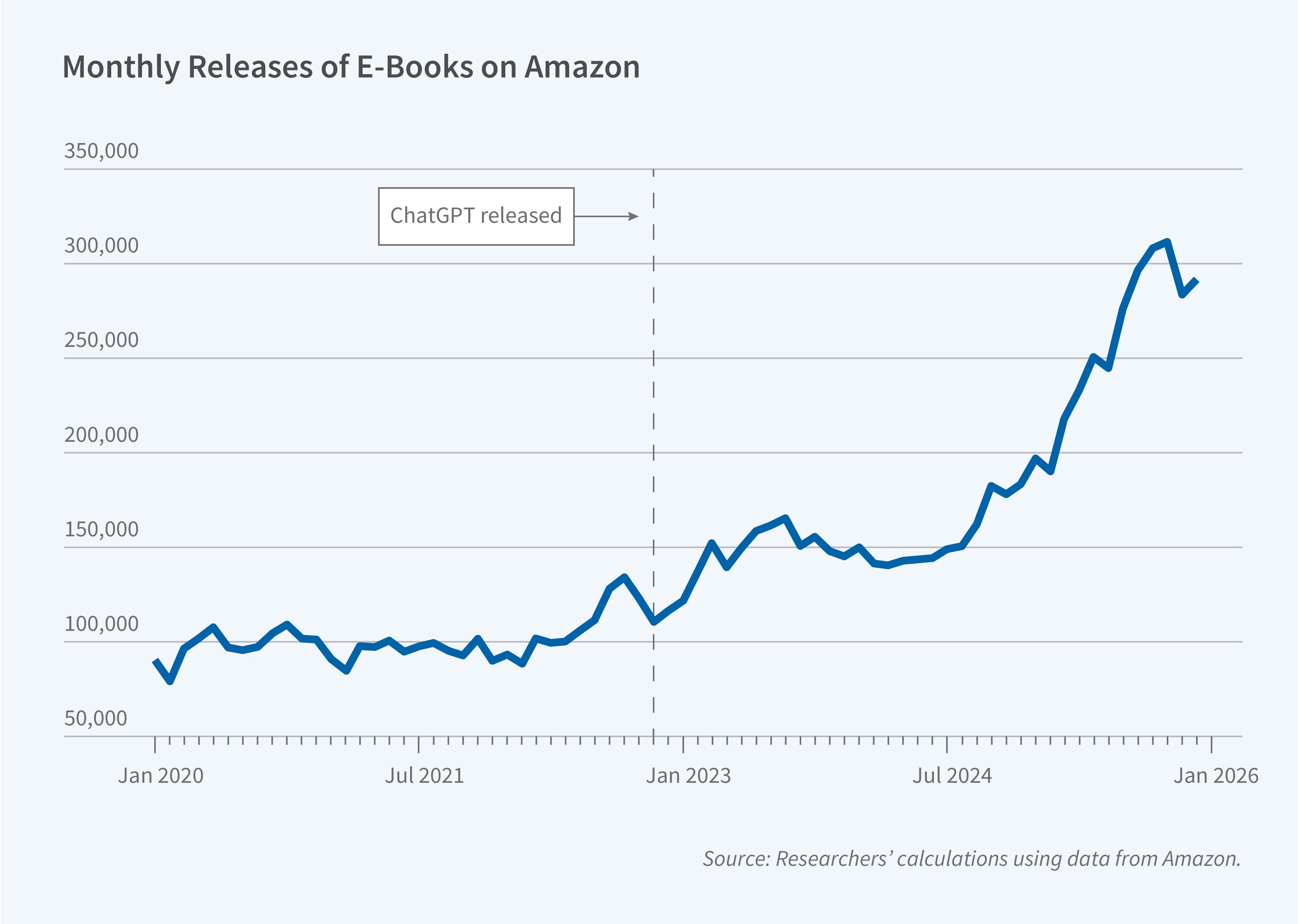
The rapid diffusion of large language models (LLMs) since late 2022 has transformed book publishing, with the rate of new e-book releases on Amazon nearly tripling between 2022 and late 2025. In AI and the Quantity and Quality of Creative Products: Have LLMs Boosted Creation of Valuable Books? (NBER Working Paper 34777), Imke Reimers and Joel Waldfogel study how LLM availability has affected both volume and quality in the distribution of new books. They assemble datasets centered on Amazon's Kindle ecosystem, including a stratified random sample of over 333,000 releases representative of the roughly 10 million e-books published between 2020 and 2025, and a census of 479,000 books across eight subcategories spanning 2008 to 2025. They measure book quality primarily through the cumulative number of reader ratings each title receives—a proxy they validate against estimated sales data—adjusted to account for differences in time since publication across book vintages.
The introduction of large language models was associated with a rapid increase in the number of new e-book releases and a decline in their average quality.
The number of new releases each month rose from approximately 100,000 during the 2020–22 period to over 300,000 by late 2025, with some categories such as Travel and Sports and Outdoors experiencing growth by a factor of more than five. This uptick coincides with ChatGPT's public deployment and rising Google search interest in LLM tools. Survey evidence indicates that nearly half of authors now use AI to assist with their work.
Average book quality has declined in the LLM era. Categories experiencing faster growth in new titles show proportionally larger declines in average quality. However, the increase in the number of releases means that the quality of books at particular absolute rank positions—for example, the 200th-best book released in a category and month—has risen. This improvement is statistically significant for books ranked outside the top 100 per category-month but not for the top 100 titles across all categories and months.
Authors who debuted in the LLM era disproportionately produce low-quality work, while authors who were active before the arrival of LLMs have increased their output, particularly in 2025, and continue to account for much of the higher-quality production.
The researchers estimate the welfare effects of the LLM-related surge in new titles by comparing a hypothetical environment in which all books are drawn from the pre-LLM quality distribution with one in which all books come from the post-LLM distribution. If the LLM era produced the same number of books as before but at its lower average quality, consumer surplus would fall by 13 percent. However, the increase in releases from 3.6 million (2020–22) to 6.7 million (2023–25) flips this result and delivers roughly 5 percent higher consumer surplus. Under a scenario reflecting the peak LLM-era release rate—a tripling of pre-LLM output—surplus would rise by roughly 10 percent.


