Employment Outcomes in Opportunity Zones
The Opportunity Zone (OZ) program, created under the 2017 Tax Cuts and Jobs Act, represents one of the largest place-based economic development initiatives in US history. It offers substantial capital gains tax relief to investors who direct funds into 8,764 designated census tracts across the country. The foregone taxes associated with OZs cost the US Treasury an estimated $8.2 billion over the 2020–24 period.
In Understanding the Employment Effects of Opportunity Zones (NBER Working Paper 34589), Matthew Freedman, Noah Arman Kouchekinia, and David Neumark provide a comprehensive long-term assessment of the program's labor market impacts. They analyze both workplace employment (jobs located in OZ tracts) and resident employment (jobs held by people living in OZ tracts). The investigators use data from two primary sources: the LEHD Origin-Destination Employment Statistics and the American Community Survey for employment rates, earnings, and poverty measures.
The sample includes 6,866 designated OZ tracts and 20,522 non-designated low-income communities (LICs) that were eligible for designation but not selected. To address the fact that designated OZs were on stronger pre-treatment economic trajectories than non-designated LICs, the researchers use matching methods to build comparison groups with similar pre-program trends.
Their analysis reveals that OZ designation increased workplace jobs by 1.3 percent. However, approximately 84 percent of these gains were offset by declines in workplace jobs in adjacent low-income communities. When examining all tracts adjacent to OZs, including higher-income areas, the negative spillover effects were even larger, suggesting the program primarily reallocated jobs geographically rather than created net new employment. The researchers find positive and statistically significant effects of OZ designation on resident and workplace job growth in urban areas. In contrast, they find no evidence of positive impacts on jobs or on measures of employment, earnings, or poverty in rural tracts.
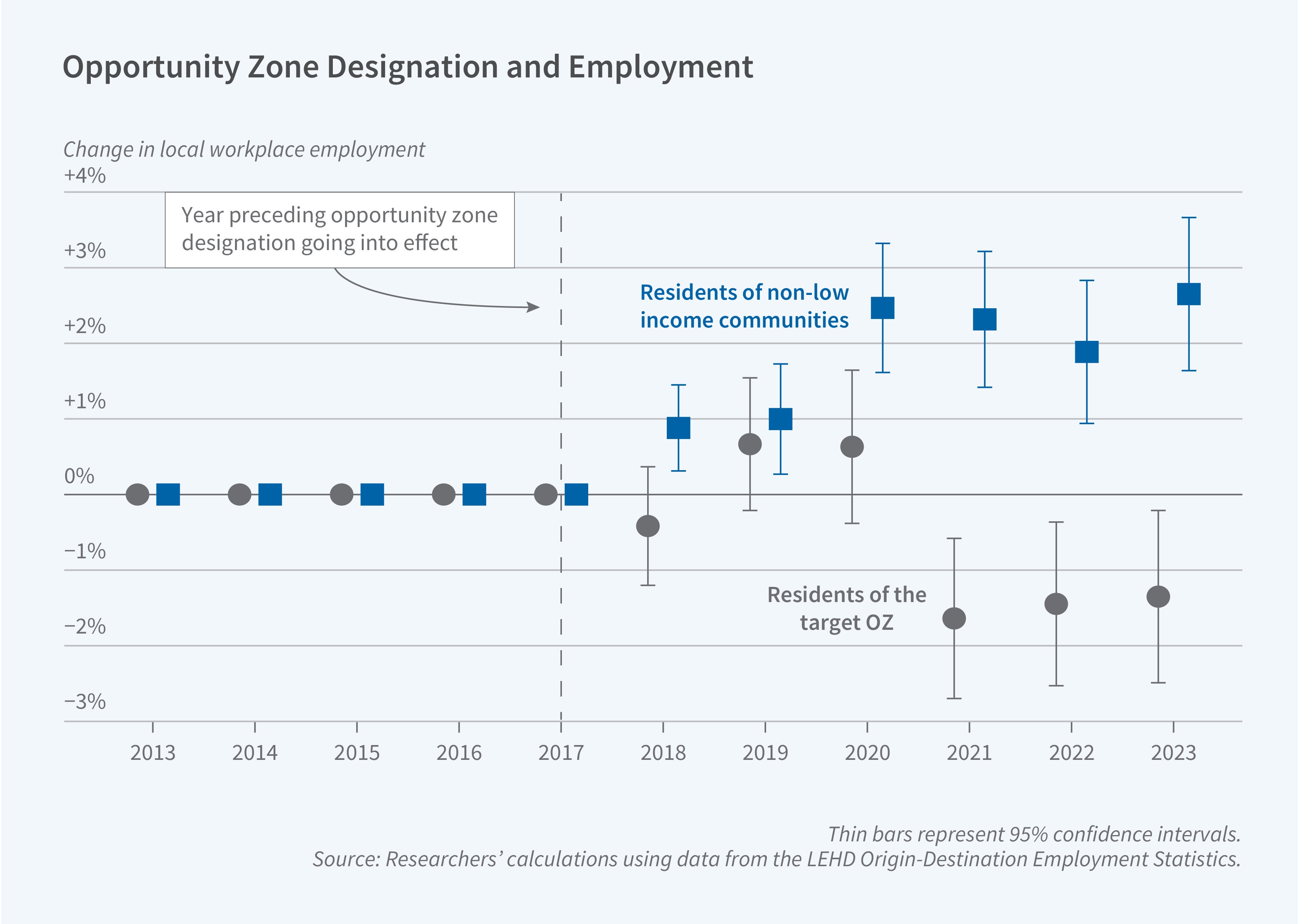
The research also demonstrates that newly created jobs in OZs disproportionately went to residents of more affluent non-LIC tracts. Overall, fewer than one in eight newly created jobs in OZs went to residents of the same or other OZs, while over 75 percent went to residents of comparatively affluent areas.
While OZ designation increased resident employment by 0.9 percent, the gain came entirely from jobs located outside OZs, particularly in non-LIC tracts. Changes in the demographic composition of OZ populations suggest these employment gains likely benefited more-advantaged new residents rather than less-advantaged original inhabitants. The researchers find that OZ designation was associated with a statistically significant increase in the White population share, a decline in the Hispanic share, and an increase in the college-educated share. OZs also experienced relatively high rates of in-migration from other metropolitan areas.
This urban-rural differential persists even after controlling for initial poverty rates and the geographic clustering of OZs, suggesting that something inherent about urban settings makes OZ investments more effective at generating employment.
The researchers acknowledge support from Arnold Ventures.


