The Earnings of Community College Bachelor’s Degree Graduates
Between 2004 and 2022, the share of community colleges offering bachelor's degrees increased from 2.1 percent to 16.5 percent, and the number of bachelor’s degrees awarded by community colleges more than quadrupled. Twenty-four states now authorize these programs, which aim to provide more affordable and geographically accessible pathways to bachelor's credentials, particularly for underrepresented minority and low-income students who have historically enrolled at community colleges in disproportionate numbers.
In Community College Bachelor’s Degrees: How CCB Graduates’ Earnings Compare to AAs and BAs (NBER Working Paper 34684), Riley K. Acton, Camila Morales, Kalena Cortes, Julia A. Turner, and Lois Miller provide the first comprehensive national analysis of labor market outcomes for community college baccalaureate (CCB) graduates. Using data from the US Census Bureau's Post-Secondary Employment Outcomes (PSEO) system, which covers 10 of the 24 states offering CCB degrees, the researchers compare earnings of CCB graduates to those of both associate degree graduates of the same institutions and bachelor's degree recipients at traditional four-year public colleges.
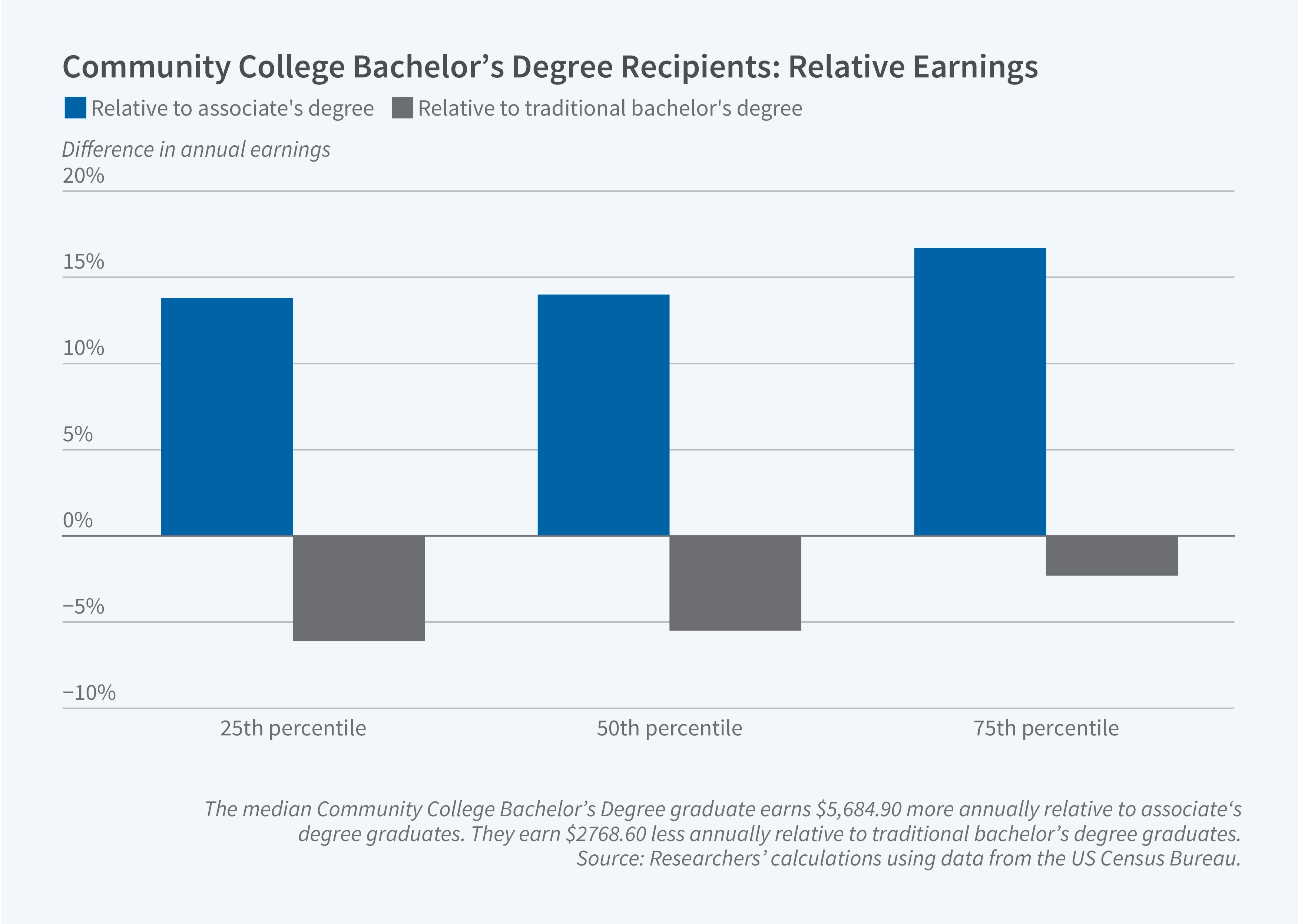
Students who receive bachelor’s degrees from community colleges have median annual earnings 14 percent greater than associate degree holders from the same institutions, but earn less than traditional bachelor’s graduates in the same fields and states.
The PSEO data link postsecondary transcript records with information on 96 percent of US employment. The researchers focus on earnings one year after degree completion. Their data sample includes nearly 13,000 CCB graduates. To isolate differences attributable to degree type, the researchers control for institution, field of study, cohort, and geography in their models.
They find that CCB graduates earn between $4,000 and $9,000 more annually than those who received associate degrees from the same institution and in the same field of study. Their median earnings are about $5,700 higher, representing an earnings premium of approximately 14 percent. However, CCB graduates earn about $2,800 less than traditional bachelor's degree recipients in the same state and field of study, a gap of approximately 5.5 percent.
There is significant heterogeneity in these earnings differentials across field of study: in nursing and criminal justice, CCB graduates achieve earnings parity with traditional bachelor's degree holders. In contrast, CCB graduates in computer information technology and engineering technology face a large earnings penalty, about $30,000 at the median in computer science and information technology fields. The researchers find that fields with well-defined occupational pathways, such as nursing, show highly concentrated employment in aligned industries, where credential level may matter more than institution type. In fields serving broader sets of industries, like computer science, employment patterns are more dispersed and the signaling value of institution type may be more important.
Consistent with differences in earnings by credential type, tuition costs for CCB programs also fall between those of associate and traditional bachelor’s degrees. Some institutions charge constant tuition rates across all course levels, while others use escalating structures where upper-division courses cost approximately 40 percent more than lower-level courses. The researchers also point out that the estimated earnings differentials are based only on short-term earnings of graduates with full-time employment, and that comparisons are descriptive in nature as they do not address potential selection into CCB programs.
The researchers acknowledge support from the Postsecondary Employment Outcomes (PSEO) Coalition, the Texas Higher Education Foundation (PSEO Research Grant #103), and Strada Education Foundation (Research Grant #1207, Title: Understanding Enrollment in and Returns to Community College Baccalaureate Degrees).


