Price Competition and Fraud Among Medicare Equipment Suppliers
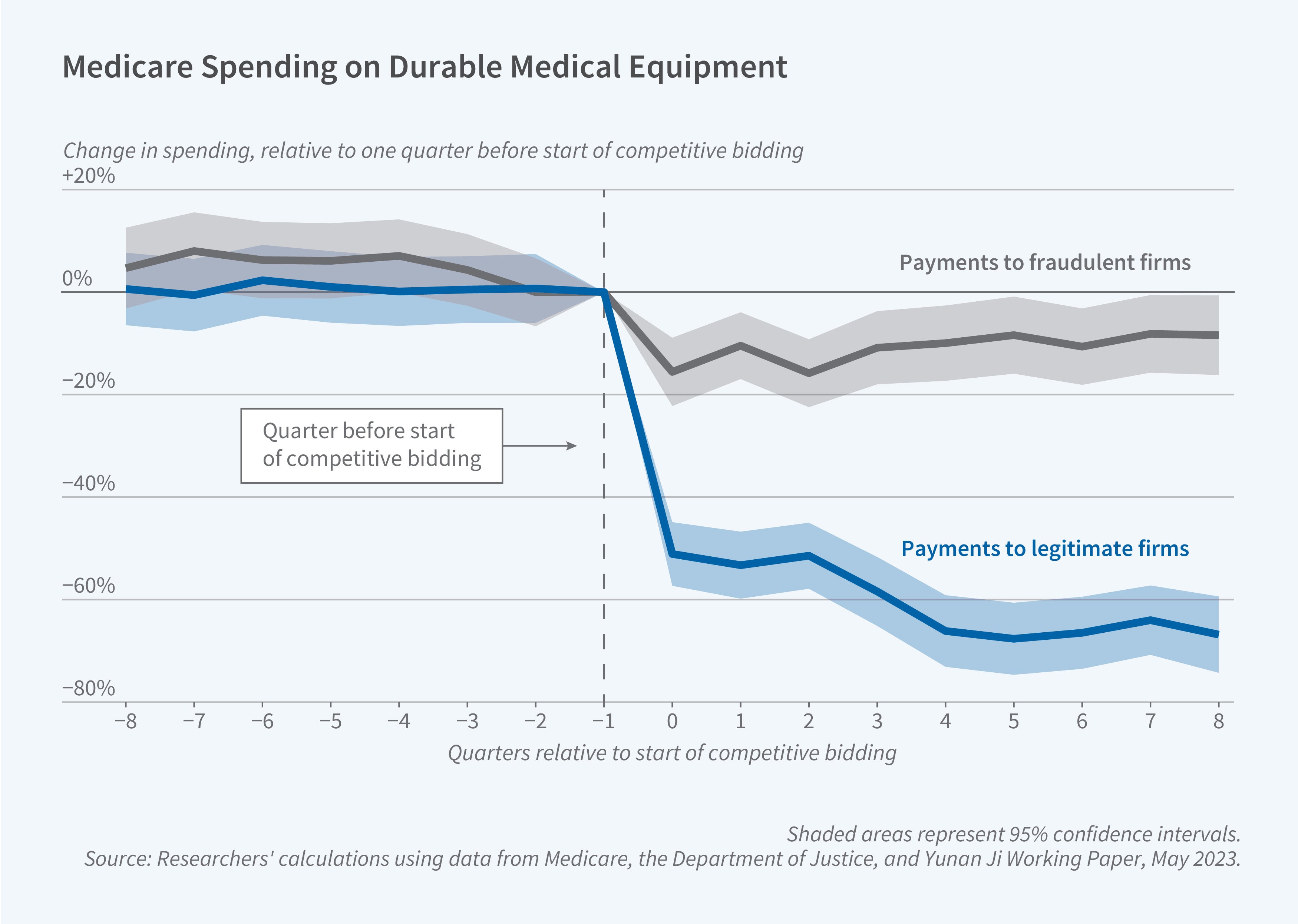
Before 2011, Medicare paid durable medical equipment (DME) suppliers a fixed, administratively set price that often resulted in high profit margins. In some cases, this price was several times what suppliers paid to acquire the equipment. In 2011, Medicare introduced procurement auctions, requiring suppliers to compete for contracts. In Competition and Fraud in Health Care (NBER Working Paper 34802), Renuka M. Diwan, Paul J. Eliason, Riley League, Jetson Leder-Luis, Ryan C. McDevitt, and James W. Roberts exploit the staggered implementation of these auctions to identify the effect of competition on fraud.
The introduction of procurement auctions for durable medical equipment tilted Medicare spending towards fraudulent firms.
Medicare spends nearly $10 billion annually on DME, purchasing products from thousands of suppliers. To measure fraud, the researchers construct a dataset of fraudulent and suspicious DME suppliers. They identify 849 firms subject to anti-fraud enforcement through Department of Justice press releases and the List of Excluded Individuals/Entities from the Office of Inspector General. They further identify an additional set of suspicious firms—those sharing names, owners, addresses, or referral networks with sanctioned suppliers. Together, these groups comprise roughly 2,900 fraudulent or suspicious firms out of more than 154,000 total suppliers.
Consistent with prior research, the researchers find competitive bidding led to a 35 percent reduction in total Medicare DME spending, the result of a 23 percent drop in prices and a 15 percent decline in quantities. However, the spending reduction was almost completely associated with legitimate firms. Payments to legitimate suppliers declined by 46 percent, while those to fraudulent firms fell by only 14 percent.
Claims submitted by fraudulent firms increased by 5 percent, compared to a 26 percent decline for legitimate firms. The number of active legitimate firms dropped by 26 percent, with virtually no change in the number of fraudulent firms. Fraudulent firms' market share rose by 8 percentage points following the introduction of competitive bidding. Even conditional on size, fraudulent firms gained market share.
This shift was driven primarily by a selection effect rather than changes in firm behavior. Quality measures—including the rate of equipment repairs and replacements and the health characteristics of patients receiving DME—showed no meaningful deterioration after the introduction of competitive bidding. The researchers do not find any evidence that fraudulent firms shifted toward legitimate business practices.
Bidding data show that fraudulent firms were far more likely than legitimate firms to participate in the auctions. Nearly 16 percent of bids came from fraudulent firms despite these firms comprising just over 2 percent of the market. The bid distributions of fraudulent firms were nearly identical to those of legitimate firms. Fraudulent firms’ key advantage was cost: They could operate at lower cost by billing for equipment never delivered, supplying products to ineligible patients, and selling used equipment as new. The researchers’ estimates confirm that lower prices favor fraudulent firms, with the extent of selection towards these firms growing stronger as prices decline.
The researchers acknowledge funding from Arnold Ventures under grant 22-08498 and the National Institute on Aging under grant T32-AG000186.


