The Impact of Expanding Paternity Leave
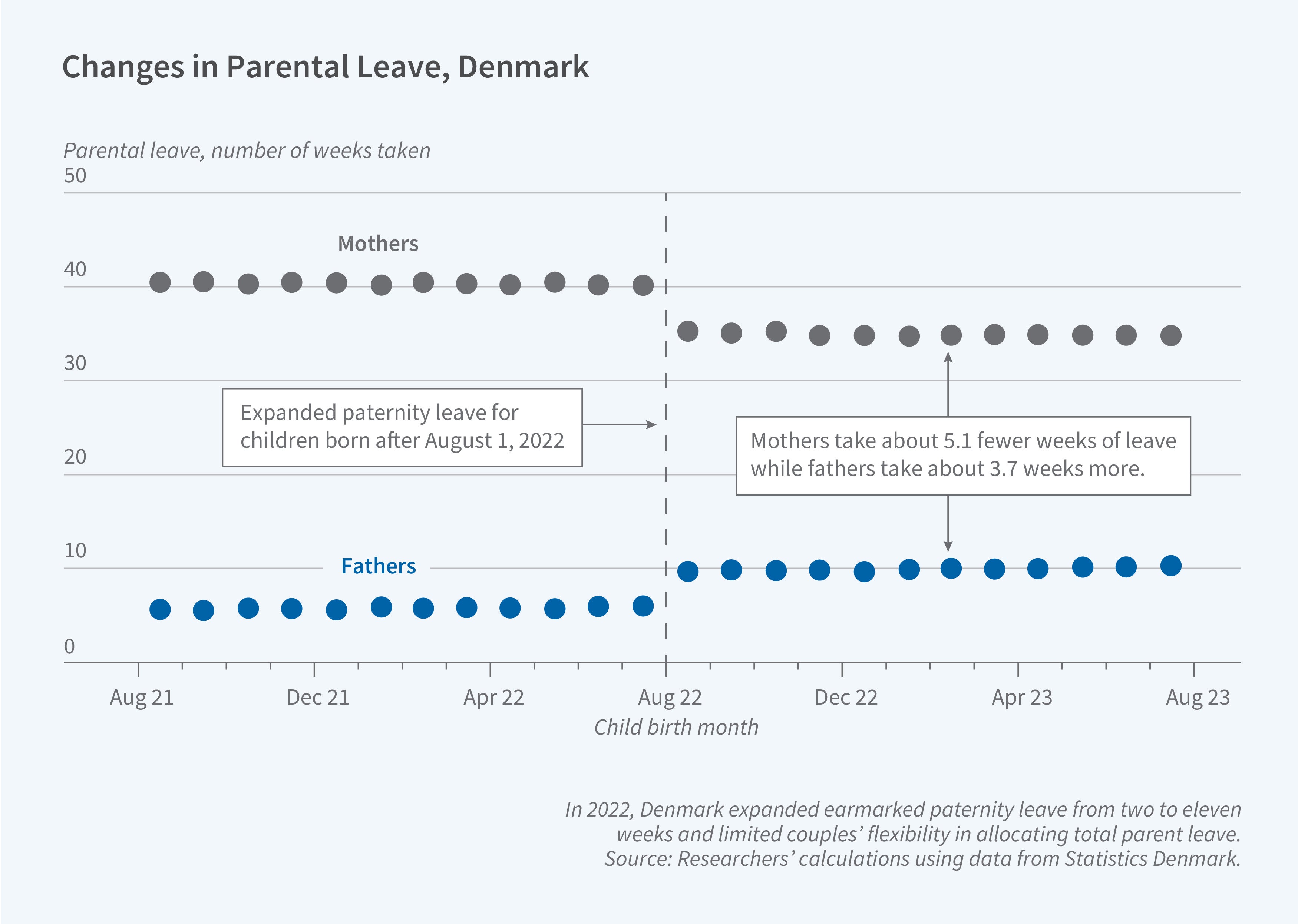
A recent European Union directive requires member states to provide at least two months of earmarked paternity leave. In Expanding Paternity Leave: Effects on Beliefs, Norms, and Gender Gaps (NBER Working Paper 34862), Henrik Kleven, Camille Landais, Anne Sophie S. Lassen, Philip Rosenbaum, Herdis Steingrimsdottir, and Jakob Egholt Søgaard study the effects of expanding earmarked paternity leave in Denmark. For fathers of children born after August 1, 2022, the reform increased earmarked paternity leave from two to eleven weeks. This increase was funded by restricting parental leave that had previously been freely transferable between parents. This had the effect of reducing the maximum leave available to mothers from 46 to 37 weeks.
Expanding paternity leave in Denmark shifted the parental allocation of leave and narrowed gender gaps in earnings, but reduced parents’ satisfaction with their leave arrangements.
The researchers fielded a survey of roughly 40,000 parents of newborns, with responses linked to full-population Danish administrative records. The survey elicited detailed beliefs and attitudes toward gender roles and childcare. It was first administered when the child was 4 months old, and then repeated at 18 months.
The reform produced large changes in leave-taking behavior. Fathers increased their leave by 3.7 weeks on average, while mothers reduced their leave by more than 5 weeks. Fathers' share of total household leave rose from approximately 12.4 percent to 20.5 percent. The reform also increased parents' support for earmarked paternity leave, with an average effect of about 0.05 for mothers (0.06 for fathers) on a policy-support index scaled from 0 to 1. Treatment raised the perceived social and workplace acceptability of paternity leave and increased recognition of its importance for the father-child bond.
The percentage of respondents who agreed that preschool children suffer when their mothers work full-time fell by 0.031 among mothers, and the perceived gap between mothers' and fathers' childcare abilities narrowed at all child ages. The gender-beliefs index declined by 0.023 for mothers and 0.020 for fathers. Effects were driven entirely by families actually exposed to the reform—those who would have taken less than 12 weeks of paternity leave absent the policy change—and were roughly 2.5 times larger among first-time parents than among those with higher-parity births.
The gender gap in earnings in the first year after childbirth fell by about 34 percentage points and the gap in hours worked fell by about 33 percentage points. More notably, even after both parents had returned to work, the earnings gap still fell by 2.8 percentage points and the hours gap by 1.4 percentage points. Relative to child penalties in Denmark of roughly 20 percent in earnings and 10 percent in hours, the reform reduced child-related gender inequality by about 14 percent.
One cost of earmarking is that the reform reduced leave satisfaction. Before the reform, about 90 percent of both mothers and fathers reported satisfaction with their leave allocation; afterward, this fell to about 50 percent for mothers and 60 percent for fathers. Both groups attributed their dissatisfaction to a preference for allocating more leave to mothers, and nearly all respondents agreed that parents should be free to divide leave as they choose.
The researchers acknowledge funding from the Carlsberg Foundation (Infrastructure Grant #CF21-0171), the Independent Research Fund Denmark (grant #4750-301280), and the Danish National Research Foundation (grant #DNRF134).
Camille Landais acknowledges funding from the European Research Council (GENEQUALITY consolidator grant) and from the Gates Foundation.


