Job Growth in Counties Targeted by the CHIPS and Science Act
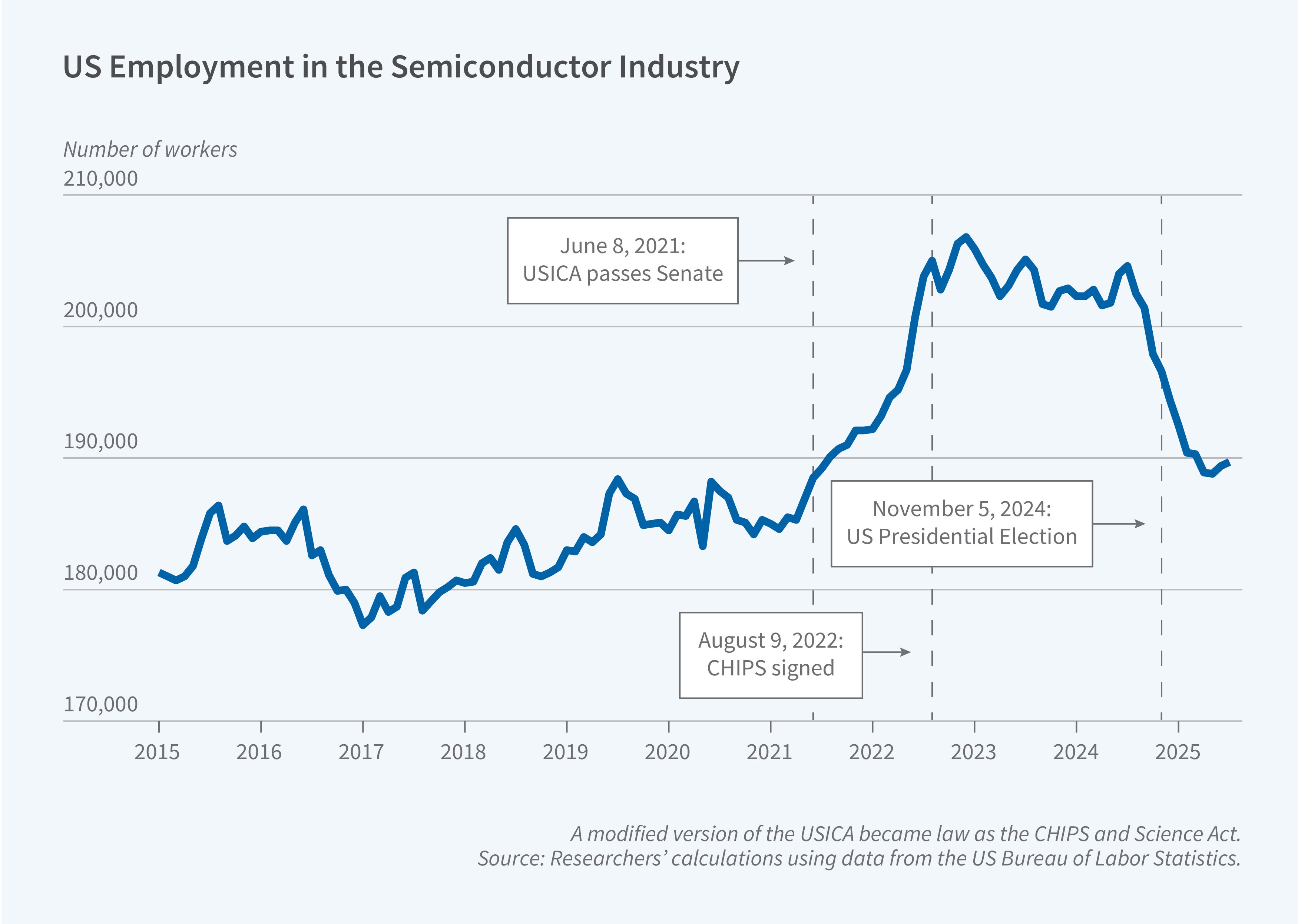
The CHIPS and Science Act, passed in August 2022, committed the federal government to spending nearly $53 billion to revitalize domestic semiconductor production. While job creation was a central argument of the legislation's proponents, there has been limited assessment since its passage of whether the act delivered on employment promises. In Employment Impacts of the CHIPS Act (NBER Working Paper 34625), Bilge Erten, Joseph E. Stiglitz, and Eric Verhoogen use county-level data to provide empirical evidence on the short-term employment effects of this legislation.
The CHIPS and Science Act generated approximately 15,000 direct semiconductor jobs and twice as many indirect jobs in affected counties.
The study applies two difference-in-differences research designs to data from the Quarterly Census of Employment and Wages. The first compares 149 counties with preexisting semiconductor facilities to 752 counties with high-tech employment but no semiconductor production. The second compares 83 counties with semiconductor fabrication facilities, the facilities that were the focus of funding, to 66 counties with semiconductor facilities but no fabrication plants. Both research designs assume these pairs of county groups would have followed parallel employment trends absent the CHIPS Act.
The researchers find that employment increases in the counties that were better positioned for CHIPS Act support started when the precursor United States Innovation and Competition Act (USICA) was introduced to the Senate in May 2021 (where it quickly found bipartisan support). This suggests that firms anticipated eventual federal support and made hiring decisions accordingly. Stock market evidence supports this interpretation: semiconductor firms experienced significant abnormal returns on May 19, 2021, when the USICA was introduced, but showed little reaction to the act's actual passage or signing.
The researchers estimate direct employment gains of 110 jobs per affected county in the semiconductor production sector in the first difference-in-differences design, representing a 12.7 percent increase relative to pre-USICA employment levels. They estimate larger absolute effects of 180 jobs per affected county with fabrication facilities in the second design, an 11.8 percent increase in these counties. These impacts emerged over the five quarters following the USICA's Senate passage and stabilized around the time the CHIPS Act was signed.
The study finds robust evidence of spillover effects on local construction employment. The researchers estimate that there were 136 additional nonresidential construction jobs per affected county with semiconductor production, and 203 jobs per county with fabrication facilities. The study does not find evidence, however, of spillovers to wages in the semiconductor sector, employment in upstream input industries, or county-level GDP.
Nationally, the researchers estimate that the legislation created approximately 15,000 jobs in the core semiconductor sector. Their estimate of the total employment gain, including jobs in related sectors such as semiconductor equipment and materials manufacturing, upstream inputs, and construction, is between 30,000 and 46,000 jobs.
The findings suggest that targeted industrial policy can generate measurable short-term employment gains in strategic sectors. However, the employment effects are modest relative to the CHIPS and Science Act appropriation, in part reflecting the highly capital-intensive nature of semiconductor production.
The researchers acknowledge support from the Alfred P. Sloan Foundation (grant no. G-2023-21088) and the Center for Political Economy’s Firms and Industrial Policy Idea Lab at Columbia University.


