NBER Macroeconomics Annual 2025, volume 40
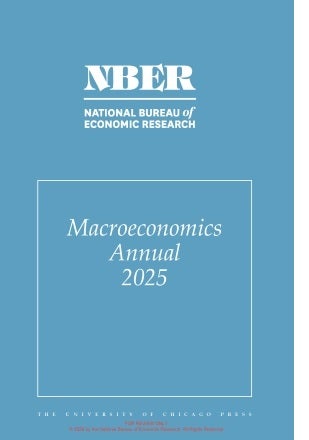
John V. Leahy and Valerie A. Ramey, editors.
This fortieth volume of the NBER Macroeconomics Annual includes four new papers on contemporary macroeconomic challenges and methodologies. Christopher Clayton, Matteo Maggiori, and Jesse Schreger examine how hegemonic powers use economic policies as tools of influence on target countries and show how the effectiveness of these policies depends on the target’s available alternatives and whether it can take advantage of those alternatives.
José Luis Montiel Olea, Mikkel Plagborg-Møller, Eric Qian, and Christian Wolf provide essential guidance for practitioners choosing between vector autoregressions and local projections for estimating impulse response functions.
Kristin Forbes, Jongrim Ha, and M. Ayhan Kose analyze inflation-output tradeoffs across rate cycles from the 1970s to the post-pandemic period using a new cross-country database that reveals how delayed but aggressive monetary responses can generate low-cost disinflation.
Satyajit Chatterjee, Dean Corbae, Kyle Dempsey, and José-Victor Ríos-Rull explore the bidirectional relationship between credit scores and inequality over the life cycle, demonstrating through a dynamic general equilibrium model how full information credit scoring systems can improve welfare outcomes.
In a keynote address commemorating the conference anniversary, Olivier Blanchard assesses the evolution of macroeconomic research over four decades, and finds substantial methodological convergence.
Related
More from the NBER
In addition to working papers, the NBER disseminates affiliates’ latest findings through a range of free periodicals — the NBER Reporter, the NBER Digest, the Bulletin on Health, and the Bulletin on Entrepreneurship — as well as online conference reports, video lectures, and interviews.



© 2023 National Bureau of Economic Research. Periodical content may be reproduced freely with appropriate attribution.