New Work, New Technologies, and the Skill Premium
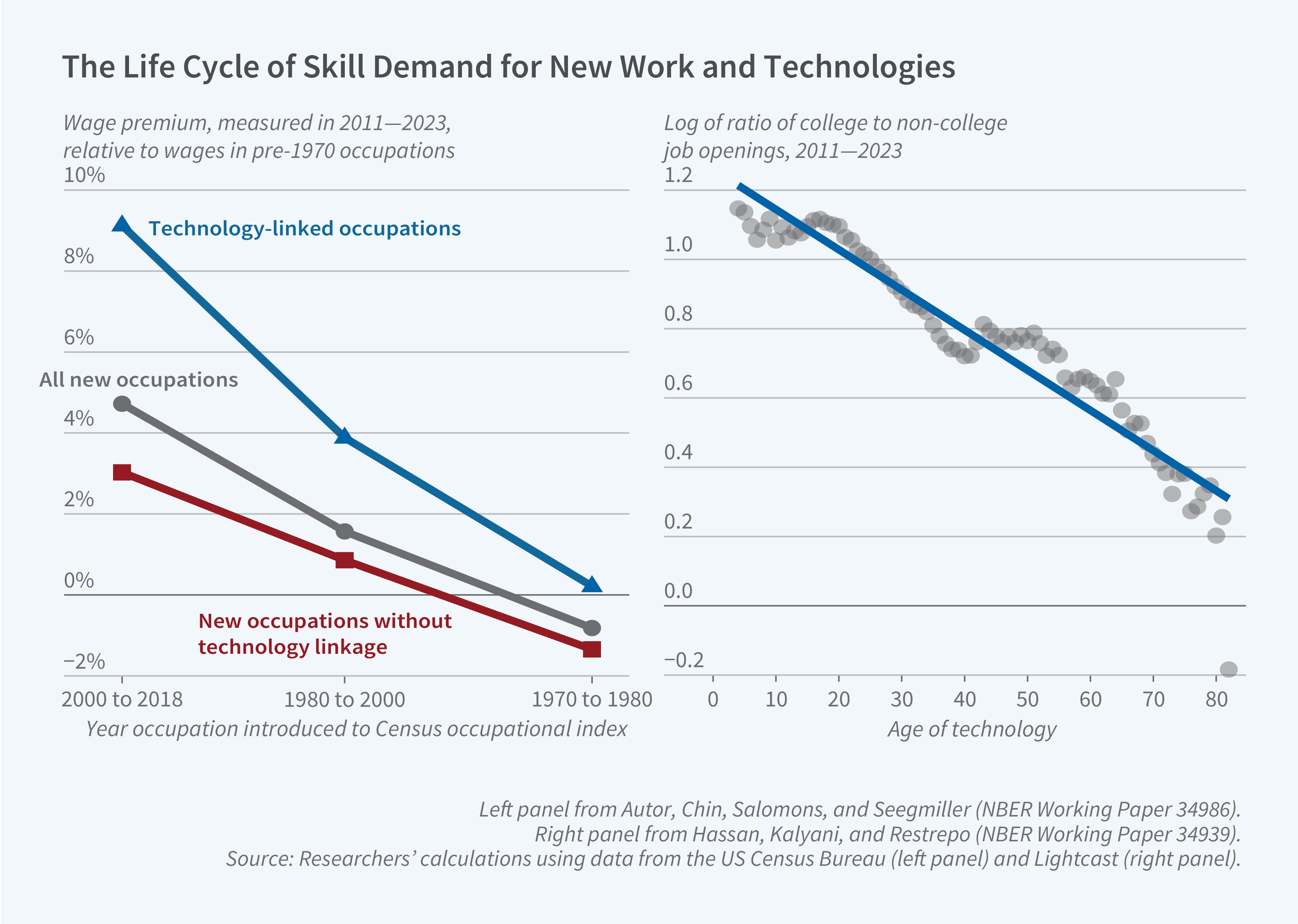
Two new NBER working papers examine how new technologies erode demand for long-standing labor via automation while also instantiating fresh labor demand—“new work”—by introducing new job tasks. They present a unified account of how demand-side forces affect skill premiums and share a common organizing idea: new work creates demand for scarce, specialized skills that initially command a wage premium which fades as this expertise diffuses through the workforce. Developed independently and working at different scales and with different data, they present complementary evidence for the life cycle of the skill premium and its implications for inequality.
In What Makes New Work Different from More Work? (NBER Working Paper 34986), David Autor, Caroline Chin, Anna M. Salomons, and Bryan Seegmiller measure new work as novel occupational titles that appear for the first time in the Census Bureau’s decennial occupation list. Using person-level occupational write-ins from the 1940 and 1950 Complete Count censuses and the confidential 2011–23 American Community Survey, they establish five findings that tie new work to the expertise mechanism.
First, new work is disproportionately performed by younger and more-educated workers, even within detailed occupation-industry-county cells: workers with advanced degrees in 2011–23 are 2.9 percentage points more likely than high-school graduates to be in new work, against an 18.3 percent base rate. Second, conditional on demographics, three-digit occupation, three-digit industry, and county, new work pays a 1.8 log-point wage premium, with technology-linked new work paying roughly four times more than non-technology-linked new work. Third, the premium declines in vintage age across both technology-linked and other new work, with titles introduced between 2000 and 2018 commanding 4.7 log points and 1970s titles drawing a slight negative premium. Fourth, in linked 1940–50 data, prior employment in new work predicts higher subsequent earnings even conditional on current new-work status and prior wages, evidence of durable expertise rather than positive selection. Finally, the construction of federally financed manufacturing plants during World War II spurred the emergence of new work.
In The Skill Premium in Times of Rapid Technological Change (NBER Working Paper 34939), Tarek Alexander Hassan, Aakash Kalyani, and Pascual Restrepo explore how the aggregate skill premium changes when the rate of new technology arrival accelerates and then slows. They develop a calibrated macroeconomic model in which college-educated workers have a comparative advantage in learning recently invented technologies that fades as technologies standardize. The skill premium tracks the age mix of technologies in use, which depends on the pace of new technology creation.
The authors quantify both the life cycle of technologies’ skill demand and the pace of technology creation using novel text-based methods, tracing 6,259 distinct technologies through US patent text, Wikipedia, and 300 million Lightcast job postings. They find that 57 percent of jobs associated with a new technology require a college degree at emergence, falling to only 34 percent 80 years after the technology’s introduction. A technology’s overall labor-market footprint peaks 35 years after introduction. The measured rate of new technology creation is stable at 25–30 per year before 1970, accelerates to a peak near 250 per year in the late 1980s, and falls back to about 100 per year by the mid-2000s.
The calibrated model generates a 32 percent increase in the college premium between 1980 and 2010 and anticipates its post-2010 flattening, which reflects the deceleration of the wave of technology creation of the '80s and '90s. The same mechanism explains where and for whom the premium rose. Because new technologies diffuse from dense to less-dense areas—the modal technology is 34 years old in the densest 1 percent of US cities, versus 48 in the bottom-half density bin—the model accounts for 6.2 of the 8.7 log point urban-rural differential rise between 1980 and 2005. And because younger workers learn new technologies faster, the skill premium rises first among the young, accounting for half the additional rise in the college premium among young workers relative to the old.
These papers offer a novel account of skill-premium dynamics that does not require successive technology waves to be inherently more skill-biased—though it does not preclude this either. Skill demand rises when the rate of emergence of new work accelerates.
For “What Makes New Work Different from More Work?” David Autor acknowledges support from the Hewlett Foundation, the Google Technology and Society Visiting Fellows Program, the NOMIS Foundation, the Schmidt Sciences AI2050 Fellowship, the Smith Richardson Foundation, and the James M. and Cathleen D. Stone Foundation. Anna M. Salomons acknowledges support from Instituut Gak.


