Quantitative Trade Policy in a Changing World
Introduction
Over the past three decades trade policy has profoundly shaped the structure of production, employment, and welfare across countries. The North American Free Trade Agreement (NAFTA), China’s entry into the World Trade Organization (WTO), and the recent resurgence of tariff protectionism illustrate how deeply globalization and policy choices are intertwined. Evaluating their effects requires quantitative frameworks that capture how shocks to both technology and policy propagate through supply chains, labor markets, and international linkages.
Our research develops tractable general equilibrium models to quantify how shocks such as tariffs affect economies—both in the aggregate and across workers, regions, and sectors. These frameworks extend the Ricardian model of trade to include multiple sectors, heterogeneous productivity and trade elasticities, input-output linkages, spatial labor markets, and dynamic features such as migration, trade imbalances, and uncertainty. Together, they provide a coherent empirical foundation for evaluating contemporary trade policy.
Building Blocks
The foundation of this research agenda lies in the Ricardian model of comparative advantage, extended to a multi-sector, multi-country economic environment with input-output linkages and spatial adjustments. In this framework, countries differ in productivity and face sector-specific trade costs; goods markets are connected through input-output linkages, and trade flows satisfy a gravity equation—larger, more productive, and geographically closer countries trade more intensively.
Our approach has been to turn theoretical and stylized models into empirically disciplined, policy-relevant models. A key methodological innovation is the exact-hat-algebra approach for trade policy analysis, which expresses equilibrium relationships as ratios (or “hats”) between counterfactual and observed economies. By conditioning on data—trade shares, input-output matrices, production, and employment—this approach enables counterfactual analysis without separately identifying unobserved structural fundamentals such as sectoral productivities or non-policy trade costs. It has become a cornerstone of applied trade research, simplifying computation while maintaining internal consistency between data, parameters, and equilibrium economic outcomes. Over time, researchers have expanded it to include geography, dynamic adjustment, uncertainty, and international asset trade. These extensions now make it possible to study a wide range of issues, including migration policy, place-based policy, and climate policy.
NAFTA and the Central Role of Production Linkages
One of our first studies quantified the effects of tariff reductions between 1993 and 2005 across NAFTA members.1 One key finding is that NAFTA created a tightly integrated regional value chain among its members. To capture this phenomenon, we embedded input-output linkages into a Ricardian trade model, which allows us to trace how policy shocks cascade through production networks within and across countries. For example, a tariff protecting the steel industry raises costs for autos and machinery, reshaping demand and employment well beyond the targeted sector.
By exploiting tariff variation across sectors and trade partners, we also estimated sectoral trade elasticities from trade policy data. With these estimates and applying the model, we found that NAFTA increased intra-bloc trade by 118 percent for Mexico, 41 percent for the United States, and 11 percent for Canada. Welfare rose by 1.3 percent in Mexico, 0.08 percent in the US, and fell slightly by 0.06 percent in Canada. Ignoring intermediate inputs or sectoral linkages reduces estimated effects by more than half. The lesson: trade policy cannot be understood solely through final goods—it operates through a complex network of inter-industry connections.
The China Shock and Uneven Adjustment Across Space and Time
China’s WTO accession in 2001 transformed global trade. In research with Maximiliano Dvorkin, we developed a dynamic spatial model linking aggregate trade shocks to regional labor markets through migration and production networks, integrating labor dynamics, trade, and spatial transition paths.2 This framework allows us not only to measure differential impacts across labor markets but also to estimate aggregate (level) effects, thereby confronting the “missing intercept” problem common in earlier approaches.
To implement this approach, we introduced dynamic hat algebra, an extension of the static “hat” method to intertemporal settings. It expresses changes in endogenous variables as ratios over time, conditional on observed equilibrium paths, allowing researchers to study dynamic adjustment with forward-looking agents—without initially restricting the economy to a steady state, without estimating all structural fundamentals, and without relying on first-order approximations to conduct counterfactual analysis.
Our results show that the China shock accounted for roughly 16 percent of the decline in US manufacturing employment between 2000 and 2007, about 550,000 jobs, while increasing aggregate US welfare by about 0.2 percent. Adjustment was gradual and costly: mobility frictions produced highly uneven effects across workers and regions. Even in a flexible labor market like that in the United States, trade openness delivers aggregate gains but imposes concentrated, long-lasting costs and results in spatial inequality when labor mobility is imperfect.
The Trade War and Its Geographical Impact
After the US-China trade war began in 2018, we applied this framework to quantify the impact of tariffs and retaliation across US labor markets.3 We asked how the effects of the trade war differed from those of the China shock.
It might seem that the trade war reversed the China shock, but this is not what we found. Figure 1 presents, for each labor market in the US, the effects of the China shock (on the y-axis) and the effects of the trade war (on the x-axis). As we can see in the figure, only four labor markets that lost with the China shock experienced welfare gains with the trade war: the nonmetallic industry in Louisiana, the metal industry in Maine, the wood and paper industry in New Mexico, and the transport equipment industry in West Virginia.
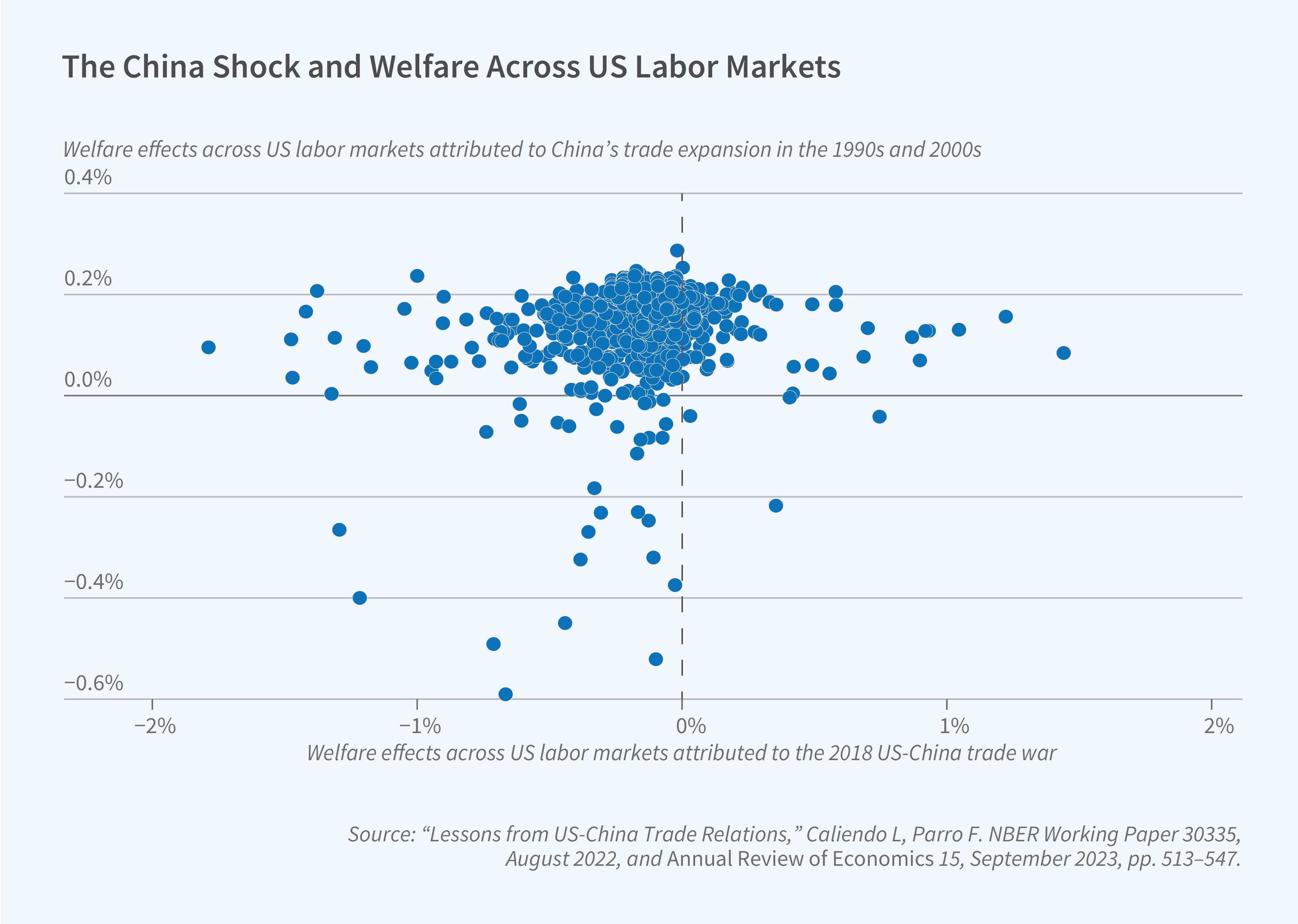
More broadly, manufacturing-intensive regions in the Midwest and Great Lakes suffered losses exceeding 0.6 percent, coastal and service-oriented areas experienced smaller declines (less than 0.2 percent), and more isolated regions were largely unaffected.
The trade war thus reduced real income but did little to restore manufacturing employment. Its effects propagated spatially through input-output linkages, triggering global reallocations along value chains rather than isolating national economies. The lesson: trade wars redistribute losses, not production. Tariffs designed to protect domestic industries can erode real incomes in the very regions they are meant to help—in particular, when other countries retaliate.
The Principle of Reciprocity and Labor-Market Adjustments
In the context of globalization and trade policy, one of the WTO’s core principles is reciprocity—the notion that negotiated concessions should be mutually balanced. In ongoing work with Chad Bown, Robert Staiger, and Alan Sykes, we formalize reciprocity within new quantitative trade models, provide formulas for reciprocal tariff changes, and examine how it shapes labor-market adjustments.4
Reciprocal tariff reductions preserve each country’s terms of trade. When reciprocity holds, domestic tariff changes alone suffice to predict labor-market reallocation, since partner responses offset external price effects. Applying reciprocity to China’s WTO accession, we find that China’s tariff cuts exceeded the reciprocal benchmark, amplifying labor adjustments in trading partners but increasing global real income overall.
Tariffs, Imbalances, and Uncertainty
Recent developments have raised questions about the role of trade policy in shaping trade imbalances and their equilibrium implications. In research with Samuel Kortum, we integrate trade in goods and assets to study how tariffs interact with trade imbalances and uncertainty.5 We extend the hat-algebra methodology to a stochastic dynamic setting and find that higher US tariffs narrow the trade deficit through adjustments in income and expenditure but raise domestic prices and lower real consumption. Surplus countries offset some losses through asset trade, illustrating how trade and financial integration jointly shape macroeconomic responses. Attempts to manipulate trade balances through tariffs are therefore costly to consumers.
Conclusion
Across these studies, several consistent insights emerge. First, tariffs propagate broadly. Protection of one sector raises costs in others through supply-chain linkages, often offsetting gains in the targeted industries. Since production linkages amplify trade policy effects, ignoring intermediate inputs or sectoral connections understates welfare and employment impacts. Second, consumers bear much of the burden of higher tariffs. Limited substitution means most price increases pass through to domestic buyers. Third, regional effects are unequal. Areas that specialize in export-oriented manufacturing or are dependent on imported intermediates experience larger declines in real wages and employment. As a result, trade openness yields aggregate gains but uneven outcomes. Fourth, economic adjustment is slow. Labor and production reallocation unfold gradually, amplifying short-term disruptions. The China shock and trade war highlight the importance of accounting for adjustment and distributional dynamics. Fifth, tariffs affect macroeconomic adjustment through general equilibrium effects. They alter relative prices, consumption, and asset flows, not just trade balances.
The global trading system is once again in flux. Supply-chain reorganization, rising uncertainty, and geopolitical tensions pose new challenges for open economies. New quantitative trade models for trade policy—anchored in data and grounded in theory—remain essential for transparent policy evaluation. They enable economists and policymakers to assess not only whether trade policy matters, but how much, for whom, and through which channels. From NAFTA to the China shock and the trade war, the lesson is clear: rigorous quantitative tools are indispensable for designing policies that balance efficiency, equity, and resilience in a changing world.
Endnotes
“Estimates of the Trade and Welfare Effects of NAFTA,” Caliendo L, Parro F. NBER Working Paper 18508, December 2014, and The Review of Economic Studies 82(1), January 2015, pp. 1–4.
“The Impact of Trade on Labor Market Dynamics,” Caliendo L, Dvorkin M, Parro F. NBER Working Paper 21149, May 2015. Published as “Trade and Labor Market Dynamics: General Equilibrium Analysis of the China Trade Shock” in Econometrica 87(3), May 2019, pp. 741–835.
“Lessons from US-China Trade Relations,” Caliendo L, Parro F. NBER Working Paper 30335, August 2022, and Annual Review of Economics 15, September 2023, pp. 513–547.
“Reciprocity and the China Shock," Bown CP, Caliendo L, Parro F, Staiger RW, Sykes AO. NBER Working Paper 32835, August 2024.
“Tariffs and Trade Deficits,” Caliendo L, Kortum SS, Parro F. NBER Working Paper 34003, August 2025.


