Entrepreneurship and Innovation Policy and the Economy, volume 5
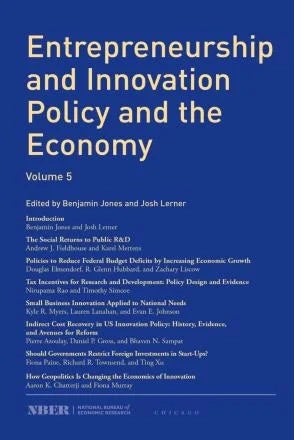 Benjamin Jones and Josh Lerner, editors
This volume of the Entrepreneurship and Innovation Policy and the Economy series brings rigorous new economic research to bear on a number of current policy issues.
Andrew Fieldhouse and Karel Mertens quantify the social returns to public R&D and find that federal investments have yielded extraordinarily high productivity payoffs. They argue that cuts to non-defense R&D risk long-run damage to economic growth.
Douglas Elmendorf, R. Glenn Hubbard, and Zachary Liscow examine the interaction of innovation-friendly growth-oriented policies with deficit reduction and conclude that while such policies alone cannot stabilize federal debt, they can meaningfully ease fiscal pressures.
Timothy Simcoe and Nirupama Rao document the effectiveness of R&D tax credits while highlighting design challenges such as the need to ensure that credits stimulate additional research rather than subsidize activity that firms would have undertaken in their absence.
Kyle Myers, Lauren Lanahan, and Evan Johnson analyze the Small Business Innovation Research (SBIR) program and show that small firms supported through SBIR pursue distinctive strategies compared to venture-backed startups.
Pierre Azoulay, Daniel Gross, and Bhaven Sampat analyze indirect cost recovery, the system by which research universities are reimbursed for overhead.
Fiona Paine, Richard Townsend, and Ting Xu assess restrictions on foreign investment in startups, weighing national security concerns against the costs to innovation ecosystems.
Aaron Chatterji and Fiona Murray argue that geopolitics is fundamentally reshaping the economics of innovation, and distill the implications of this development for the approaches that are used in studying innovation policy.
Related
More from the NBER
In addition to working papers, the NBER disseminates affiliates’ latest findings through a range of free periodicals — the NBER Reporter, the NBER Digest, the Bulletin on Health, and the Bulletin on Entrepreneurship — as well as online conference reports, video lectures, and interviews.



© 2023 National Bureau of Economic Research. Periodical content may be reproduced freely with appropriate attribution.