Impact of Minimum Pay Rules on Gig Delivery Drivers
Platform-based delivery work has expanded dramatically over the past decade, creating millions of work opportunities for independent contractors who operate outside traditional employment protections. Because gig workers are not covered by standard minimum wage laws, several jurisdictions have implemented minimum pay standards specifically for them. In Delivering Higher Pay? The Impacts of a Task-Level Pay Standard in the Gig Economy (NBER Working Paper 34545), Yuan An, Andrew Garin, and Brian K. Kovak examine Seattle's App-Based Worker Minimum Payment Ordinance, which took effect in January 2024. The ordinance, which applies to tasks starting or ending within the city limits, establishes a minimum base compensation for delivery tasks as the greater of $0.44 per minute plus $0.74 per mile, or $5 per task.
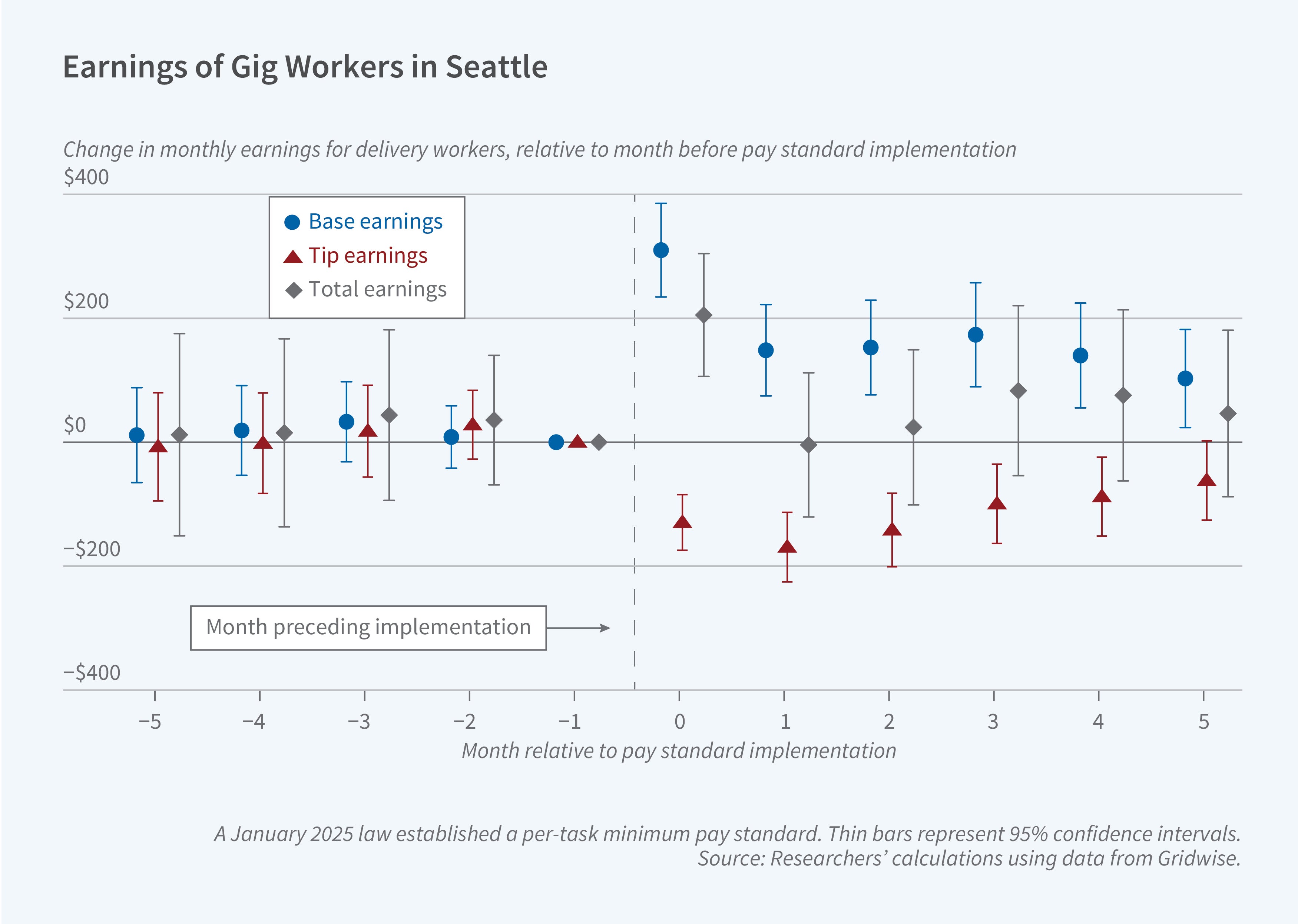
A minimum pay law for gig delivery workers in Seattle doubled base pay per task but resulted in reduced tips, fewer available tasks, and no net increase in monthly earnings.
The researchers analyze unique data from Gridwise, a third-party app that tracks detailed gig work activity across multiple platforms. Their dataset covers over 2.8 million tasks completed by nearly 6,000 workers in Washington state from August 2023 through July 2024. It includes task-level information on base pay, tips, bonuses, locations, and timing. The researchers compare workers whose pre-reform delivery activity was concentrated in Seattle with workers active elsewhere in Washington state.
The minimum pay standard immediately doubled average base pay per task in Seattle from $5.37 to $12.52 while pay rates remained constant in the rest of the state. However, average tips per delivery declined substantially following the policy, offsetting over one-third of the base pay increase. This decline appears attributable in part to changes in app interfaces. Platforms like Uber Eats and Instacart disabled upfront tipping for Seattle customers, requiring tips to be added after delivery completion.
For highly attached incumbent drivers, who completed an above-median number of tasks pre-reform (approximately 20 per month), increased base earnings per task were offset both by decreased tips and by a reduction in the number of tasks completed per month. By February 2024, the number of monthly tasks fell by at least 20 percent. Taken together, drivers’ monthly earnings remained virtually unchanged after the reform.
Declining task availability translated into increased unpaid time for drivers. The utilization rate—the share of active time spent on revenue-generating tasks—fell by 11 percentage points for highly attached drivers. Wait times between tasks increased by approximately 5 minutes, and the straight-line distance driven between tasks rose by 0.25–0.30 miles. The researchers find no evidence that total hours spent on delivery apps declined, indicating that drivers continued working without earning more while incurring additional vehicle costs during idle periods.
The pattern was somewhat different for less-attached incumbent workers (who completed a below-median number of tasks before the policy). These drivers experienced similar increases in pay per task but showed no significant decline in tasks completed per month. However, since these workers completed far fewer baseline tasks, around 6 per month versus 106 for above-average workers, the absolute earnings effects were small and statistically insignificant.
Within three months, new entrants accounted for the majority of Seattle delivery tasks, while incumbents completed twice as many tasks as entrants elsewhere in Washington. This influx of new workers competing for a declining pool of tasks helps explain why the earnings gains for incumbent drivers disappeared after the first month, consistent with a free-entry market where increased pay per task attracts additional workers until expected earnings return to pre-reform levels.
The researchers acknowledge support from the Block Center for Technology and Society at Carnegie Mellon University.


