Why Are Credit Card Interest Rates So High?
Credit cards are the primary form of unsecured consumer borrowing in the United States, with nearly 800 million accounts nationwide and about 78 percent of adults holding one in their name. In 2025, total credit card purchase volume reached $6.5 trillion, or 70 percent of retail spending. Nearly half of households carry a balance from month to month, and for them, the interest rate charged on their card averaged 22 percent in 2025, an 18-percentage-point spread over the federal funds rate. This spread far exceeds those on comparable forms of credit: Commercial and industrial loans carried a 3.7 percent spread and mortgage rates a 2 percent spread over the federal funds rate, while high-yield corporate bonds carried a 2.8 percent spread over Treasuries.
In Credit Card Banking (NBER Working Paper 35607), Itamar Drechsler, Hyeyoon Jung, Weiyu Peng, Dominik Supera, and Guanyu Zhou examine why credit card rates are so much higher than rates on other loans and how the credit card lending business generates its profits. The researchers use supervisory account-level data from the Federal Reserve’s FR Y-14M reports, covering approximately 550 million monthly credit card accounts from the 20 largest US banks—more than 90 percent of the credit card market. They track accounts originated between January 2015 and December 2017 through December 2023, sorting them into portfolios by FICO credit score at origination to examine how revenues, expenses, and defaults vary with borrower risk.
A large undiversifiable default risk premium and market power sustained through heavy marketing spending are key drivers of credit card rates.
The analysis tests four possible explanations for elevated credit card rates: compensation for defaults, the cost of rewards programs, a premium for undiversifiable default risk, and market power. Charge-offs, or loan losses, account for a spread of about 6 percentage points on average and reach 9.3 percent for the riskiest (600 FICO) borrowers. However, even after subtracting charge-offs from APR spreads, a large “default-adjusted” spread remains—averaging 8.8 percent. Default compensation alone cannot explain the rates charged.
Rewards programs, which cost the six largest issuers $67.9 billion in 2023, do not drive high rates. Rewards expenses, which were 1.6 percent of purchase volume that year, were more than offset by interchange income of 1.8 percent paid by merchants. Net interchange income is positive across all FICO scores for both borrowers and transactors (those who repay balances in full).
Operating expenses average between 4 and 5 percent of balances annually and explain roughly half of the default-adjusted spread. Marketing is a particularly large component as credit card banks spend between 1 and 2 percent of assets on marketing annually, about 10 times the share spent by other banks. Within the same FICO score, banks with higher operating expenses charge higher interest spreads and earn larger gross margins—a 1 percent increase in a bank’s operating expense rate corresponds to a 62-basis-point increase in the interest spread charged to borrowers, suggesting these expenditures generate pricing power and are not simply passed through to customers.
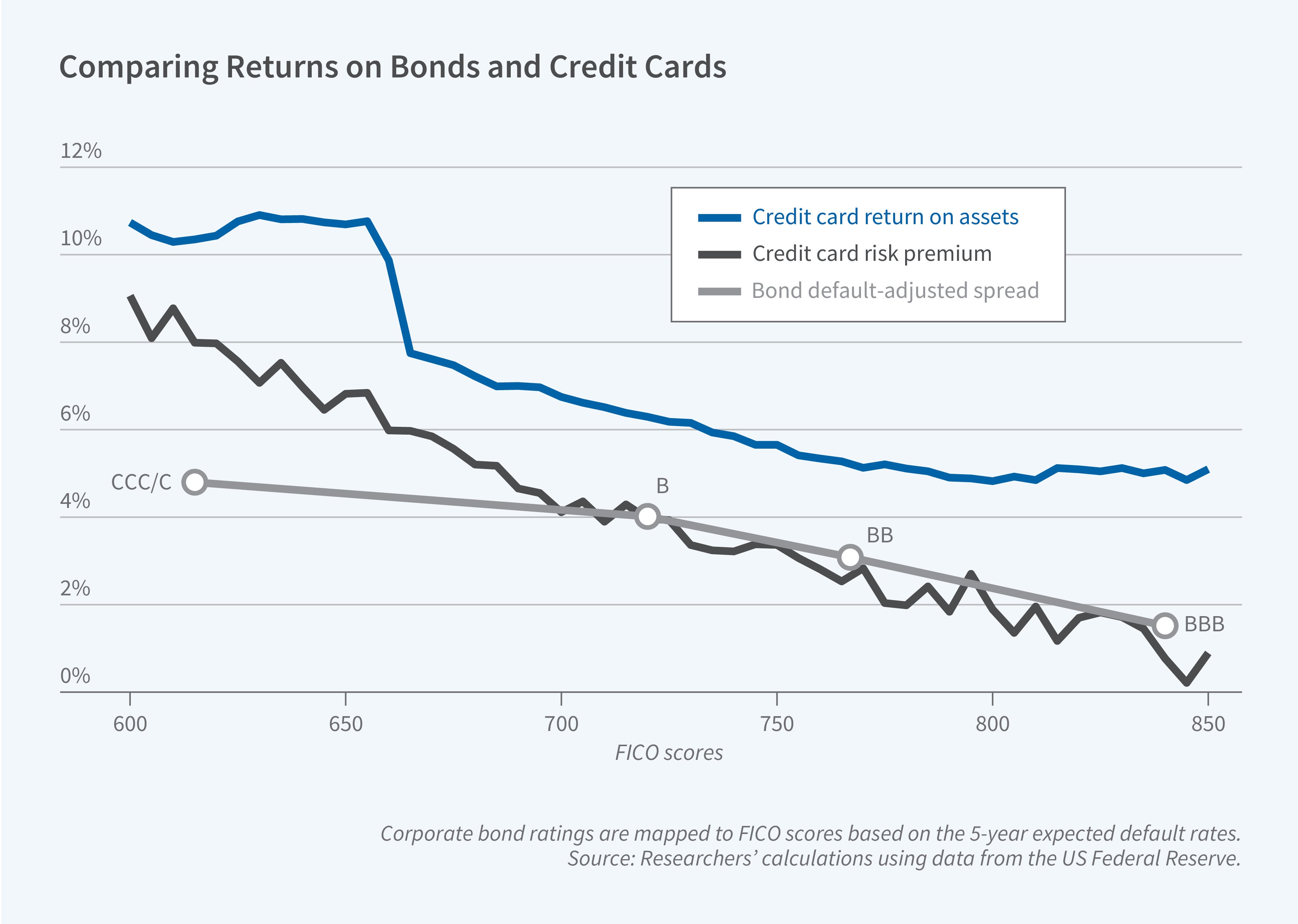
After accounting for all income and expenses, the researchers find that credit card lending generates a return on assets (ROA) of 6.8 percent, more than four times the aggregate banking sector’s ROA. Using a factor model that treats aggregate charge-off rates as a proxy for systemic default risk, they estimate that credit card rates price in a default risk premium of 4.3 percent per year—compensation for risk that cannot be diversified away because charge-offs are correlated across FICO portfolios and rise sharply during recessions. This premium is comparable to that found in high-yield corporate bonds of similar credit quality, though it is estimated to exceed bond premiums by roughly 3 percentage points for the riskiest borrowers (equivalent to CCC/C-rated bonds). After adjusting for this risk premium, the researchers find that credit card lending still generates a risk-adjusted excess return of approximately 1.5 percent relative to the broader banking sector.