Where Immigrants Settle and US Economic Growth
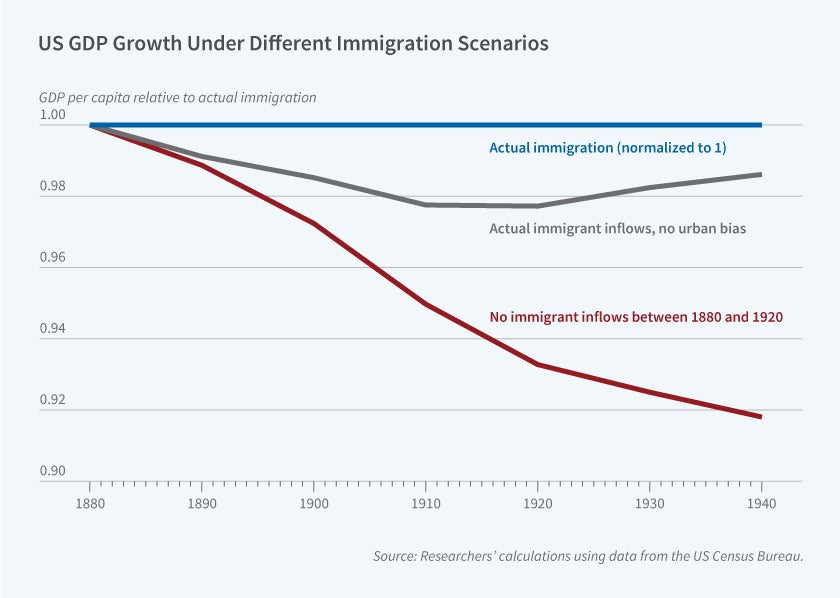
Between 1880 and 1920, more than 20 million immigrants arrived in the United States. Economists have long debated how that wave shaped American growth, typically pointing out two channels: immigrants enlarged the labor force and the consumer market, and they brought skills and knowledge from abroad. In Immigration, Innovation, and the Geography of Growth (NBER Working Paper 35392), Costas Arkolakis, Sun Kyoung Lee, and Michael Peters add a third channel that has drawn far less attention: where immigrants settled, and how that geography shaped innovation and long-run growth.
Immigration to the US between 1880 and 1920 raised income per capita by an estimated 8.2 percent by 1940. Skills mattered most but the location choices of immigrants were also important.
To weigh all three channels, the researchers link the complete universe of historical US patents and millions of immigration records to individual census records, matching roughly 434,000 patents and over 600,000 immigrants between 1880 and 1920. Because they follow the same individuals across census waves, the data capture not just immigrants’ pre-migration occupations and patenting, but their residential and migration choices over the life cycle, and how these varied with skill. Embedding this evidence in a spatial growth model, the researchers evaluate the three forces behind immigrants’ contribution: their numbers, their skills, and their concentration in particular places.
Had immigration stopped between 1880 and 1920, the model implies, US income per capita would have been 8.2 percent lower by 1940. Because innovation compounds, the gap widens over time: even in 2000, income per capita would have been 9.6 percent lower, as the ideas of the missing immigrants and their descendants would never have materialized.
Skills account for the largest share of this effect. Had the same immigrants arrived without their skills, holding the population unchanged, income per capita would still have been 5.9 percent lower by 1940, about three-quarters of the total. Skill differences across origin groups were stark: British and German immigrants were substantially more prolific in patenting than Italian and Irish immigrants, and the researchers show they were positively selected on their pre-migration occupations.
The study’s distinctive finding concerns geography. Immigrants concentrated heavily in cities, where invention was also concentrated: counties in the most urban quintile had immigrant shares approaching 40 percent, against under 10 percent in rural counties, and those urban areas produced four to five times as many patents per capita. Had immigrants instead spread across the country like the native-born, income per capita would have been close to 2 percent lower by 1920. Because invention was so geographically concentrated, where immigrants chose to settle mattered in its own right, amplifying their contribution to innovation.
The researchers also examine the 1921 Emergency Quota Act and the 1924 Johnson-Reed Act, the first major federal restrictions on immigration, which sharply curtailed arrivals from southern and eastern Europe and Asia. Removing these restrictions, the model implies, would have raised income per capita by about 1.7 percent by 2000, a modest effect because the excluded groups were small relative to the US population and, on average, less skilled than those who continued to arrive.
The researchers acknowledge funding from the National Science Foundation under RIDIR grant #1831524 and the NBER and Ewing Marion Kauffman Foundation for the Entrepreneurship Grant. Sun Kyoung Lee acknowledges support from the US Census Bureau under cooperative agreement no. CB16ADR0160001.


