Variation in Working Hours Across Countries and Over Time
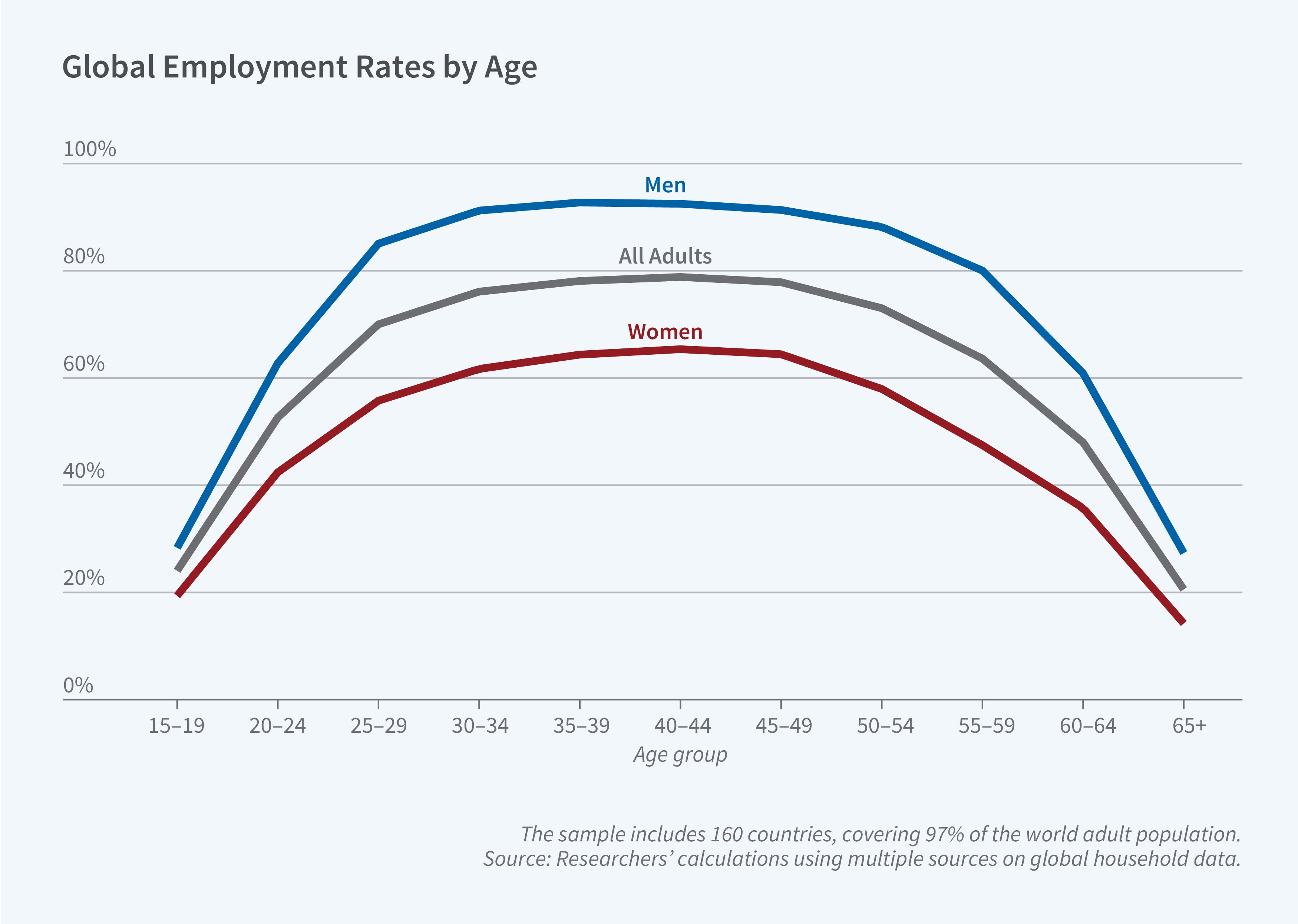
Past studies of working hours have covered limited sets of countries or focused primarily on wealthy nations, leaving significant gaps in our understanding of global labor patterns. In Global Working Hours (NBER Working Paper 34217), Amory Gethin and Emmanuel Saez construct the most comprehensive database on working hours to date, covering 160 countries and 97 percent of the world's population. They combine labor force surveys from multiple sources, including the International Labour Organization, the World Bank, and national statistical offices, and assemble both cross-sectional data for recent years and time series spanning over 20 years for 86 countries.
Global working hours follow a bell-shaped pattern with economic development, with prime-age hours remaining remarkably stable as male hours fall and female hours rise.
The researchers find that globally, adults aged 15 and older supply an average of 24.5 hours per week to market work, with 59 percent of adults employed. Women account for 35 percent of global market work hours, with the gender gap driven primarily by lower employment rates for women (47 percent) than for men (71 percent). The relationship between economic development and working hours is complex. Hours worked per adult increase modestly from 23 in low-income countries to 26 in upper-middle-income countries, then decrease sharply to 20 hours in high-income countries.
Globally, individuals between the ages of 15 and 19 work 7.4 hours per week on average, while those over the age of 60 work 11 hours. Prime-age adults aged 20–59, 72 percent of whom are employed, work an average of 43.5 hours when employed, resulting in an average of 30.6 hours of work. The researchers find that increasing school attendance by 1 percentage point decreases youth work by about 0.25 hours per week. Both youth and elderly hours decline with development, while prime-age hours show remarkable stability.
Male prime-age hours decline from 35 per week in lower-middle-income countries to 24 in high-income countries. Women's prime-age hours show the opposite pattern, increasing with development. The researchers find that moving from 0 percent to 100 percent Muslim/Hindu population share reduces female work by 12 hours, while being a former communist country is associated with an increase of 5.5 hours in female working time.
Agricultural workers maintain steady hours around 40 per week across all development levels. In middle-income countries, manufacturing and market services workers average around 50 hours per week, substantially higher than agricultural workers. The researchers note that because the share of agriculture is large in poor countries and declines dramatically with development, this structural transformation contributes to the increase in hours in the early stage of development.
Additionally, the researchers examine how hours vary with the level of government spending on social programs, the fraction of workers in formal jobs with contracts and protections, and the stringency of workplace rules. An increase in social spending of 1 percent of GDP is associated with a decline in work hours of between 2 and 3 percent. Moving from a setting with no workers with formal jobs to one with all workers in formal employment is associated with close to a 50 percent drop in working hours. Similarly, countries with the strictest workplace regulations (like France) see about 20 percent fewer working hours than countries with no regulations.
Financial support from the Berkeley Stone Center on Inequality and the European Research Council is gratefully acknowledged.


