From Access to Pathways: Community Colleges and Educational Opportunity
For decades, economists have sought to understand why some students complete college while others do not. Much of this work has focused on the demand side factors that determine whether students attend college, such as tuition costs, financial aid, academic preparation, and the information students possess when making enrollment decisions. Yet gaining access to higher education is only the beginning of a much longer journey. Students must decide where to enroll, whether to transfer, which credentials to pursue, and ultimately how those credentials translate into labor market success. Understanding those educational pathways and their effects on educational attainment, labor market success, and economic mobility has become the central focus of my recent research.
This summary describes four recent studies that trace those pathways from initial enrollment decisions to long-run labor market outcomes. Together, they ask a common question: How does the set of institutions realistically accessible to students shape their educational and economic opportunities?
The studies begin by showing that geographic access to colleges—particularly community colleges—plays a central role in determining students’ postsecondary opportunities. They then follow students beyond their initial enrollment decisions to examine how those geographic constraints influence degree completion. Building on those findings, I turn to the rapid expansion of community college bachelor’s degree programs as one institutional response to geographic barriers. Finally, I examine whether employers value bachelor’s degrees awarded by community colleges and the implications of these findings for the economic returns to different postsecondary pathways.
Taken together, these studies suggest that educational opportunities depend not only on whether students gain access to higher education, but also on the pathways available to them after they enroll. Geography influences those pathways, institutions may expand or constrain them, and labor markets ultimately determine how they are rewarded.
Geographic Access and Educational Opportunity
When economists think about access to higher education, we often focus on tangible costs like tuition and fees. However, colleges themselves are unevenly distributed across space, creating large differences in the travel or moving costs students face to attend them. Some students grow up surrounded by multiple postsecondary institutions, while others live many miles from the nearest community college or university.1
In one study, my coauthors and I broadened the traditional focus on demand-side determinants of college enrollment by examining an often-overlooked supply-side constraint: the geographic distribution of colleges themselves.2 Previous research has shown that students are more likely to attend nearby institutions, but much less was known about whether geographic access contributes to racial, ethnic, and socioeconomic disparities in college enrollment. To address this question, we examined how living in a higher education desert—an area where students face unusually long travel distances to reach postsecondary institutions—shapes students’ postsecondary choice sets.
We find that distance plays an important role in shaping where students enroll, but its effects differ sharply across groups. Living more than 30 miles from the nearest community college substantially reduces community college enrollment. White and higher-income students often respond by substituting toward four-year institutions, largely offsetting the lack of nearby community college access. In contrast, Black, Hispanic, and economically disadvantaged students are much less likely to make this substitution, making them up to 12 percentage points less likely to enroll in college when they live in a community college desert. In other words, the same geographic constraint changes students’ postsecondary choice sets in different ways. These findings suggest that geography does not simply influence where students enroll; it changes the educational opportunities available to different students, widening existing racial, ethnic, and socioeconomic disparities in college enrollment.
These findings suggest that geography functions as an implicit cost of college attendance. Unlike tuition or fees, geographic barriers receive comparatively little attention in discussions of higher education access. Yet commuting time, transportation costs, and the challenges associated with relocating can substantially influence educational choices. For students with work obligations, caregiving responsibilities, or limited financial resources, these geographic constraints may be especially consequential.
While documenting enrollment effects is important, a natural question follows: Do these geographic barriers ultimately affect degree attainment?
Geographic Access and Educational Attainment
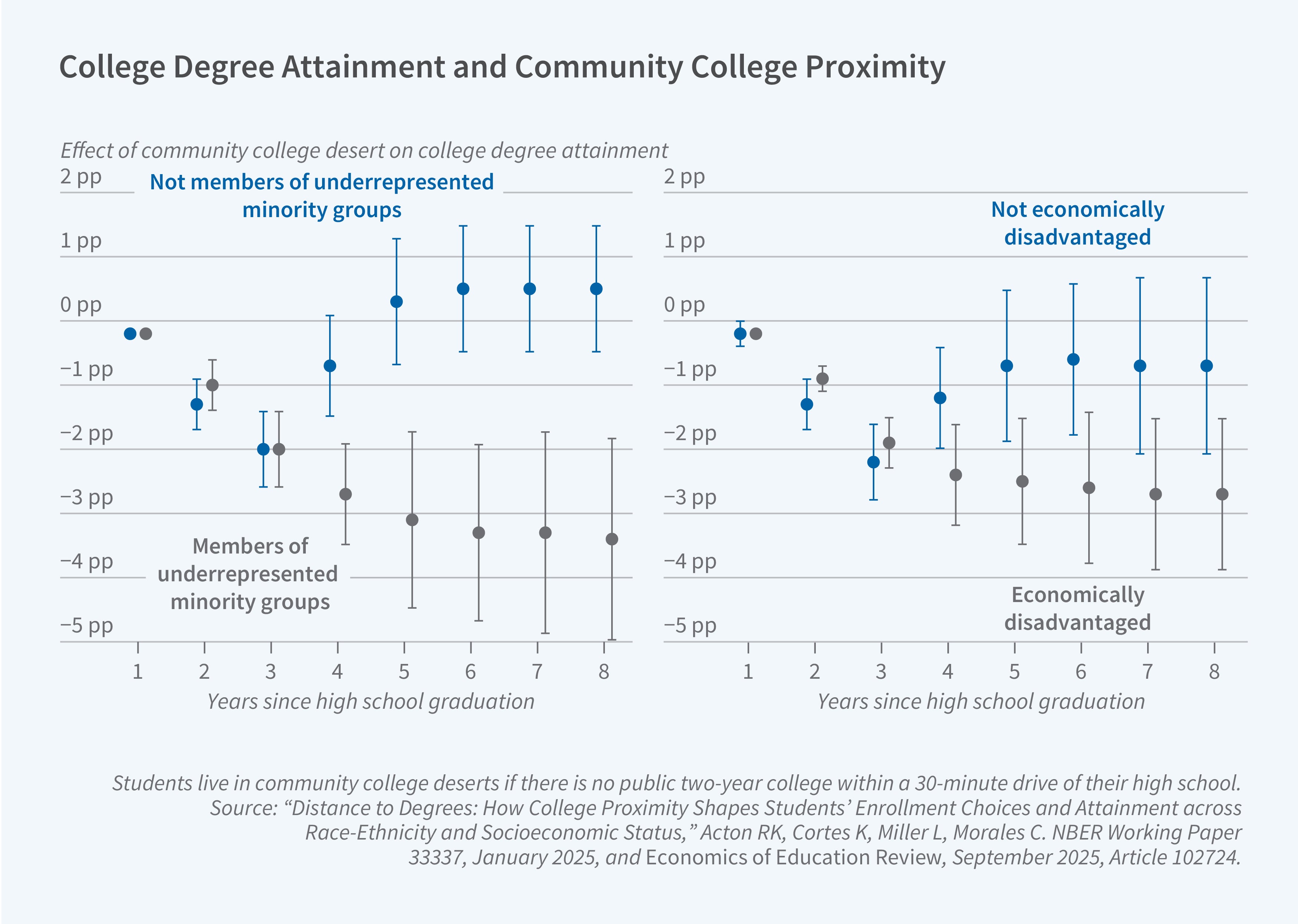
In subsequent work, my coauthors and I asked whether the enrollment differences documented in our earlier study persist over time or eventually disappear.3,4 Following students for up to eight years after high school graduation, we find that those living in areas with limited postsecondary access do not catch up to their peers. Geographic barriers have lasting consequences, shaping not only where students initially enroll but also whether they accumulate credits, transfer to four-year institutions, and ultimately complete college degrees.
The most pronounced effects arise from access to community colleges. Students who live in community college deserts are 2.7 percentage points (31 percent) less likely to earn an associate’s degree within six years of high school graduation. They also accumulate fewer college credits and are less likely to transfer successfully to four-year institutions or earn bachelor’s degrees. Rather than fading over time, the gaps observed shortly after high school graduation persist, and in some cases become more pronounced, throughout students’ postsecondary careers.
The persistence of these effects reflects important, underlying differences in how students respond to the same geographic constraint. White and higher-income students often compensate for limited community college access by enrolling directly in four-year institutions. As a result, distance primarily changes the type of degree they earn—reducing associate’s degree completion while increasing bachelor’s degree completion. In contrast, Black, Hispanic, and economically disadvantaged students are far less likely to make this substitution. Instead, living in a community college desert reduces the likelihood that they enroll in college at all, leading to lower rates of associate’s degree completion, fewer successful transfers, and ultimately fewer bachelor’s degrees. For example, living in a community college desert reduces overall degree completion by 3.3 percentage points (16.9 percent) for underrepresented minority students and by 2.6 percentage points (15.7 percent) for economically disadvantaged students.
It can be important to distinguish between outcomes that affect the extensive margin—whether students complete any college degree—and the intensive margin—which type of degree they ultimately earn. Our findings reveal that geographic access operates through both channels. For Black, Hispanic, and economically disadvantaged students, nearby community colleges increase educational attainment at the extensive margin by making college attendance and degree completion more attainable. For White and higher-income students, community college access primarily affects the intensive margin by shifting students between associate’s and bachelor’s degree pathways. These differences suggest that educational disparities arise not only because students have unequal geographic access to colleges, but also because they differ in how they respond to geographic constraints.
Community College Bachelor’s Degrees as New Pathways
Our earlier findings naturally led to another question. If community college access plays such an important role in shaping bachelor’s degree attainment, could bringing bachelor’s degree programs directly to community colleges expand educational opportunity? Over the last two decades, a growing number of states have authorized community colleges to offer bachelor’s degrees, and today 24 states allow at least some community colleges to confer these degrees.
The rationale is straightforward. Community colleges tend to be more geographically accessible than four-year universities. They often charge lower tuition, maintain flexible schedules for working adults, and disproportionately serve students from historically underserved populations. If community colleges can successfully offer bachelor’s degrees, they may create new pathways to degree attainment for students who otherwise would not complete a four-year degree. Yet despite the rapid growth of these programs, remarkably little evidence exists regarding their labor market value. Do graduates benefit economically from earning a bachelor’s degree at a community college? How do their outcomes compare with those of associate’s degree holders and graduates from traditional four-year institutions?
To answer these questions, my coauthors and I conducted the first national analysis of community college bachelor’s degree outcomes using administrative data from the Post-Secondary Employment Outcomes project.5,6
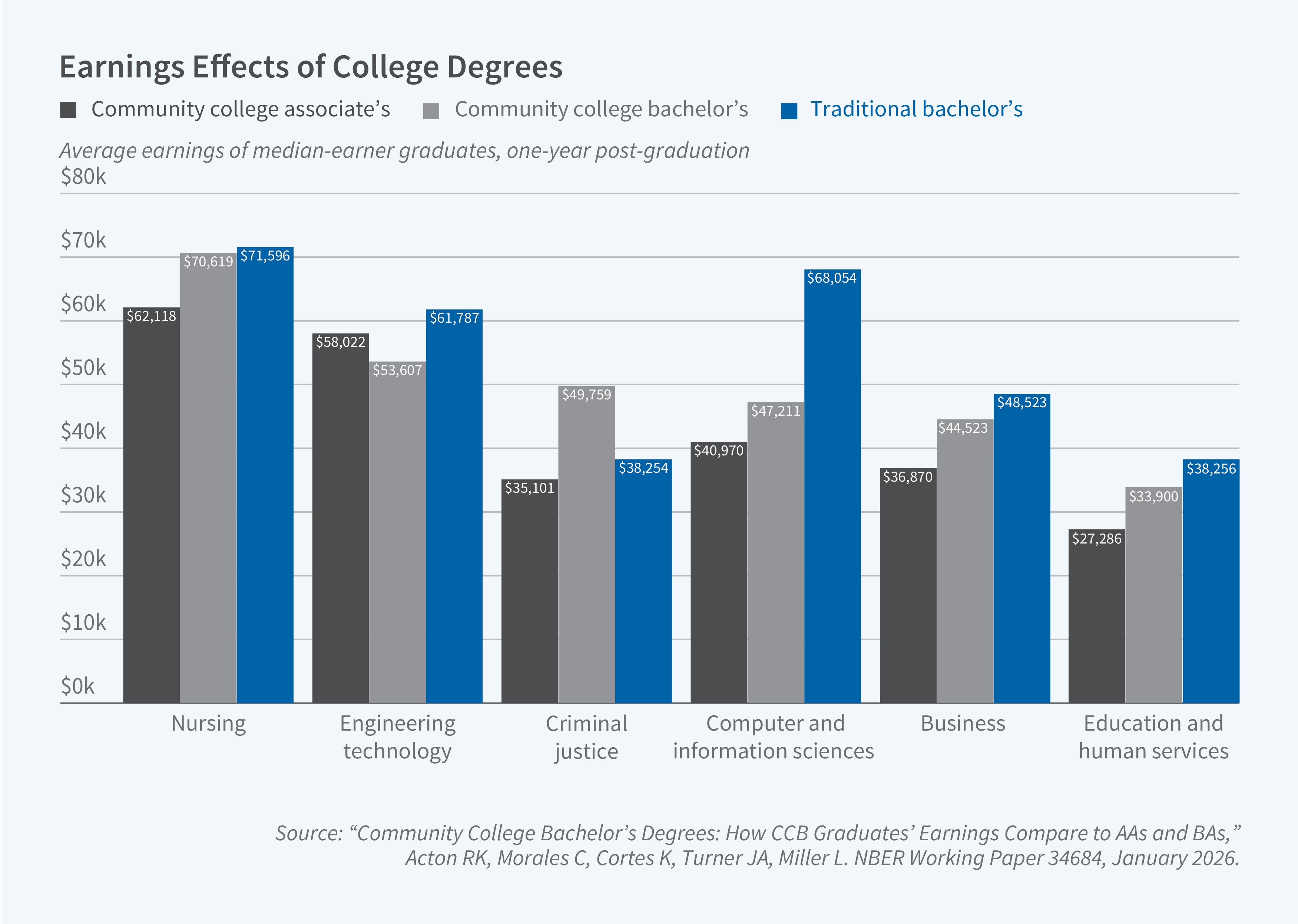
Our findings indicate that community college bachelor’s degrees occupy an intermediate position in the higher education landscape. Relative to associate’s degree holders, graduates with community college bachelor’s degrees earn substantially more. One year after graduation, annual earnings are roughly $4,000 to $9,000 higher than those of comparable associate’s degree recipients. These gains are economically meaningful and suggest that the additional education associated with the bachelor’s credential generates substantial value.
At the same time, average earnings remain somewhat below those of graduates of traditional four-year institutions. On average, community college bachelor’s graduates earn roughly $2,000 less than comparable graduates with bachelor’s degrees from traditional colleges and universities one year after graduating. However, these averages conceal substantial variation across fields of study.
In nursing, criminal justice, and several health-related fields, earnings differences between community college and traditional bachelor’s degree graduates are minimal or nonexistent. In contrast, larger gaps emerge in fields such as computer science and information technology. These findings suggest that the labor market value of institutional type depends importantly on the field of study rather than reflecting a uniform premium or penalty.
The study also reveals another important feature of community college bachelor’s programs: They are closely tied to local labor markets. Graduates are highly likely to be employed in the same state where they earned their degrees, and many work in occupations closely aligned with their field of study. These patterns are consistent with the workforce-oriented mission that has characterized many community college bachelor’s programs since their inception.
Perhaps most importantly, the results demonstrate that community college bachelor’s degrees generate substantial economic returns relative to stopping at the associate’s degree level. Yet average earnings remain modestly below those of graduates from traditional four-year institutions. Why do these earnings differences persist? Are employers discounting community college bachelor’s degrees, or are other mechanisms at work?
Observational earnings data cannot distinguish between these explanations. Employers may value community college bachelor’s degrees differently, but graduates may also sort into different occupations, industries, or geographic labor markets. Differences in earnings could therefore reflect employer preferences, worker choices, or both. To distinguish among these possibilities, we need to move beyond observed labor market outcomes and study employer behavior directly.
Rather than asking how much graduates earn after entering the workforce, my coauthors and I asked a more fundamental question: When employers encounter a community college bachelor’s degree on a résumé, how do they respond?
Do Employers Value Community College Bachelor’s Degrees?
Much of the debate surrounding community college bachelor’s degrees ultimately revolves around employer perceptions. Critics have sometimes questioned whether employers will treat bachelor’s degrees awarded by community colleges as equivalent to those awarded by traditional four-year institutions. If employers discount these credentials, then expanding access alone may not translate into improved labor market opportunities.
Observational data provide only limited insight into this question. Graduates of community college bachelor’s programs may differ from graduates of traditional institutions in ways that are difficult to observe. Consequently, earnings differences alone cannot tell us whether employers value the credential itself differently.
To address this question directly, my coauthors and I conducted the first résumé audit study of community college bachelor’s degrees.7 We submitted nearly 4,700 fictitious applications to more than 1,500 real job vacancies in the early childhood education labor market, experimentally varying applicants’ educational credentials while holding all other characteristics constant.
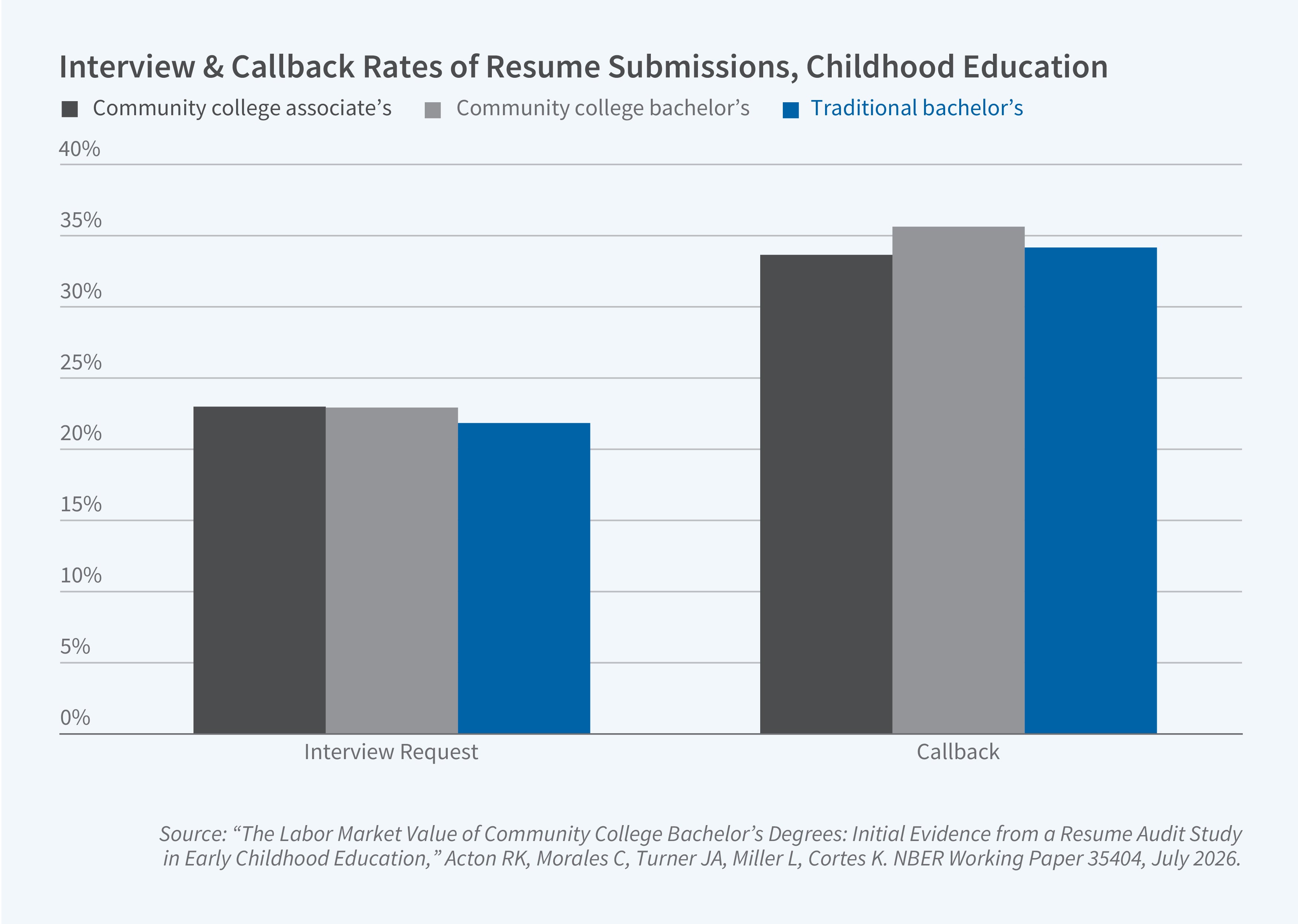
The experimental evidence provides little support for the view that employers systematically discount community college bachelor’s degrees, at least within the early childhood education industry. Applicants holding community college bachelor’s degrees had callback rates that were statistically indistinguishable from those of applicants holding traditional bachelor’s degrees. They also performed similarly to applicants with associate’s degrees. Across a variety of specifications and outcome measures, we find little evidence that employers systematically penalize applicants because their bachelor’s degree was awarded by a community college.
These findings are especially notable because early childhood education has become one of the fastest-growing fields for community college bachelor’s programs. The sector has experienced increasing professionalization, rising educational requirements, and persistent labor shortages. If employers systematically discounted community college bachelor’s degrees, one might expect those concerns to appear in hiring decisions. Instead, we observe remarkably similar employer responses across credential types.
Our study also moves beyond traditional callback measures. We collected and analyzed the text of employer responses to examine whether employers communicate differently with applicants holding different credentials. Once again, we found little evidence of systematic differences. Employers were generally no less warm, enthusiastic, or personalized in their communications with community college bachelor’s graduates than with traditional bachelor’s graduates.
In addition, we surveyed employers and hiring managers after the audit study concluded. Their responses help illuminate the mechanisms underlying the experimental findings. Employers consistently emphasized work experience, reliability, interpersonal skills, and organizational fit as the primary determinants of hiring decisions. The institution awarding the degree ranked far below these factors.
Taken together, these findings suggest that employer skepticism may not be the primary obstacle facing community college bachelor’s graduates—at least in this labor market. This conclusion also helps reconcile the findings from our earlier labor market outcomes study.8,9 The modest earnings differences between community college bachelor’s graduates and traditional bachelor’s graduates do not appear to arise because employers systematically discount the credential. Instead, they are more likely to reflect differences in the characteristics and work experiences of individuals with various degree types, or other factors that influence earnings independently of employer acceptance.
The Economics of Community College Pathways
These studies suggest that educational opportunity is shaped by more than students’ academic preparation or financial resources alone. Geographic access influences the postsecondary options available to students. Those initial choices have lasting consequences for educational attainment, and community colleges can expand bachelor’s degree pathways for students who might otherwise face limited opportunities. At the same time, our findings suggest that understanding these pathways requires looking beyond educational attainment itself to the labor market value of the credentials students ultimately earn.
Evaluating these pathways requires considering both benefits and costs. Our work has shown that community college bachelor’s degrees generate meaningful earnings gains relative to associate’s degrees, but understanding their economic value also requires examining the costs students incur to obtain them. In ongoing work, we complement our analysis of labor market returns with evidence on both published tuition (“sticker price”) and the prices students actually pay after grants and financial aid (“net price”).10,11 This broader perspective aligns with growing interest in evaluating postsecondary programs according to both their costs and their labor market returns, including recent discussions surrounding gainful employment.
Our résumé audit study in early childhood education provides an important first step toward understanding how employers value community college bachelor’s degrees. Yet it also highlights how much remains to be learned. We are currently conducting a large-scale follow-up audit study that extends this work to additional fields of study and labor markets, allowing us to examine whether employer responses to community college bachelor’s degrees differ across occupations, industries, and geographic settings. These analyses will provide the first comprehensive evidence on how employers value these degrees across a broad range of hiring contexts.
These studies—including our ongoing large-scale audit study—point toward a broader research agenda centered on understanding the economics of community college pathways. Community college bachelor’s degrees represent one such pathway, but they exist alongside transfer and articulation agreements, reverse transfer policies, career and technical education, work-based learning, student support interventions, and other institutional innovations that shape students’ progression through higher education. Understanding how access to higher education and the pathways students follow through it interact—and which generate the greatest improvements in educational attainment and labor market success—remains an important frontier in the economics of higher education.
Endnotes
“Using Geographic Variation in College Proximity to Estimate the Return to Schooling,” Card D. NBER Working Paper 4483, October 1993, and in Aspects of Labour Market Behavior: Essays in Honour of John Vanderkamp, Christofides L, Grant EK, Swidinsky R. editors. University of Toronto Press, 1995.
“Distance to Opportunity: Higher Education Deserts and College Enrollment Choices,” Acton RK, Cortes K, Morales C. NBER Working Paper 33085, October 2024, and in Financing Institutions of Higher Education, Campbell JY, Husbands Fealing K, editors, pp. 301–345. University of Chicago Press, 2026.
“Distance to Degrees: How College Proximity Shapes Students’ Enrollment Choices and Attainment Across Race-Ethnicity and Socioeconomic Status,” Acton RK, Cortes K, Miller L, Morales C. NBER Working Paper 33337, January 2025, and Economics of Education Review, September 2025, Article 102724.
“Distance to College Contributes to Educational Disparities,” Acton RK, Cortes K, Miller L, Morales C. The NBER Digest, April 2025.
“Community College Bachelor’s Degrees: How CCB Graduates’ Earnings Compare to AAs and BAs,” Acton RK, Morales C, Cortes K, Turner JA, Miller L. NBER Working Paper 34684, January 2026.
“The Earnings of Community College Bachelor’s Degree Graduates,” Acton RK, Morales C, Cortes K, Turner JA, Miller L. The NBER Digest, March 2026.
“The Labor Market Value of Community College Bachelor’s Degrees: Initial Evidence from a Resume Audit Study in Early Childhood Education,” Acton RK, Morales C, Turner JA, Miller L, Cortes K. NBER Working Paper 35404, July 2026.
“Community College Bachelor’s Degrees: How CCB Graduates’ Earnings Compare to AAs and BAs,” Acton RK, Morales C, Cortes K, Turner JA, Miller L. NBER Working Paper 34684, January 2026.
“The Earnings of Community College Bachelor’s Degree Graduates,” Acton RK, Morales C, Cortes K, Turner JA, Miller L. The NBER Digest, March 2026.
“Community College Bachelor’s Degrees: How CCB Graduates’ Earnings Compare to AAs and BAs,” Acton RK, Morales C, Cortes K, Turner JA, Miller L. NBER Working Paper 34684, January 2026.
“The Labor Market Value of Community College Bachelor’s Degrees: Initial Evidence from a Resume Audit Study in Early Childhood Education,” Acton RK, Morales C, Turner JA, Miller L, Cortes K. NBER Working Paper 35404, July 2026.


