Multinational Corporate Finance: From Integration to Decoupling
In late twentieth and early twenty-first centuries, the dominant narrative in corporate finance was one of vanishing borders. Multinational companies stood at the center of this transformation, through cross-border mergers and other types of investment, acting as bridges between global markets. In this era of integration, firms did not cross borders just to find new customers; they did so to optimize their financial structures, lower their cost of capital, and bypass local market inefficiencies.
Once two firms from different countries are merged, international transactions can be consummated inside of firms, rather than negotiated between different firms. As Coase famously observed, transacting inside a firm can be more efficient than arms-length contracting.1 Much of our work, both jointly and with other coauthors, examines the factors that lead to the formation of multinational companies and the way in which they internalize international factors inside the firms.2
However, the tide has turned. The rise of economic nationalism and protectionism—ranging from political interference in mergers to aggressive tariff regimes—has introduced new frictions. Our more recent research tracks this change, examining how multinationals that thrived during the push for globalization are now being forced to adapt to a world of “decoupling.”
It is not clear what the consequences of deglobalization will be for the structure of firms. Will there be fewer cross-border deals, and possibly breakups of international conglomerates? How can we understand economic nationalism and how likely is it to change in a deglobalized political environment? More generally, are multinationals likely to continue to be an important engine of international commerce? The insights from our work about global integration potentially have insights about the future of multinationals in a deglobalized economy.
Why Cross Borders?
A fundamental question in international finance is why firms choose to acquire assets in foreign jurisdictions rather than their own. In Erel, Liao, and Weisbach, we analyze a comprehensive sample of nearly 57,000 cross-border deals between 1990 and 2007.3 In Tables 1 and 2 we present an abridged version of summary statistics using updated data through 2020.4
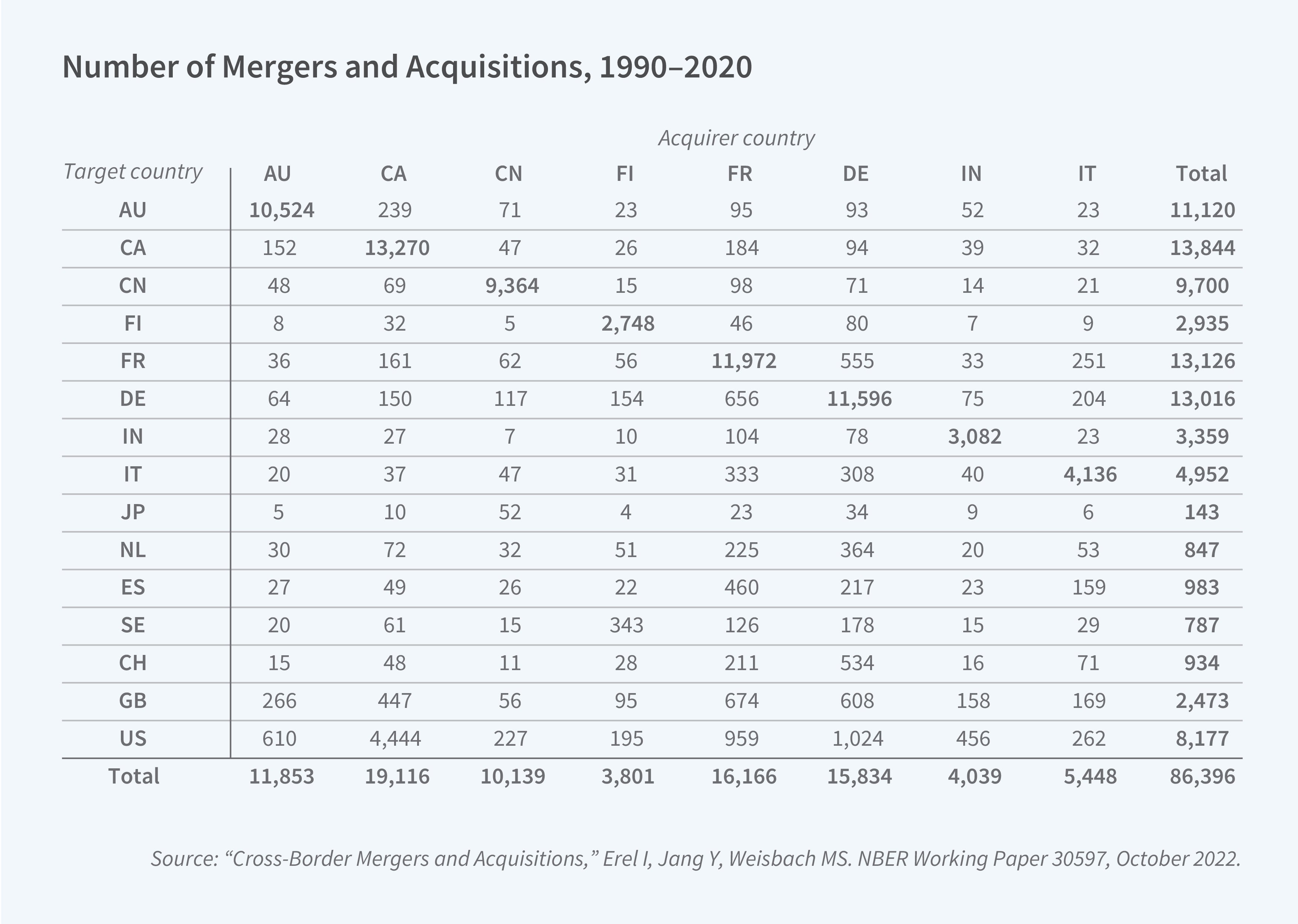
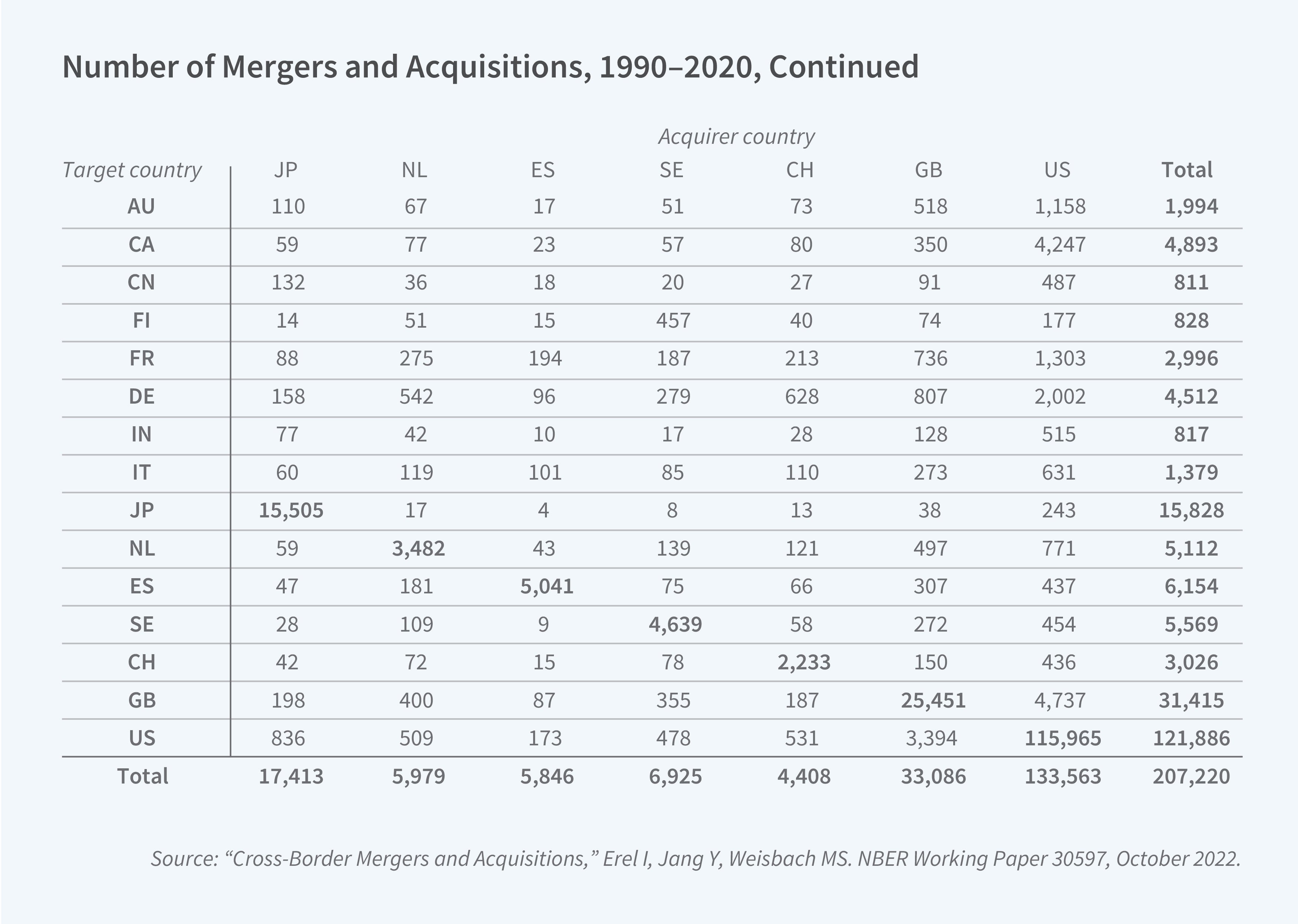
There are several patterns evident in this table. While diagonal elements, representing domestic deals, are by far the largest category, the volume of cross-border flows is substantial and highly concentrated. Among the cross-border deals, geography appears to be an important factor: Companies are more likely to acquire companies in nearby and trading-partner countries.
While traditional factors like geography and bilateral trade are significant, financial “valuation” motives are also a primary driver of these flows. Capital tends to flow from strong markets to weaker ones: Firms in countries with appreciating currencies and high stock market valuations (specifically high market-to-book ratios) are significantly more likely to be acquirers. Conversely, firms in countries experiencing economic underperformance are often targets. This pattern suggests that cross-border mergers and acquisitions (M&As) serve as a mechanism for capital to seek out undervalued assets globally, effectively acting as an arbitrage of national market conditions.5,6
Beyond valuation, the “quality” of a country’s institutions is an important determinant of acquisition patterns. Several studies find that firms from countries with high-quality accounting standards, strong disclosure requirements, and robust shareholder protections tend to be the dominant buyers.7 In many ways, a cross-border acquisition is an export of governance. By bringing a subsidiary under the umbrella of a high-standard parent, the firm essentially lowers the information asymmetry and agency costs that constrain local markets.
Once a firm becomes part of a multinational network, its financial condition and its ability to finance investments can change fundamentally. A common management claim is that acquisitions create value by providing the target with access to capital. In Erel, Jang, and Weisbach, we put this claim to the test using a sample of over 5,000 European acquisitions.8
Our results imply that target firms are indeed financially constrained prior to being acquired. Once under the ownership of a larger multinational, these constraints vanish. The evidence is visible in several key metrics. First, target firms drastically reduce their cash-to-assets ratios after being acquired. In an independent state, these firms must “hoard” cash for precautionary reasons; as part of an multinational enterprise, they can rely on the parent’s liquidity pool, allowing that capital to be deployed more productively. Second, the sensitivity of a firm’s investment and cash holdings to its own internal cash flow—a classic measure of financial constraints—drops significantly.
In this way, a multinational firm can reallocate capital across borders more efficiently than local financial institutions might allow. This internal reallocation is particularly valuable in segmented markets where external finance is expensive or unavailable.
The Real Economy Channel: When Interconnectedness Becomes a Liability
However, this deep integration has a “dark side.” While internal capital markets provide efficiency, they also serve as a conduit for economic shocks. Bena, Dinc, and Erel document the way in which multinationals can spread distress across borders even without goods being traded.9
When a multinational’s subsidiary in one country faces an economic crisis, the parent does not have to let that subsidiary suffer in isolation. Instead, the parent can reallocate resources away from healthy subsidiaries in other countries to help struggling ones or to protect the parent’s own liquidity. Bena, Dinc, and Erel find that subsidiaries of parents in crisis-hit countries reduced their own investment and employment growth, even if their local economy was doing well. This finding implies that a shock to a parent or a subsidiary in one corner of the globe can have employment consequences in an entirely different hemisphere through the internal reallocation decisions of multinationals.
The Rise of Economic Nationalism
As we move into the current era of protectionism, the almost frictionless model of multinational corporations has come under attack. Before the current wave of tariffs, there was nonetheless substantial political interference in the market for corporate control. Dinc and Erel study the way in which governments in Europe intervene in acquisition bids, treating domestic acquirers differently from foreign acquirers.10
Dinc and Erel find that when a foreign firm tries to acquire a firm, especially a firm that is a “national champion,” governments are likely to interfere—either through direct blocking or by subsidizing a “white-knight” domestic bidder. This nationalism is most potent when and where nationalistic sentiments are stronger—e.g., when only the far-right political parties are strong or when the government is politically fragile. These interventions appear to have a deterrent effect: When a country blocks one foreign deal, foreign investment in that country drops for several years afterward.
Protectionism can scare away global capital. Firms stop looking at firms in protectionist countries as potential targets, not because the business case is weak, but because potential political frictions are likely to make deals harder to close. Presumably, even if a cross-border acquisition is allowed to occur, the new multinational will face additional barriers relative to domestic competitors. The paper’s message is even more relevant today than when this paper was written, given the increased nationalism in the world since then.
When Protectionism Kills Talent
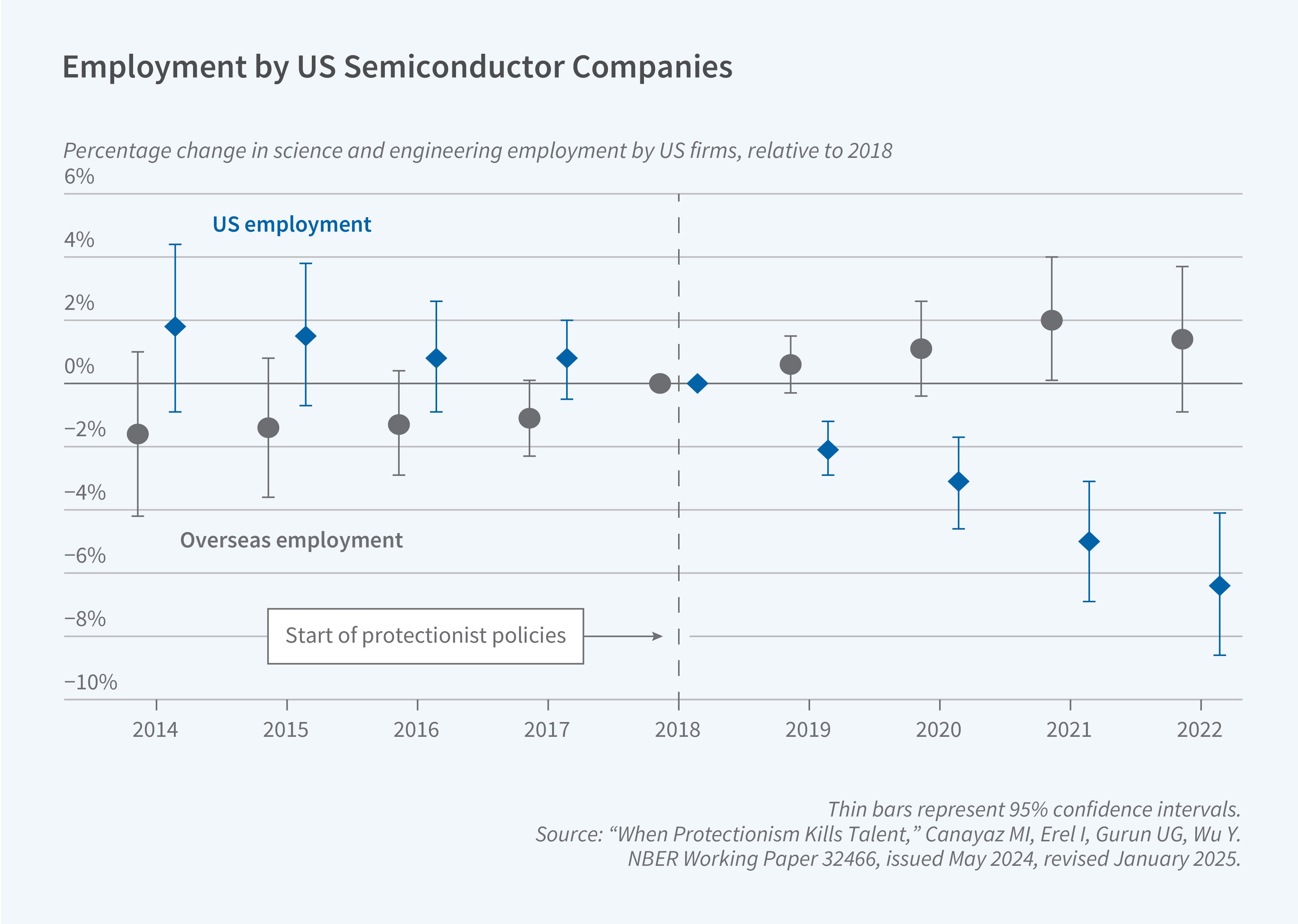
The most recent stage of this decoupling is perhaps the most damaging: the impact on human capital and innovation. Canayaz, Erel, Gurun, and Wu examine the protectionist measures in the semiconductor industry after 2018.11 Focusing on the US chip manufacturing sector, the study finds that protectionist policies intended to protect an important domestic industry have weakened its core strength: its people. As tariffs and immigration restrictions increased, science and engineering employment in the sector declined. Firms responded to US restrictions by shifting their recruitment overseas. Instead of bringing jobs home, the policies gave firms incentives to move jobs and skills to other jurisdictions. Furthermore, fewer domestic students chose to pursue chip-related degrees. Far from revitalizing domestic manufacturing, these measures reduced the US share of global expertise in the very technologies that the policies were meant to secure. The result of the protectionist policies appears to have been substantial reductions in patented innovation.
Private Equity: A New Approach to Multinational Acquisition
Together with the shifting political environment, there has been a change in the predominate form of multinational acquisition. Coincident with the worldwide decline in the number of public firms has been an increase in the importance of private markets. A large fraction of all acquisitions, both domestic and cross-border, are now buyouts consummated through private funds. Jenkinson, Kim, and Weisbach provide much detail on the structure of these transactions as well as statistics on their increasing importance.12
Buyouts, especially large ones, often have an international flavor to them. Funds are raised from investors around the world who often invest in companies in other countries. As such, they can reflect and magnify political sentiments. For example, during the globalizing period of the early 2000s, China was one of the most active sources of buyout targets; with the cooling of relations between China and the West, we have seen a corresponding decrease in buyouts of Chinese companies by Western funds.
One area where funds have created a new form of multinational organization is infrastructure. Giant funds, some of which have close to $50 billion in assets, have been acquiring infrastructure assets globally. Howell, Jang, Kim, and Weisbach examine the real effects of a sample of private equity acquisitions of airports and find efficiency gains and improvements in airport quality.13 In addition to financial improvements, airports add capacity, increase the number of airlines and routes serviced by the airport, and become more likely to win awards based on passenger feedback.
Conclusion: Navigating a Fragmented World
The body of research we have conducted over the past two decades suggests that multinational firms have moved capital, governance, and technology across borders to overcome local market failures. In many cases, multinational corporations provided stability and liquidity when local markets failed. Yet, the “global decoupling” currently underway presents a challenge of a different magnitude. While multinational corporations can navigate financial and maybe cultural barriers, the frictions of political nationalism and talent barriers are harder to bypass. As we look toward the future, the question for the coming years is no longer how firms will integrate into a global market, but how they will survive the fragmentation of it.
Endnotes
“The Nature of the Firm,” Coase RH. Economica 4(16), November 1937, pp. 386–405.
“The Corporate Finance of Multinational Firms,” Erel I, Jang Y, Weisbach M. NBER Working Paper 26762, February 2020, and in Global Goliaths: Multinational Corporations in the 21st Century Economy, Foley CF, Hines J, Wessel D, editors, pp. 183–226. Washington: Brookings Institution, 2021.
“World Markets for Mergers and Acquisitions,” Erel I, Liao RC, Weisbach MS. NBER Working Paper 15132, July 2009. Published as “Determinants of Cross-Border Mergers and Acquisitions” in The Journal of Finance 67(3), June 2012, pp. 1045–1082.
“Cross-Border Mergers and Acquisitions,” Erel I, Jang Y, Weisbach MS. NBER Working Paper 30597, October 2022, and in Handbook of Corporate Finance, Denis D, editor, pp. 345–376. Cheltenham, UK, and Northampton, MA: Edward Elgar Publishing, 2024.
“World Markets for Mergers and Acquisitions,” Erel I, Liao RC, Weisbach MS. NBER Working Paper 15132, July 2009. Published as “Determinants of Cross-Border Mergers and Acquisitions” in The Journal of Finance 67(3), June 2012, pp. 1045–1082.
“Corporate Liquidity, Acquisitions, and Macroeconomic Conditions,” Erel I, Jang Y, Minton BA, Weisbach MS. NBER Working Paper 23493, June 2017, and Journal of Financial and Quantitative Analysis 56(2), March 2021, pp. 443–474.
“Cross-Border Mergers and Acquisitions," Erel I, Jang Y, Weisbach MS. NBER Working Paper 30597, October 2022, and in Handbook of Corporate Finance, Denis D, editor, pp. 345–376. Cheltenham, UK, and Northampton, MA: Edward Elgar Publishing, 2024.
“Do Acquisitions Relieve Target Firms’ Financial Constraints?” Erel I, Jang Y, Weisbach MS. NBER Working Paper 18840, February 2013, and The Journal of Finance 70(1), February 2015, pp. 289–328.
“The International Propagation of Economic Downturns Through Multinational Companies: The Real Economy Channel,” Bena J, Dinc S, Erel I. NBER Working Paper 27873, September 2020, and Journal of Financial Economics 146(1), October 2022, pp. 277–304.
“Economic Nationalism in Mergers and Acquisitions,” Dinc IS, Erel I. The Journal of Finance 68(6), December 2013, pp. 2471–2514.
“When Protectionism Kills Talent,” Canayaz MI, Erel I, Gurun UG, Wu Y. NBER Working Paper 32466, issued May 2024, revised January 2025.
“Buyouts: A Primer,” Jenkinson T, Kim H, Weisbach MS. NBER Working Paper 29502, November 2021, and Handbook of the Economics of Corporate Finance 1(1), 2023, pp. 161–238.
“All Clear for Takeoff: Evidence from Airports on the Effects of Infrastructure Privatization,” NBER Working Paper 30544, issued October 2022, revised March 2023, and forthcoming in the Review of Financial Studies.


