Pop-Up Journal - Literature Review
There is a voluminous literature on estimating the rate of return to R&D. The studies that comprise this literature use a range of different empirical strategies, data sets, and institutional settings to measure returns. Hall, Mairesse, and Mohnen (HMM, 2010) survey this literature and assess areas of emerging consensus as well as topics on which further investigation is required.
To guide current research on this question, this initiative includes a new review that builds on HMM’s foundation. Presented at the inaugural Pop-Up Journal conference and included in the first issue, this review will be updated at least once a year, and each issue of the Pop-Up Journal will include brief descriptions of some of the significant research advances of the past year that have been added to this evolving review.
Database of Published Estimates
As an input to the literature review, Timothy Simcoe and Chieh-Hsuan Hu of Boston University have compiled a database of published estimates of the rate of return to R&D spending. For each study included in this database, they have included the unit of analysis, the source of funding for the type of research being studied and the entity carrying out the research, whether the estimated returns are internal to the research performer or external and include effects on the broader economy, and the headline estimate of the return. They have invited the authors of the studies that are included in this database to review and edit the entries related to their work. The current entries in the spreadsheet have not been fully reviewed by the relevant authors, so they should be viewed as preliminary.
Preliminary Findings
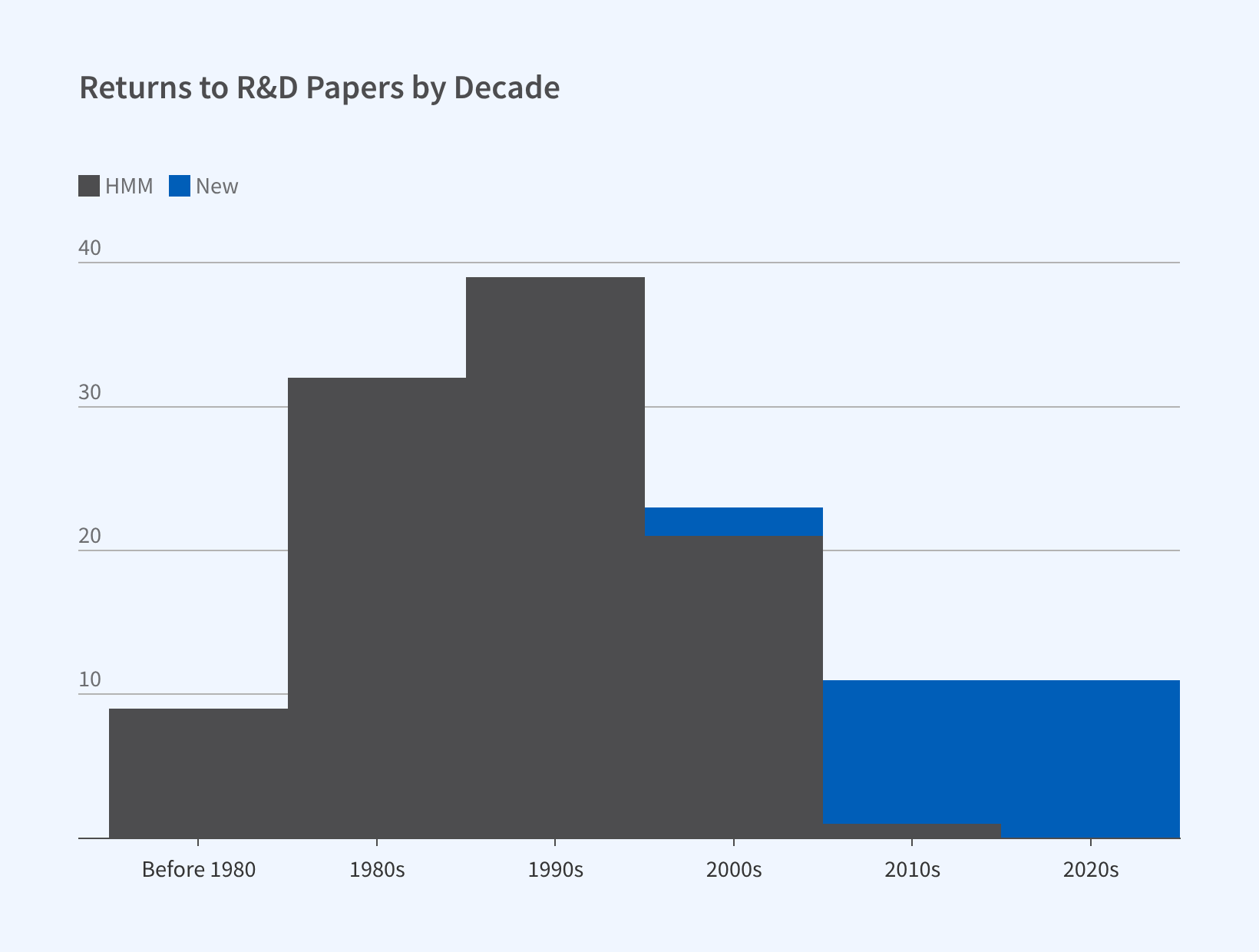
Simcoe and Hu identify 125 studies that present estimates of the rate of return to R&D. Most of these studies, 100 of 125, focus on private R&D spending. That share is roughly in line with private R&D’s 77 percent share of US R&D investment in 2024. Sixty-three of the 125 papers measure returns at the firm level, while only 4 focus exclusively on public sector R&D. The graph below shows the number of studies by decade of publication, and indicates the ones that were included in the HMM survey as well as the database, as well as those that were published more recently and not included in that study.
At the 2026 conference, Simcoe and Hu presented a preliminary summary of their findings. For publicly funded research, they find a median estimate of the internal rate of return of 38 percent. When the rate of return measure includes spillovers, the median estimate rises to close to 64 percent but the range of estimates also expands. Internal returns for a firm have a natural benchmark in the firm’s cost of capital, but it is less clear what the benchmark should be for external or society-wide returns.
Open Questions
Reviewing the database of past studies raises a number of open questions. How well do patents, publications, citations, counts of scientists measure external knowledge stocks? How reliable is “proximity weighting” as a method for estimating research spill-overs? How do the returns to publicly funded R&D performed in the public sector, publicly funded R&D conducted by universities, privately funded research carried out by universities, and privately funded R&D carried out by private firms differ? These questions, among others, constitute an agenda for future research on the rate of return to R&D.