Pop-Up Journal - Expert Survey
How large are the economic returns to federal research and development? A large body of empirical research addresses this question in various ways. Sifting through this research, and deciding how much weight and emphasis to place on particular results, requires familiarity with a range of data sources and empirical methods as well as judgement about the context in which various studies are set. To learn about the conclusions that researchers who have studied the economic returns to R&D have drawn about this question, the Pop Up Journal initiative commissioned a survey of experts in August 2026. The survey provides information on expert opinion at the start of this initiative; there will be additional surveys in future years that will try to determine whether the professional consensus evolves, and if it does, what factors cause experts to update their views.
Inaugural Survey
The first survey was fielded online from September 18 to October 1, 2026, and 23 of the 47 experts invited to take the full 90-minute version responded by October 1. Respondents gave low (10th percentile), central (50th) and high (90th) estimates of R&D returns and forecasts of what would happen if federal R&D spending rose or declined in future years. Ezra Karger presented preliminary results from the survey at the conference on October 2, 2026.
The headline question asked about the impact on GDP of a one-time, 20 percent increase in federal nondefense R&D appropriations in FY2027. This would translate into an increase of about $18 billion, which would be spent through existing R&D-related programs. The panel's median forecast was a gross internal real rate of return (IRR) of 25 percent per year, with median low and high forecasts of 10 percent and 40%. This IRR implies a stream of future increases in real GDP that, when discounted at a 7 percent real annual rate, have a present discounted value of about $4 for every $1 of public R&D outlay.
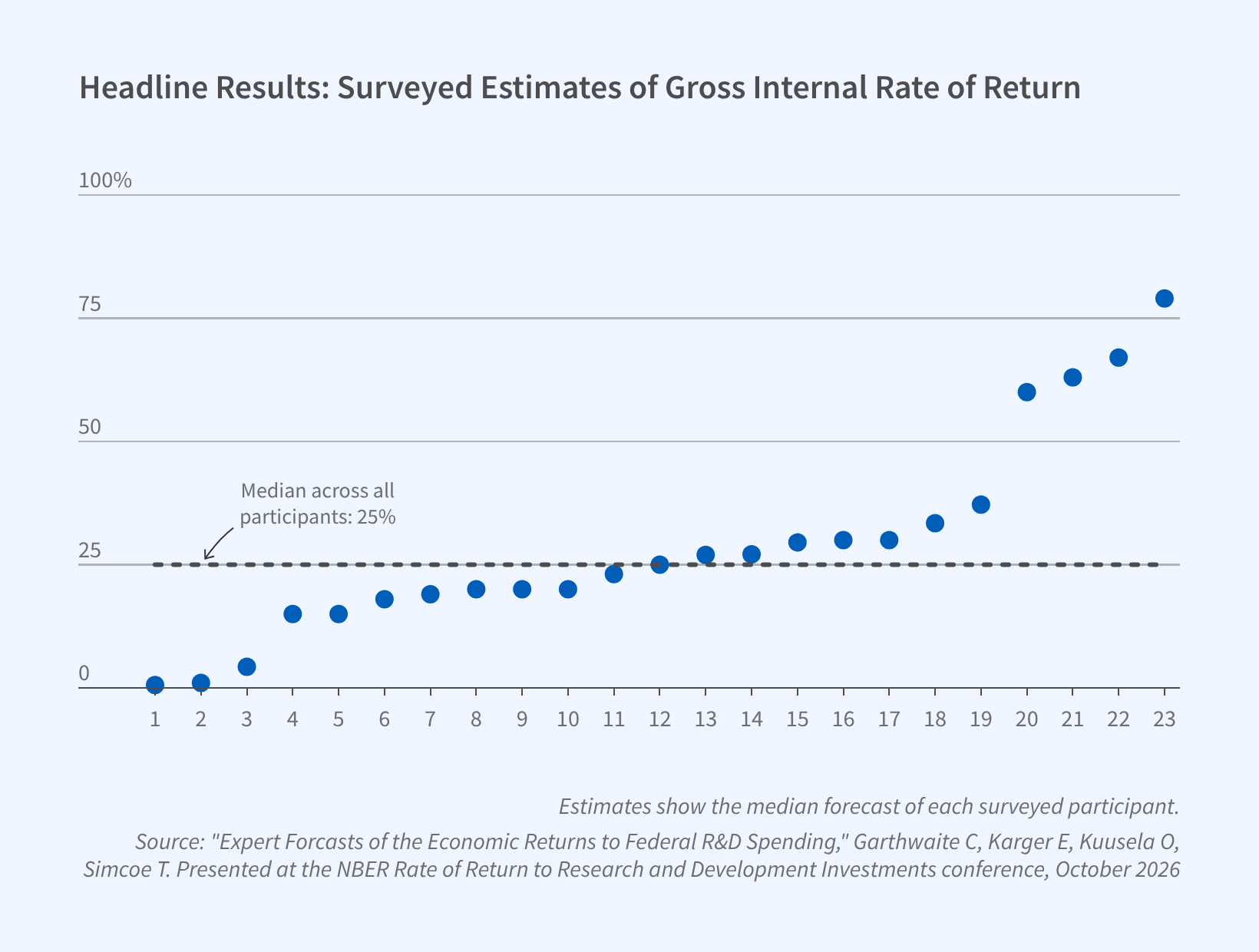
These 25 percent median IRR is close to the findings of a number of existing studies. For example, the results in Fieldhouse and Mertens (2026), based on aggregate data, suggest an annual IRR of about 30 percent, and Campbell et al. (2026),al Budget Office that estimate the PDV of incremental GDP is between $3.57 to $3.82 per dollar of new R&D spending. A number of respondents pointed out that the reaction to a one-time increase in federal spending would likely be different than a permanent increase, because in the former case there would be little time for the scientific workforce to expand and carry out new research. This is a point that Freeman and Van Reenen (2009) have made in reference to the large uptick in NIH research spending in the mid-1990s and at other times.
The experts who responded to the survey also viewed the rate of return as sensitive to the size of the expansion or cutback of federal R&D outlays. The median forecast IRR falls to 20% if the federal R&D is increased by 100% instead of by 20% in the hypothetical above.
Future waves of the survey will consider narrower questions, such as the rate of return by agency (NIH, NSF, and DOD) and how the mechanism for soliciting proposals and distributing research might affect the rate of return.