Valuing the Dollar’s Reserve Currency Status
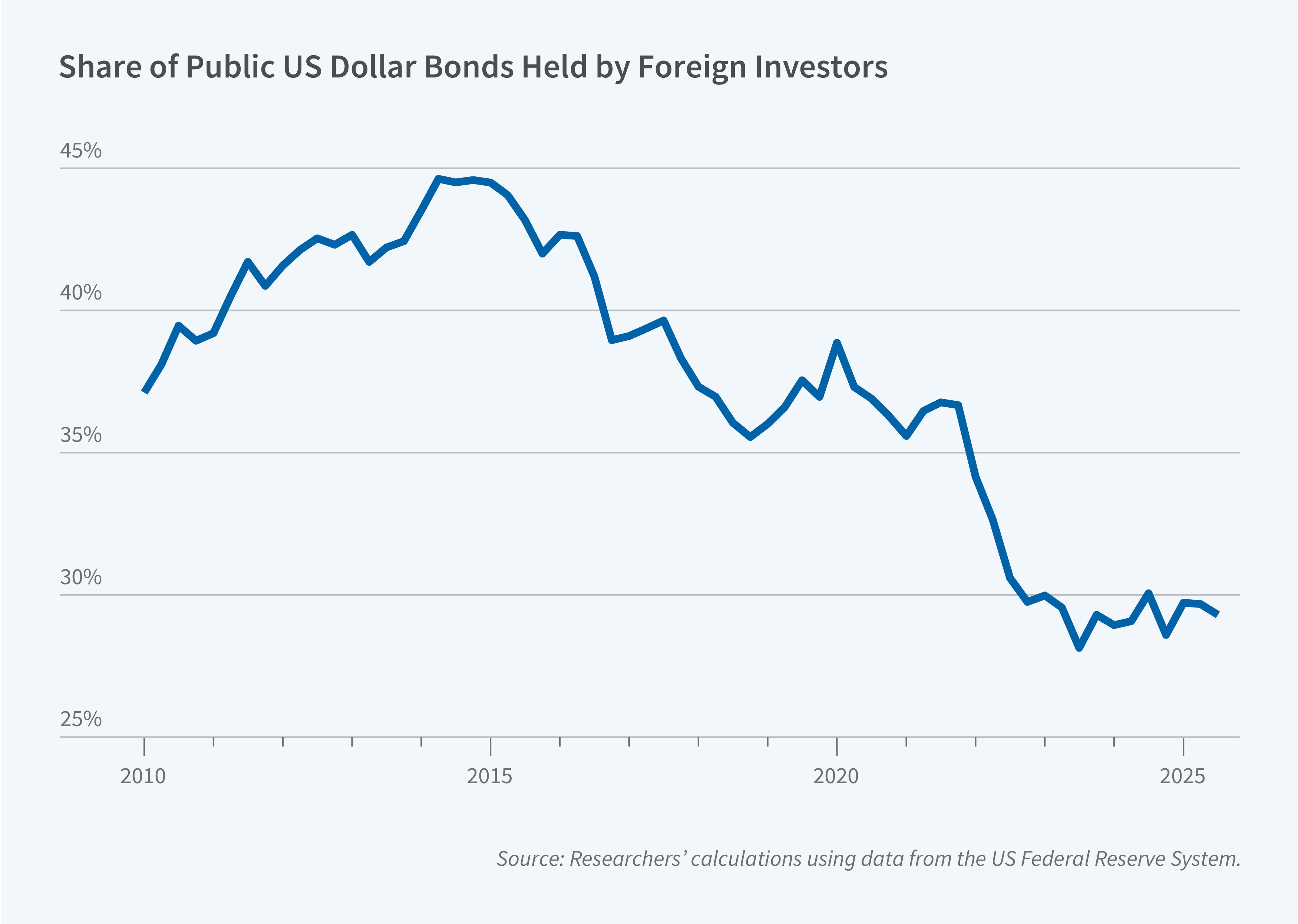
The dollar’s role as the world’s primary reserve currency has allowed the United States to borrow more cheaply than other countries, an advantage that economists call the “exorbitant privilege.” Foreign central banks, investors, and institutions hold Treasury bonds and other dollar assets not just for returns but for their value as safe, liquid instruments for payments and collateral. This demand generates what amounts to a fee, or seigniorage, paid by the rest of the world for access to dollar liquidity. There have been recent signs that this privilege is eroding: The premium investors pay to hold Treasuries over comparable foreign bonds has fallen since 2022. In the last two decades, foreign ownership of US public debt has dropped from roughly 45 to 30 percent, even as foreign holdings of private dollar assets have held steady.
In Dollar Erosion: Understanding the Loss of Reserve Currency Status (NBER Working Paper 35328), Zhengyang Jiang, Arvind Krishnamurthy, Hanno Lustig, and Robert J. Richmond estimate how much US interest rates and the value of the dollar would change if the world no longer treated US safe assets as a special form of international liquidity. They develop and calibrate a general equilibrium model that incorporates Federal Reserve Flow of Funds data on the supply of US public and private safe assets and the share held by foreign investors, as well as trade data and convenience yield estimates from prior research measuring the premium investors pay for the safety and liquidity of dollar-denominated debt.
Loss of the dollar’s reserve currency status could result in more than an 8 percent real depreciation, an increase in US real interest rates, and a loss of US wealth of more than $18 trillion.
The researchers’ model suggests that complete loss of reserve currency status would produce an 8.8 percent real depreciation of the dollar and a 0.9 percentage point increase in US real interest rates. These estimates correspond to a baseline calibration in which dollar bonds carry a 2 percent annual convenience yield, foreign investors hold dollar-safe assets equal to roughly 52 percent of US GDP, and the consumption-basket weight on foreign goods is 5 percent, which corresponds to a strong home bias in US consumption.
The size of the required depreciation depends heavily on the extent of home bias and on the elasticity of substitution between US and foreign goods, a measure of how readily consumers switch from one country’s goods to another’s when relative prices change. When this substitutability is low, or when home bias is strong, prices have to move more to bring goods markets back into balance, implying a larger currency adjustment. In an alternative calibration with a higher trade elasticity, the estimated depreciation falls to 5.1 percent. In another calibration that further restricts the consumption-relevant trade share, the depreciation estimate rises to at least 17 percent.
Loss of reserve status would require domestic investors to absorb dollar-denominated bonds worth roughly 50 percent of GDP that were previously held abroad. Because domestic investors are only willing to hold a larger quantity if they receive a higher interest rate in return, this reabsorption is estimated to raise the US real interest rate by approximately 90 basis points. Unlike the exchange-rate response, the estimated change in the interest rate proves stable across different assumptions about trade elasticities and consumption patterns. It depends on bond-market rather than goods-market parameters.
Given the fall in the value of the dollar and the rise in real interest rates, the researchers calculate that the loss of reserve currency status would impose a wealth loss on the United States. Using historical values of risk-adjusted discount and growth rates, they estimate that the present value of the foregone seigniorage revenue equals approximately 60 percent of US GDP, or roughly $18 trillion. With forward-looking estimates of discount and growth rates, this present value is even greater.


