Consequences of Organ Procurement Reform
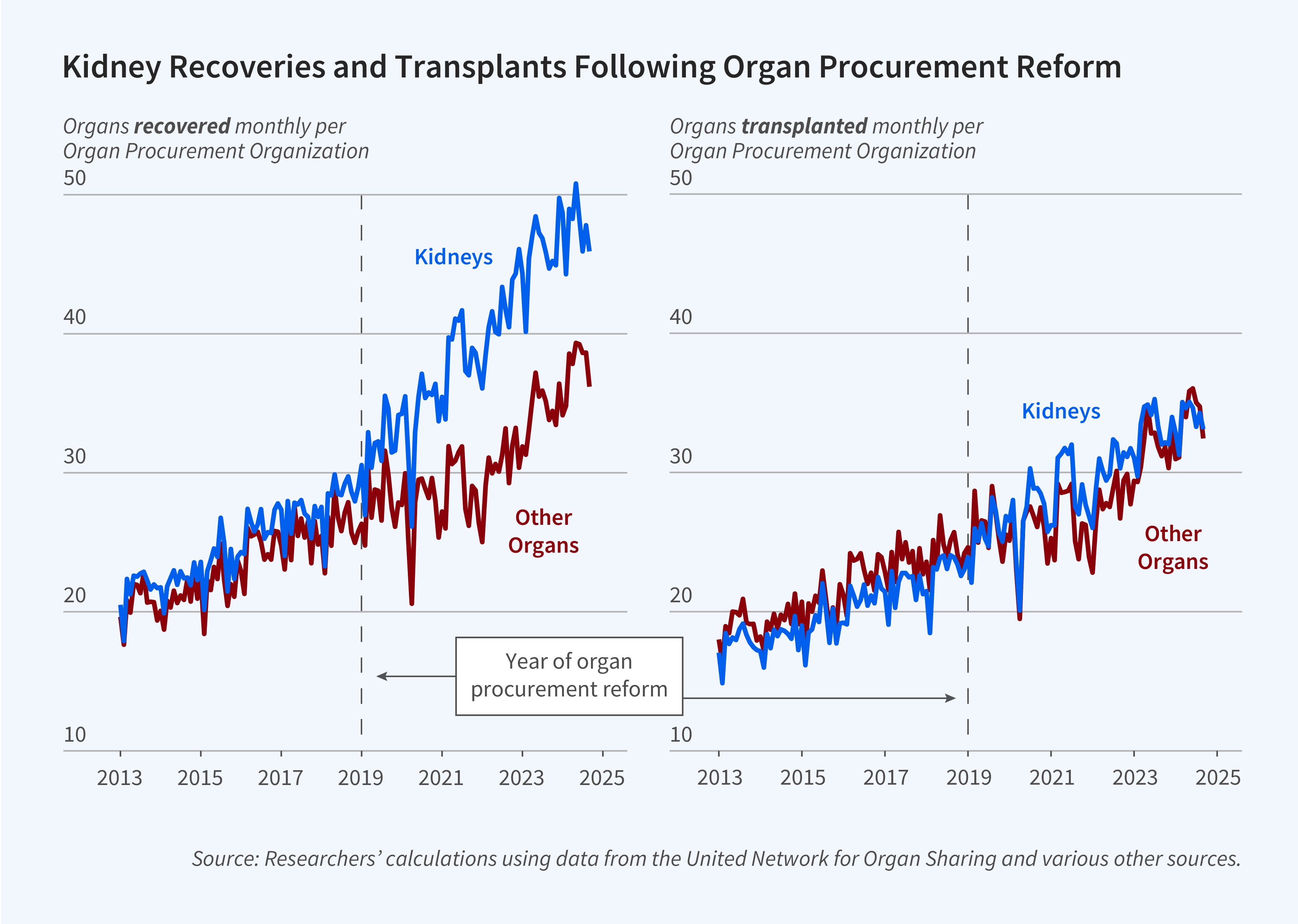
In 2019, the United States introduced new regulations for Organ Procurement Organizations (OPOs) designed to increase transparency and accountability in the organ donation system. These changes included stronger performance incentives aimed at improving outcomes in a sector that handles over 45,000 transplants annually and manages a waiting list of more than 100,000 patients. In Economic Incentives and Organ Procurement: Evidence from a US Reform (NBER Working Paper 34140), Erkut Y. Ozbay, Ariel Rava, Sergio S. Urzúa, and Emanuel Zur examine the impact of this reform on organ donations, transplant activity, and system costs.
A 2019 US reform of Organ Procurement Organizations increased kidney recoveries by 29 percent and resulted in an estimated $359 million in fiscal savings.
The reform replaced inconsistent, self-reported performance metrics with standardized, independently verified measures. Currently, the 56 OPOs operating across the United States hold monopolistic rights within their designated service areas to recover donor organs from the deceased. The reform introduced a three-tier performance ranking system that automatically recertifies high-performing OPOs, while lower-performing organizations face intensified oversight or potential decertification.
Using comprehensive data from Freedom of Information Act requests and official transplant records from 2015 to 2024, the researchers compare kidney procurement with that of other organs. Because Medicare provides full reimbursement for kidney procurement costs, the OPOs have strong financial incentives to prioritize kidney recovery over recovery of other organs.
After the reform, the average number of kidneys procured per OPO per month increased by just over 7, a nearly 30 percent increase relative to the pre-reform baseline of about 25. However, only 39 percent of these newly recovered kidneys were transplanted, compared to 81 percent prior to the reform, suggesting that financial incentives drove procurement activity even when transplant outcomes were uncertain.
The reform's impact varied across OPO performance tiers. Mid-performing OPOs showed the largest increases with 8.7 additional kidneys per month, compared to 7.4 for top-performing and 6.0 for low-performing OPOs. The increased organ recovery came primarily from strengthening relationships with hospitals that had only occasional pre-reform interactions with OPOs, rather than establishing entirely new partnerships.
Increased procurement came with higher costs. Total kidney-related procurement costs rose by an average of $2.63 million per OPO per year. The researchers estimate that between January 2019 and September 2024, the reform generated approximately $1.96 billion in reduced aggregate dialysis costs. After accounting for increased OPO operational spending, they calculate net savings of roughly $359 million to US taxpayers through 2023.
While the reform, along with Medicare’s guaranteed reimbursement for kidney procurement, increased organ procurement and generated fiscal benefits, the researchers note that it may also have led to resource concentration on kidneys at the potential expense of other organs, like hearts, livers, and lungs, which have shorter viability windows and face more complex reimbursement structures.
- Abby Hiller


