Urban Congestion Pricing and the Response Times of Emergency Medical Services
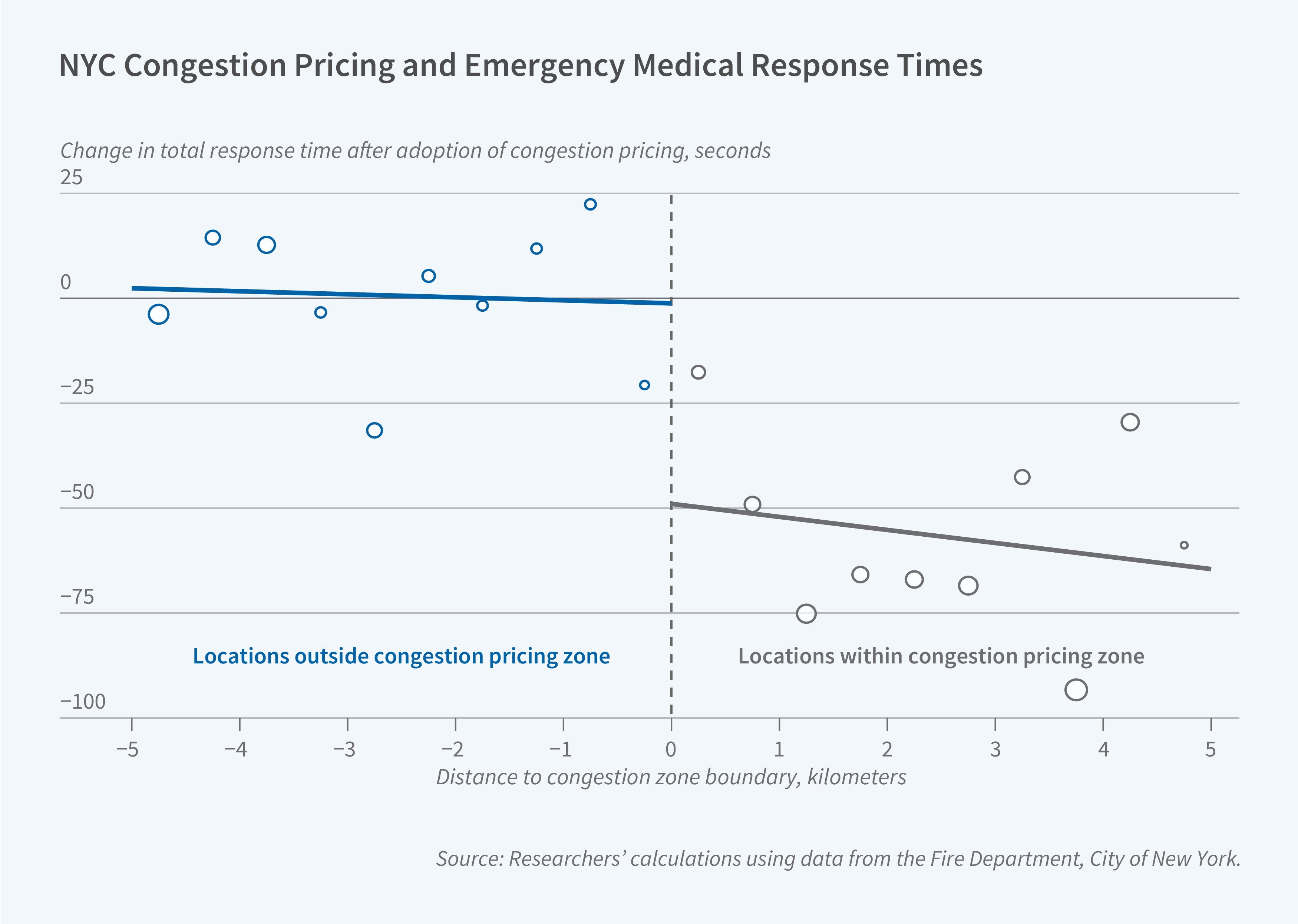
Cities around the world, including London, Stockholm, Milan, and most recently, New York City (NYC), have adopted congestion pricing, charging drivers a fee to enter high-traffic zones. The primary motivation has been to reduce gridlock, but these policies also have other effects. In Congestion Pricing and Emergency Medical Service Response: Evidence from New York City (NBER Working Paper 35414), Yulia Chikish, Gregory J. Colman, Dhaval M. Dave, Brad R. Humphreys, Zachary Santamaria, and Zachary Winship examine one of these other consequences: improvement in response time of emergency medical services (EMS). NYC implemented its congestion relief zone (CRZ), the first comprehensive congestion pricing program in the US, on January 5, 2025. The zone’s boundary at 60th Street in Manhattan creates a sharp line separating tolled and untolled areas, allowing the researchers to compare locations just inside versus just outside the boundary, before and after congestion tolls took effect.
New York City’s congestion pricing program cut total emergency medical service travel times by just over a minute on average.
The researchers analyze dispatch records from the Fire Department of New York City for roughly half a million EMS incidents in 2024–2025, combined with traffic camera data from New York University’s C2SMART research center that measure vehicle, truck, pedestrian, and bicycle density at fixed locations near the boundary. Within a 5-kilometer band around the boundary, hospital transport time—the interval between an ambulance leaving the incident scene and arriving at a hospital—fell by about 54–59 seconds, an improvement of roughly 8 percent relative to the pre-policy average of about 12 minutes. Total EMS travel time, combining response to the scene and transport to the hospital, declined by nearly 63–70 seconds, or almost 5–6 percent. Travel time to the incident scene itself fell by a smaller and less precisely estimated amount, about 7–9 seconds or 2 percent. Prior research has found that longer EMS response times are associated with higher 90-day mortality rates for the patients.
Underlying these improvements were substantial changes in traffic patterns near the boundary of the congestion pricing zone. Passenger vehicle density fell by approximately 21 percent and truck density by 18 percent, while pedestrian and bicycle density rose by roughly 14 percent and 20 percent, respectively. The EMS improvements emerged quickly after implementation and were concentrated spatially near the 60th Street boundary, with little evidence that congestion—or its associated costs to emergency response—simply shifted to nearby areas outside the CRZ.


