How Do Falling Birth Rates Affect Economic Growth?
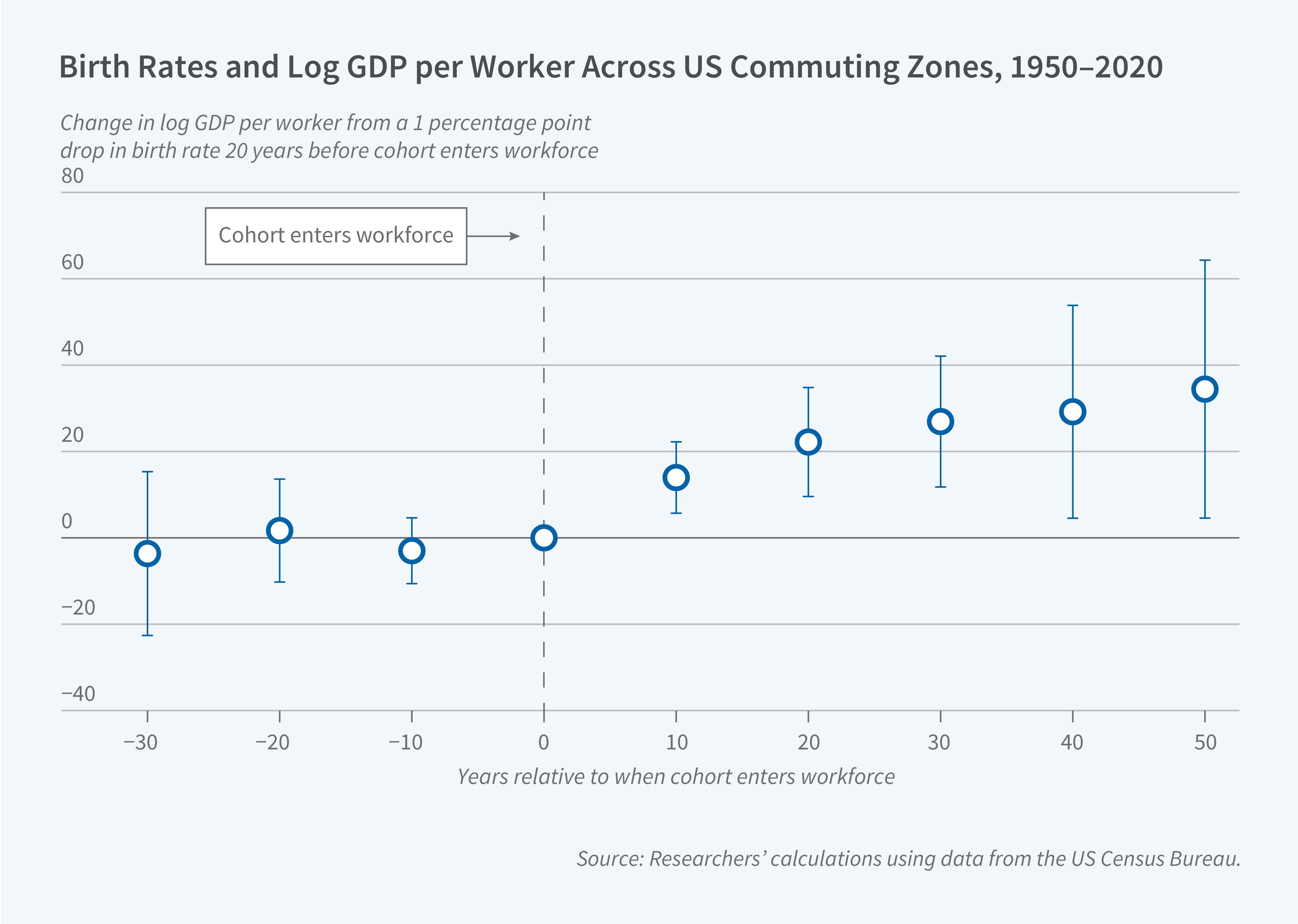
The global crude birth rate—the number of births per 100 people—fell from 3.78 in 1950 to 1.71 in 2025. The United Nations projects that populations will begin shrinking in most countries later this century. This will be the first episode of sustained population decline since the fourteenth-century bubonic plague. China, Japan, and South Korea now have some of the lowest birth rates on record and are projected to see substantial population declines and sharply older workforces by the middle of the twenty-first century.
Older workers are often assumed to be less productive and innovative than their younger counterparts, so falling birth rates are sometimes viewed as harbingers of slowing economic growth. Shrinking labor forces can lower aggregate demand and investment. In Baby Busts and Growth Booms: Demographic Change and the Macroeconomy (NBER Working Paper 35401), Daron Acemoglu, David Autor, Keelan Beirne, and Andrew Scott examine seven decades of demographic change to test whether falling birth rates have been associated with weaker economic performance.
Declining birth rates over the past seven decades have been associated with higher GDP per worker and higher wages, perhaps because labor scarcity spurs labor-saving technological innovation.
The researchers use cross-country data from 1950 to 2020, relating birth rates to subsequent changes in GDP per working-age adult 20 years later (20 years being roughly the interval between birth and workforce entry). They also study age-composition-adjusted wage growth across 722 US commuting zones, controlling for initial income levels and the number of younger and older workers.
Across countries, a 1-percentage-point lower birth rate in 1950 is associated with 23 log points higher GDP per worker in 2020. A comparable relationship holds for US commuting zones: A 1-percentage-point lower birth rate in 1940 is associated with faster composition-adjusted wage growth, by about 15 log points, between 1960 and 2020. These relationships are robust to the inclusion of controls for education, urbanization, and regional trends, and are similar in magnitude whether measured using birth-rate variation from the baby-boom era or the baby-bust era.
Despite these gains in output and wages per worker, the researchers find no statistically significant relationship between birth rates and aggregate GDP or earnings. Lower birth rates raise income per worker without reducing total economic output, even though they shrink the working-age population.
Investigating the mechanism at work linking lower fertility with higher income per worker reveals that countries with lower birth rates show larger shares of high-tech exports, more patenting in labor-saving categories (such as automation and information/communication technologies), and faster growth in total factor productivity. A 1-percentage-point lower birth rate is associated with 15 log points higher total factor productivity growth over 30 years. US commuting zones with lower birth rates show a similar reallocation of employment toward high-tech and R&D-intensive industries and away from labor-intensive ones. Capital stocks also rise following declines in birth rates, in contrast to the prediction of standard growth models that a shrinking labor supply should reduce investment.
The researchers acknowledge support from the Hewlett Foundation, the Smith Richardson Foundation, the James M. and Cathleen D. Stone Foundation, and ESRC grant T002204. They also thank the Google Technology and Society Visiting Fellows Program, the NOMIS Foundation, and the Schmidt Sciences AI2050 Fellowship for research support.


