Multimodal Freight Transport
Over half of US freight, measured in ton-miles, moves using more than one transport mode. Roughly two-thirds of shipments traveling over 500 miles rely on combinations of road, rail, and waterway networks connected by ports and inland terminals. Recent disruptions—from pandemic-era port congestion to the Panama Canal drought and threatened rail strikes—have shown how problems at local bottlenecks can ripple through this multimodal system, raising transport costs and affecting supply chains nationwide.
In Multimodal Transport Networks (NBER Working Paper 35065), Simon Fuchs and Woan Foong Wong develop a spatial equilibrium framework of multimodal transportation for evaluating infrastructure investments and disruptions. Their analysis embeds route choice, mode choice, and mode-specific congestion—particularly at intermodal terminals where freight switches between networks. The recursive framework of the model allows the researchers to tractably distinguish between substitution across transport modes and across routes, as well as account for the complexities of modeling multimodal transport networks within a general equilibrium setting.
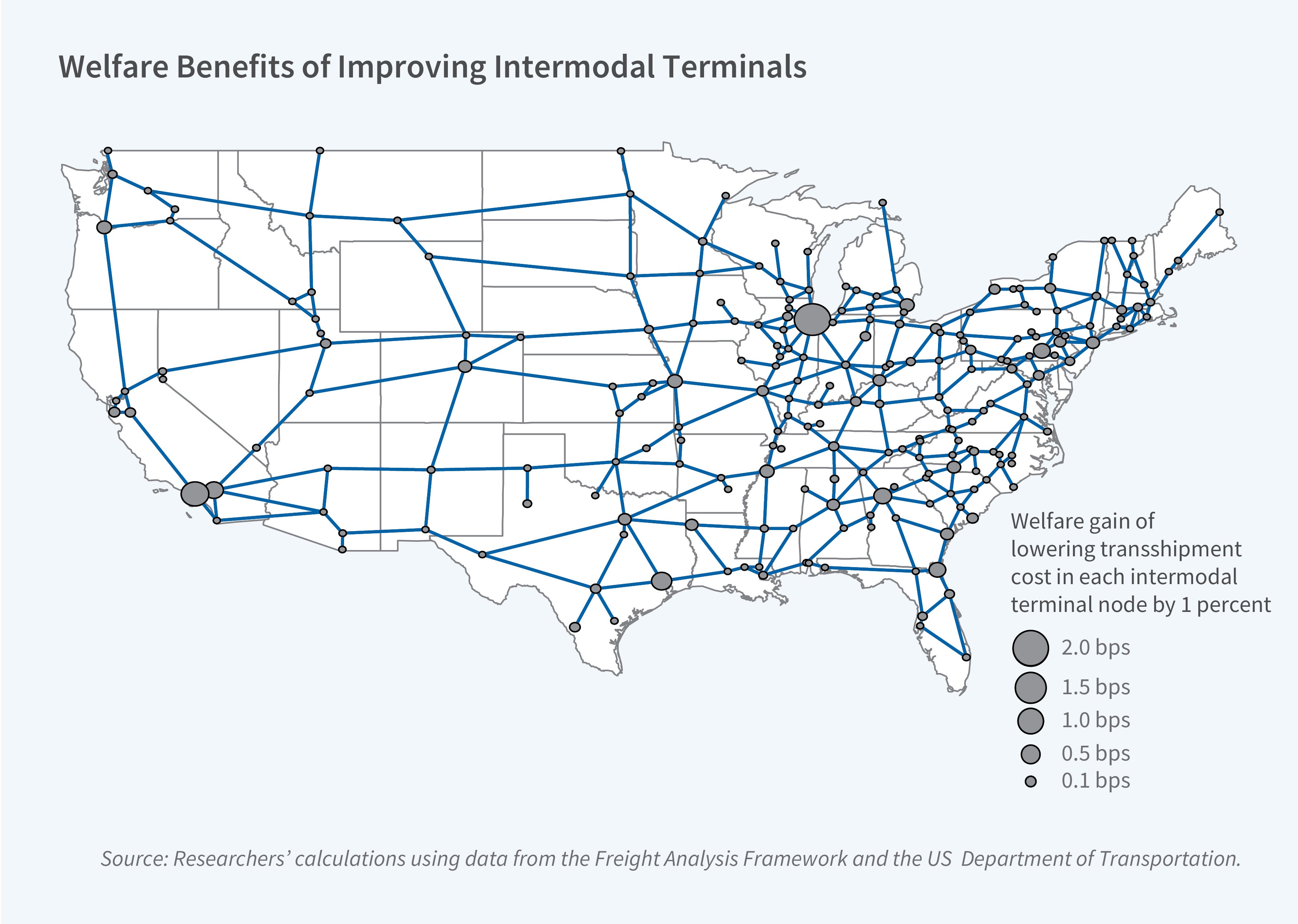
Centrally located intermodal terminals like Chicago, Atlanta, and Kansas City are key bottlenecks in the US multimodal freight network. Targeted improvements could generate large welfare gains by improving the connections between coastal ports and interior regions.
To pin down the choice between transport modes, the researchers estimate an elasticity of modal substitution of 1.1 from studying how rail-to-truck traffic flows respond to increases in interstate highway capacity. To evaluate the impact of congestion at intermodal terminals, they use minute-level location data from more than 3,700 unique ships at the 30 largest US container ports and estimate that a 1 percent increase in port traffic prolongs ship dwell times by about 0.25 percent.
They quantify the importance of improving the integration of the multimodal transport network by simulating a 1 percent reduction in mode-switching costs at each terminal. The terminals where lower costs result in the highest welfare gains are interior hubs like Chicago, Atlanta, and Kansas City, rather than exclusively major coastal ports, highlighting their important role in connecting coastal and interior regions. Improving these central terminals could increase real GDP by $0.5–$1.9 billion, with additional environmental benefits from shifting away from carbon-intensive road transport.
A decomposition exercise using highway link improvements reveals that ignoring congestion when calculating potential welfare gains leads to an overestimate of 85 percent, while ignoring productivity and amenity externalities overstates them by 57 percent. Conversely, abstracting from multimodal flexibility or fixing routes understates gains by 22 percent, suggesting that most rerouting responses to highway improvements occur across modes rather than within a single mode.
Shutting down the rail network, as threatened during the fall 2022 strike, would reduce real GDP by approximately $230 billion with an additional $12 billion in environmental costs from shifting freight onto roads. The Jones Act requires domestic shipping to use US-built, US-crewed, and US-owned vessels. Repealing it to allow for cheaper foreign ships would generate welfare gains equivalent to roughly $3.2 billion in GDP. Panama Canal disruptions from drought conditions would impose welfare losses of about $2.7 billion. In all three scenarios, congestion at intermodal terminals compounds the welfare effects.


