Who Gets Ahead in Venture Capital: New Evidence from 100,000 Investors' Careers
Firms that were initially backed by venture capitalists account for 41 percent of US stock market capitalization, seven of the ten largest US companies by market value at the end of 2025, and 62 percent of public companies' R&D spending. Venture capital (VC) investing relies heavily on individual judgment, as investors try to identify promising startups and help guide them toward success.
In Human Capital in Venture Capital: Evidence from 100,000 Venture Capitalists (NBER Working Paper 35501), Blake Jackson and Ilya A. Strebulaev study whether individual differences among VC professionals—in education, work experience, and demographics—help explain who succeeds in the industry, how careers progress, and why investment returns are so concentrated among a small number of individuals. They also examine whether achieving public recognition as a top investor itself improves subsequent investment access and success.
Fewer than 40 percent of the venture capitalists who have made investments have ever funded a successful firm.
The researchers built a new dataset covering more than 100,000 professionals affiliated with US VC firms, including 37,000 investment professionals. They used large language models, supplemented with manual validation, to extract biographical details from archived VC firm websites over the period 1996 to 2025. About half of the data points collected are not available in standard commercial datasets. These VC firms collectively raised and deployed 96 percent of the capital invested by institutional US venture funds during the sample period. Investment outcomes were drawn from commercial datasets (PitchBook and VentureSource) as well as records extracted from the archived biographies. They also used the annual Forbes Midas List, which ranks the top 100 VCs each year, to run an analysis comparing VCs who barely made the list to those who barely missed it.
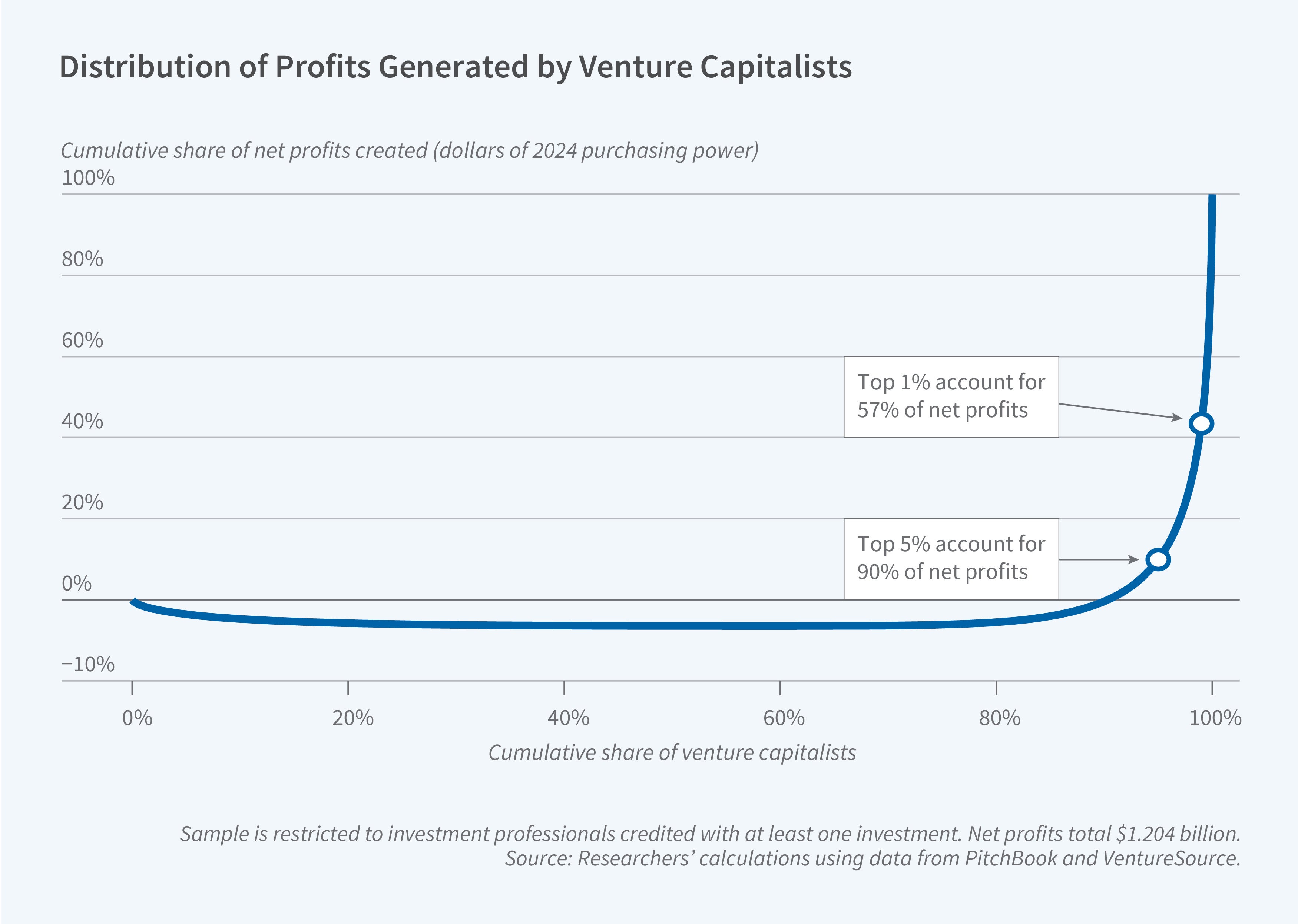
Only 38 percent of the VC investors—individuals in the database who made at least one investment—were ever credited with a successful investment, and just 15 percent recorded three or more successes. In dollar terms, the top 1 percent of VCs—about 120 individuals—account for roughly 57 percent of the approximately $1.2 trillion in inflation-adjusted net profits generated across the sample, while the top 5 percent account for about 90 percent.
VC investors who previously made successful investments are more likely to succeed again. Investors with one prior success are 2 percentage points more likely to have a successful outcome, and those with five prior successes are about 7 percentage points more likely to succeed. This is almost a 50 percent jump relative to the average rate of investment success.
On a career basis, female VC investors are credited with 37 percent fewer successful investments on average than male VCs from the same entry cohort, and successful investors disproportionately come from higher-ranked schools, hold top MBA degrees or advanced degrees, previously served as CEO or founder of a successful startup, or transitioned from technology or investment banking careers. VC investors with an MBA from a highly ranked school are estimated to generate net lifetime profits at least twice those of the average VC investor.
Female professionals are 2.6 percentage points less likely to be promoted to partner, though this gap has narrowed over time. Professionals with MBAs, advanced degrees, or prior experience at startups or technology firms, and those who join VC firms at more senior levels, are more likely to be promoted.
VC investors who were just above the threshold for inclusion on the Midas List were more than 4 percent more likely to invest in companies with successful outcomes in the years following their inclusion. This effect appears to be concentrated in new investments rather than existing ones, suggesting that recognition improves a VC's access to high-quality startups rather than conferring new investing skill.