What Leads to Fiscal Adjustment?
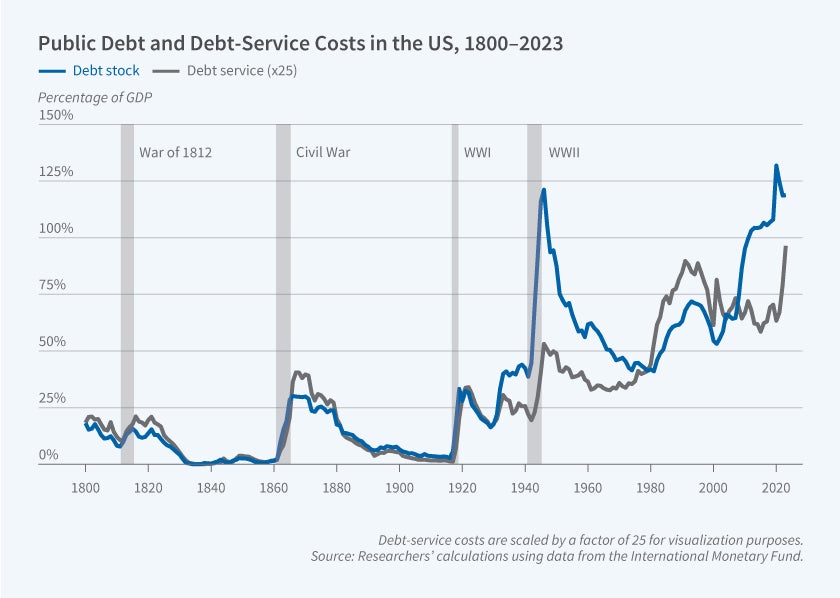
Many analyses of fiscal sustainability focus on the ratio of debt to GDP and the gap between interest rates and economic growth rates. Yet some governments have carried debt loads exceeding annual GDP for extended periods without crisis, while others have faced fiscal pressure at comparatively modest debt-to-GDP levels. In From Stocks to Flows: Debt Service and Fiscal Sustainability (NBER Working Paper 35459), Barry Eichengreen, Maxime Menuet, and Gregory Donnat explore the links between the outstanding stock of debt, the cost of debt service as measured by the ratio of interest payments to GDP, and fiscal adjustment.
Two centuries of US fiscal data suggest that rising interest costs as a share of GDP, rather than increases in the debt-to-GDP ratio, prompt fiscal policy adjustments.
The study draws on US time series data from 1800 to 2023 as well as the IMF’s Public Finances in Modern History database, a more recent panel dataset for 12 advanced economies. The researchers examine how primary surpluses, the difference between tax revenue and spending excluding interest payments, respond to the debt ratio and the cost of debt service. They find a much tighter relationship between changes in the primary surplus and debt-service costs than between primary surpluses and debt ratios themselves. In the US data, the effects of movements in the debt ratio are statistically distinguishable from zero, while increases in debt-service costs are associated with policy actions that boost primary surpluses. The response to higher debt-service costs builds gradually and persists over several years. Evidence from the cross-country panel points in the same direction.
Financing conditions also shape the adjustment. When government borrowing rates exceed economic growth, a condition that results in debt burdens growing automatically, the fiscal response to higher debt-service costs is stronger and develops over several years. When the differential is negative, the response is smaller and not statistically significant at conventional levels.
A similar pattern holds for sovereign risk premia, the extra yield investors demand to hold a country’s debt. Fiscal adjustment is faster to emerge but of more modest magnitude when risk premia are high, whereas it is slower to emerge but ultimately larger when risk premia are low.
Before the creation of the Federal Reserve and the federal income tax in 1913, US fiscal stabilization relied on sharp, short-lived corrections concentrated in the years following wars. The level of fiscal responsiveness, however, was below the threshold needed for full debt stabilization. After 1913, primary surpluses became substantially more persistent, governments were able to sustain larger debt ratios under more favorable financing conditions, and long-run responsiveness rose to a level that is consistent with sustainability.
Taken together, the findings suggest that debt-service costs provide a more direct gauge of fiscal pressure than debt ratios alone. Interest payments constitute immediate claims on government resources, while even high debt ratios may remain manageable when financing conditions are favorable. Debt service is the channel through which the stock of debt translates into a current fiscal constraint.


