Subsidized Childcare and Mothers’ Labor Outcomes in Quebec
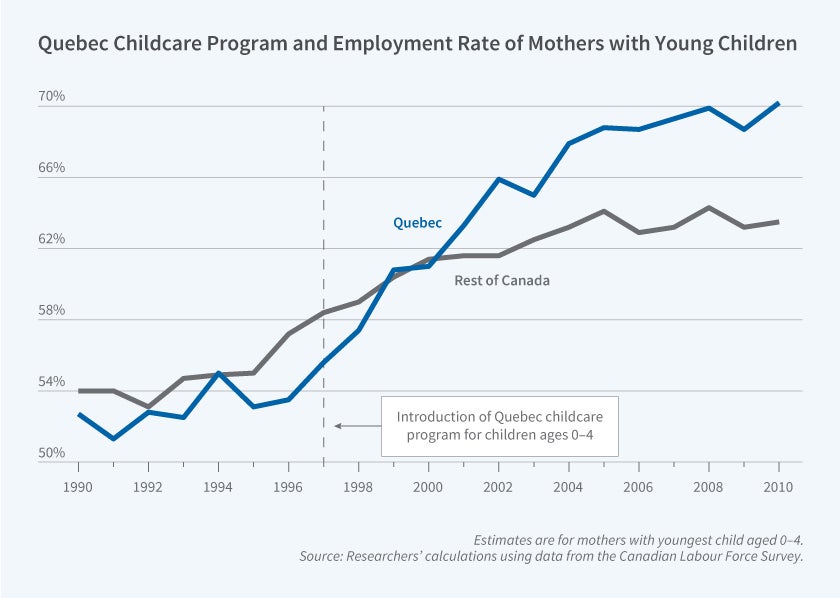
Governments in many countries have expanded public childcare in part to help mothers remain attached to the workforce. Prior research has generally found that subsidized childcare raises mothers’ employment while children are young, but less is known about whether these effects persist once children have grown. In Investing in Mothers? The Long-Run Impact of a Universal Child Care Program on Maternal Work and Income (NBER Working Paper 35514), researchers Michael Baker, Jonathan Gruber, and Kevin S. Milligan examine the long-run consequences of Quebec’s universal, heavily subsidized childcare program, introduced in 1997 for children ages 0–4, on mothers’ employment, earnings, use of social insurance programs, and tax payments.
Even after their children left preschool, mothers who had access to Quebec’s universal childcare program worked and earned more than mothers who did not.
The researchers combine two Canadian data sources: repeated cross-sections from the Labour Force Survey (LFS) and income tax records spanning 26 years from the Longitudinal Administrative Databank. They compare mothers in Quebec with mothers in the rest of Canada before and after the program’s introduction, tracking outcomes as children age.
In the LFS data, the researchers find that mothers with children ages 0–4 who were fully exposed to the program were 5 percentage points more likely to be employed than mothers who were not exposed. This employment effect persists at least until children reach age 15.
In the longitudinal tax data, the employment effect grows with mothers’ age, rising from 7 percentage points in their early 30s to 10 percentage points by their late 30s to 12 percentage points by age 50. The effect on earnings grows even faster, reaching an increase of 27 percent of earnings by age 50, roughly twice the proportional size of the employment effect at that age. The researchers attribute this widening earnings effect to increases in hours worked, higher hourly wages, and shifts into more highly compensated occupations, changes that continue to unfold long after children have left preschool.
Most of the increase, about two-thirds, reflects earnings growth within the same occupation rather than a move to a different one, pointing to a role for accumulated work experience. Program exposure increased mothers’ total years of work by 1.7 years by age 50, relative to an average of 14.4 total work years for unexposed mothers. The researchers estimate that these additional years of work explain about 2.4 percentage points of the growth in hourly wages, roughly one-third of the estimated 6.8 percent increase in within-occupation hourly wages.
Overall, the researchers estimate that about a quarter of the increase in earnings associated with program eligibility can be attributed to increased labor supply conditional on participation, a similar amount to the shift to higher-paying occupations, a smaller share to added experience, and nearly 40 percent to unexplained within-occupation wage growth.
The researchers compare these labor market gains against the program’s cost, estimated at about $6,000 per eligible child. Because program costs are incurred upfront while fiscal benefits of higher taxes on earnings accrue later in mothers’ careers, the net present value of the fiscal balance depends heavily on the discount rate applied. Using discount rates of 1.5 and 3 percent, and counting fiscal benefits through age 55, the researchers find that these gains recover 98 and 75 percent, respectively, of the program’s costs, and imply a real internal rate of return of about 1.5 percent.


