Skill Erosion During Career Interruptions: Evidence from Military Physicians
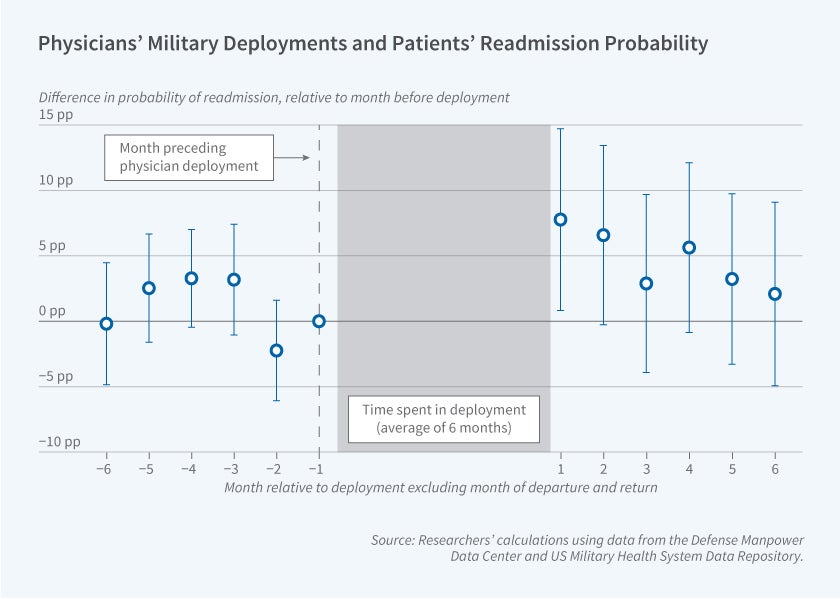
Workers lose proficiency when they stop practicing a skill, yet directly measuring this “forgetting” and the subsequent relearning process has proved difficult. In Physician Learning and Forgetting: Evidence from the US Military (NBER Working Paper 35502), Trevor Fitzgerald, Atul Gupta, and Stephen D. Schwab examine surgeons and obstetricians/gynecologists in the US Military Health System (MHS). These physicians are periodically sent on combat deployments that last about six months on average.
A six-month break from routine practice is associated with a measurable but temporary decline in care quality.
These deployments are assigned based on operational need rather than physician quality or preference, and the procedures performed while deployed, largely wound care and stabilization, overlap little with routine home-base practice. Because patients in the MHS cannot choose their physician and physicians receive no financial incentive tied to procedure volume, this setting is a promising venue for isolating how a practice gap affects physician performance.
The study draws on patient-level claims data from the MHS Data Repository covering 2007 through 2017, linked to Defense Manpower Data Center personnel records identifying deployment dates. It includes 690 surgeons and 486 obstetricians, of whom 369 and 87, respectively, deployed at some point. The researchers compare patient outcomes for deploying physicians in the six months before and after deployment against outcomes for matched non-deploying physicians observed over the same calendar period.
In the first two months after returning from deployment, obstetricians’ C-section rates rose by 18.5 percentage points, or 74 percent of their pre-deployment rate. There was no corresponding rise in the underlying medical risk profiles of their patients. This elevation in C-section rates persisted for roughly nine months before returning to baseline.
For surgeons, patient readmission rates within 90 days rose by 6.2 percentage points, or 48 percent of their baseline, during the first two months after returning from deployment. This effect faded within six months. A similar but more persistent pattern emerged for emergency department visits following surgery, which remained elevated throughout the six-month observation window. The researchers found no evidence that these effects were explained by changes in patient case mix, procedure volume, or physician mental health following deployment.
The paper also estimates how quickly recent case experience improves performance. A doubling of recent procedure volume was associated with a 2.3 percentage point drop in readmission rates (17 percent of baseline) for surgeons and a 2.8 percentage point (11 percent of baseline) drop in C-section rates for obstetricians.


