Firm Responses to Changes in Overtime Pay Thresholds
Under the Fair Labor Standards Act, salaried employees are guaranteed overtime pay if their base salary falls below a legally defined “overtime exemption threshold.” Workers earning above this threshold can be classified as exempt from overtime protections. Because this federal threshold has not kept pace with inflation, the share of salaried workers automatically covered for overtime fell from over 50 percent in 1975 to less than 10 percent by 2016. In response, a number of states have raised their own overtime exemption thresholds above the federal level.
In The Labor Market Effects of Expanding Overtime Coverage (NBER Working Paper 35433), Simon Quach studies 19 state-level overtime exemption threshold increases between 2014 and 2021. The analysis draws on anonymized monthly administrative payroll data from a major payroll processing company, covering more than a tenth of the US labor force, which allows for precise measurement of workers’ base pay as distinct from overtime compensation. Quach compares states that raised their thresholds to states that did not. He also draws on Current Population Survey data to examine effects on hours worked.
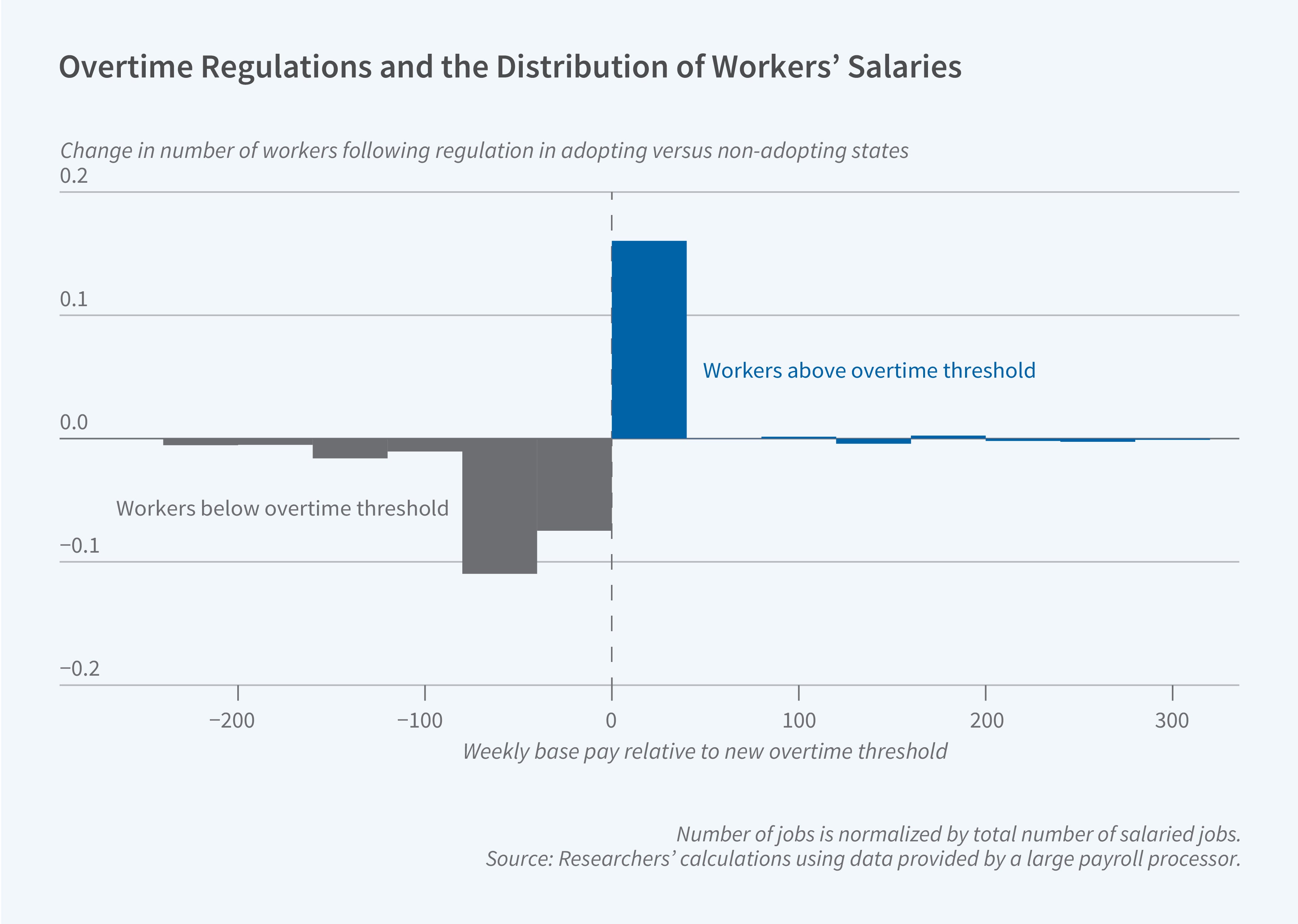
When states raise their overtime exemption thresholds, some firms offer affected workers raises to keep them above the new threshold.
Raising the overtime threshold generally leads firms to raise workers’ base salaries above the new cutoff rather than adjust employment or hours. On average, in the month when a new threshold took effect, the number of salaried workers earning between the old and new thresholds fell by 21 percent. Three-quarters of this decline is explained by employers pushing salaries just above the new threshold, thereby preserving affected workers’ exemption from overtime protection.
Employment effects were small and statistically insignificant. Aggregate employment changes could not be distinguished from zero when accounting for both salaried and hourly workers. This finding contradicts the original rationale behind overtime law, which anticipated that firms would hire additional workers for reduced hours per employee in a “work-sharing” mechanism.
The study finds no evidence that firms lowered base wages to offset the cost of newly required overtime pay. Instead, workers’ total labor income rose. Affected salaried workers saw a 1.4 percent increase in earnings, driven primarily by higher base pay rather than overtime compensation itself. Because only about 16 percent of affected workers were pushed above the threshold, the benefits were concentrated: This subset of bunched workers experienced an estimated 8.5 percent increase in base salary, while other affected workers saw comparatively modest gains from overtime pay.


