Capital Gains Taxation and Investor Risk-Taking
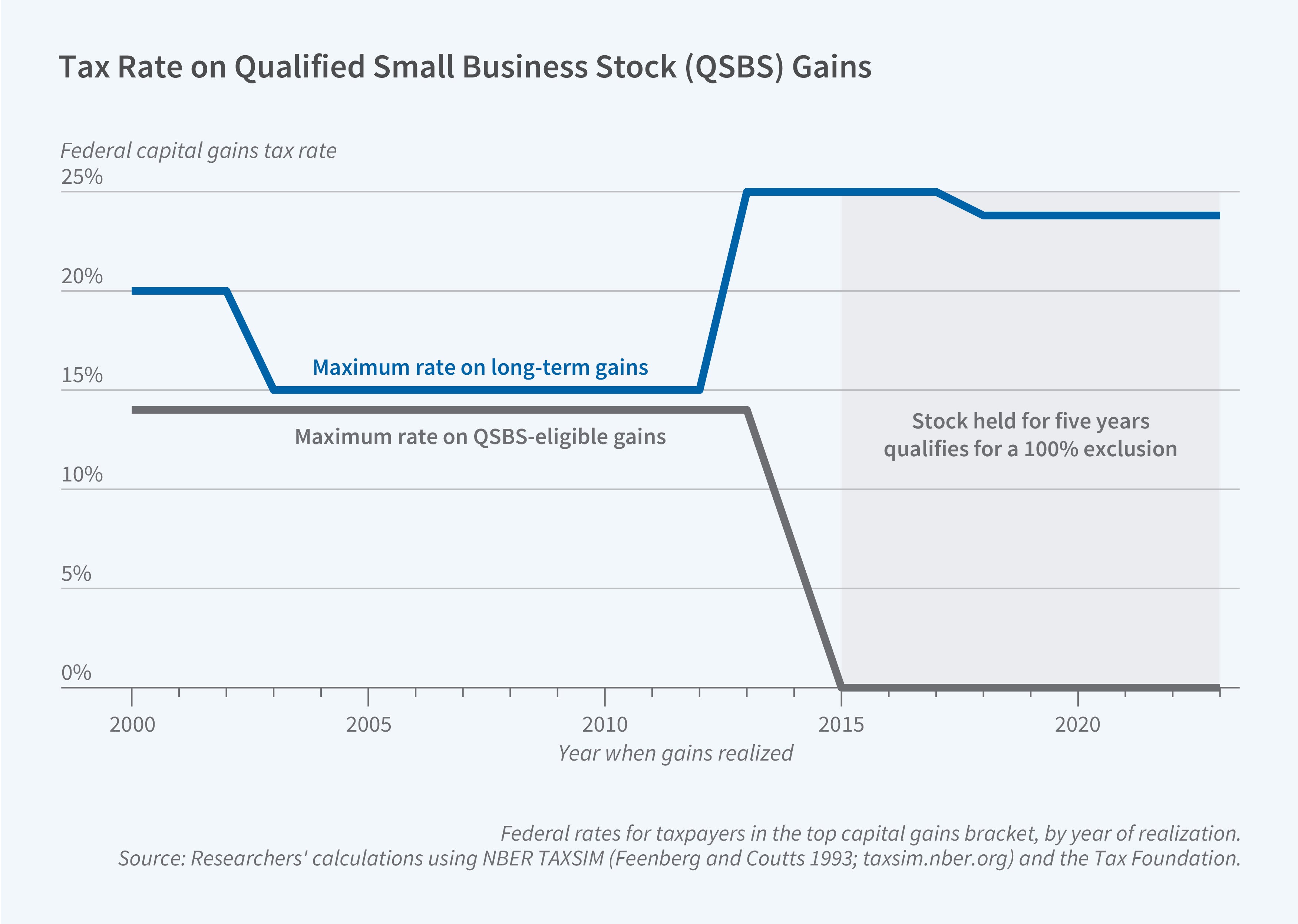
Many countries offer tax relief to investors in risky, young, innovative firms. Whether tax subsidies aimed at startup investing affect the level or direction of investment, or simply offer sophisticated investors a tax arbitrage opportunity that boosts returns without changing investment behavior, is a perennial question.
In Tax Incentives and Venture Capital Risk-Taking: Evidence from the QSBS Program (NBER Working Paper 35418), Murillo Campello and Guilherme Junqueira examine how investors respond to changes in the Qualified Small Business Stock (QSBS) program. This US tax incentive, offered by federal and state governments, reduces capital gains taxes on qualifying startup investments held for at least five years. The researchers focus in particular on venture capitalists (VCs), whose general partners receive incentive-based compensation tied to fund returns. They compare VC behavior to that of angel investors, who invest their own capital, and corporate investors, who face a different tax regime.
Capital gains tax relief leads venture capitalists, but not angel or corporate investors, to shift their portfolios toward riskier, more innovative startups.
The researchers study the American Recovery and Reinvestment Act of 2009 and the Small Business Jobs Act of 2010, which together moved QSBS from excluding a small share of capital gains from taxation to eliminating capital gains taxes entirely on qualifying investments. The study draws on investment-level data from PitchBook covering 39,000 investors and 35,000 portfolio companies. These data track 158,000 investor-firm relationships between 2004 and 2022, following each from initial investment through exit or failure.
VCs systematically shift toward riskier investments when QSBS tax benefits apply, while angel and corporate investors show no comparable change. In eligible sectors after 2009, VC investments become 81 percent more likely to target pre-commercial-stage startups, whose viability is highly uncertain. When QSBS applies, VCs are also nearly twice as likely to invest in startups carrying preexisting debt, and they are more likely to invest in startups located outside their home state or industries in which they have no prior track record. At the same time, VCs reduce their reliance on external risk-sharing mechanisms: They are 16 percent less likely to participate in large investment syndicates.
Tax-advantaged VC investments in eligible sectors experience a 71 percent higher rate of complete business failure relative to non-tax-advantaged VC investments. At the same time, tax-advantaged VC investments that do succeed generate substantially higher returns than non-QSBS investments. Portfolio companies that qualify for QSBS and reach an exit show more than double the valuations and are nearly four times as likely to achieve “unicorn” status (a valuation above $1 billion). None of these patterns—the increased risk-taking in project selection, elevated failure rates, and valuation gains—appear among angel investors, who face the same tax subsidies, or among corporate investors, who are subject to a different tax regime.
The researchers also find that a 1-percentage-point increase in the tax subsidy is associated with an approximately 2 percent increase in the share of investors exiting exactly at the five-year threshold, indicating that investors strategically time their exits to capture the tax benefit. Larger VC funds, which earn higher carried-interest fees, and funds backed by more sophisticated limited partners, such as elite university endowments, show stronger risk-taking responses to the tax subsidy.


