The Long-Term Effects of Tuition-Free Community College
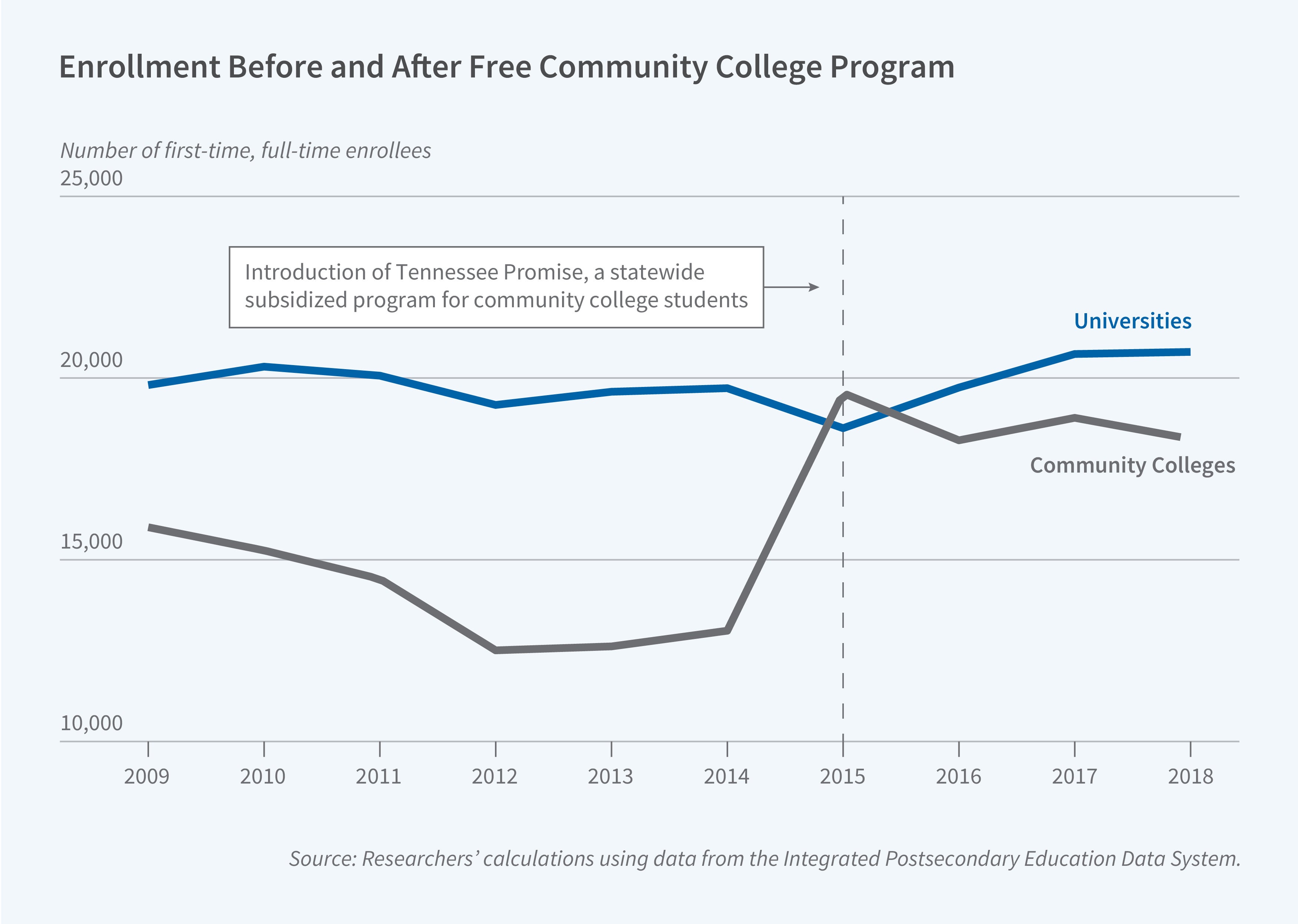
Over the past decade, “free college” programs have expanded rapidly across the United States, with more than 20 states adopting some form of tuition-free postsecondary aid. In A Promise Worth Keeping? Impacts of Free Community College on Degrees and Earnings (NBER Working Paper 35226), Paige Schoonover, Jonathon Attridge, Celeste K. Carruthers, and Jilleah G. Welch study Tennessee Promise, the first statewide tuition-free community college program in the US. Launched for the high school graduating class of 2015, Tennessee Promise covered any gap between a school’s tuition and mandatory fees and a student’s existing grant aid. The program grew from a single-county pilot in 2009 to full statewide eligibility by 2015. Its average cost was less than $1,000 per participant per year.
Tennessee Promise, a statewide tuition-free community college program, significantly increased college enrollment and associate degree attainment among eligible students.
The researchers draw on two complementary data sources. For institutional-level outcomes, they use 2000–2023 data from the Integrated Postsecondary Education Data System and exploit variation in Promise exposure across Tennessee institutions over time. They use colleges and universities in other states as a comparison group and Tennessee schools as the treatment group. For individual-level outcomes—enrollment, degree attainment, earnings, and household formation—they use 2000–2024 American Community Survey microdata.
The findings suggest that access to Tennessee Promise raised postsecondary enrollment among 18-to-19-year-old high school graduates by 5.4 percentage points, or almost 10 percent of their baseline rate, with somewhat larger effects for nonwhite students and those living outside metropolitan areas. At the institutional level, Promise exposure was associated with a statistically significant 15 percent increase in associate’s degrees conferred at two-year institutions and a 24 percent increase in transfer-out students, while two-year graduation rates fell by roughly 21 percent of the comparison mean, a finding consistent with the enrollment of more academically marginal students.
A concern with aid programs focused on two-year programs is that some students who would have attended four-year institutions will instead enroll in community colleges, ultimately reducing bachelor’s degree completion. The researchers find evidence consistent with initial diversion into two-year pathways, including an 8 percent increase in transfer students at four-year institutions. However, Promise-eligible individuals were approximately 2.7 percentage points more likely to hold a bachelor’s degree by age 24. Women drove this effect: Promise-eligible women were 4.1 percentage points more likely to hold at least a bachelor’s degree by ages 23–24.
Beyond education, the researchers find that Promise increased wage and salary income by about 7 percent over ages 21–24, though they urge caution given that only 5.4 percent of eligible cohorts showed measurable enrollment increases. The researchers do not find any evidence of an increase in labor force participation, but they do find delays in family formation: Eligible individuals were approximately 27 percent less likely to be married before age 21 and 17 percent less likely to have a child in the household by age 22.
The researchers acknowledge that an early phase of this project was supported by the Gates Foundation and the Tennessee Higher Education Commission.


