Cognitive Load and Treatment Decisions of Emergency Department Doctors
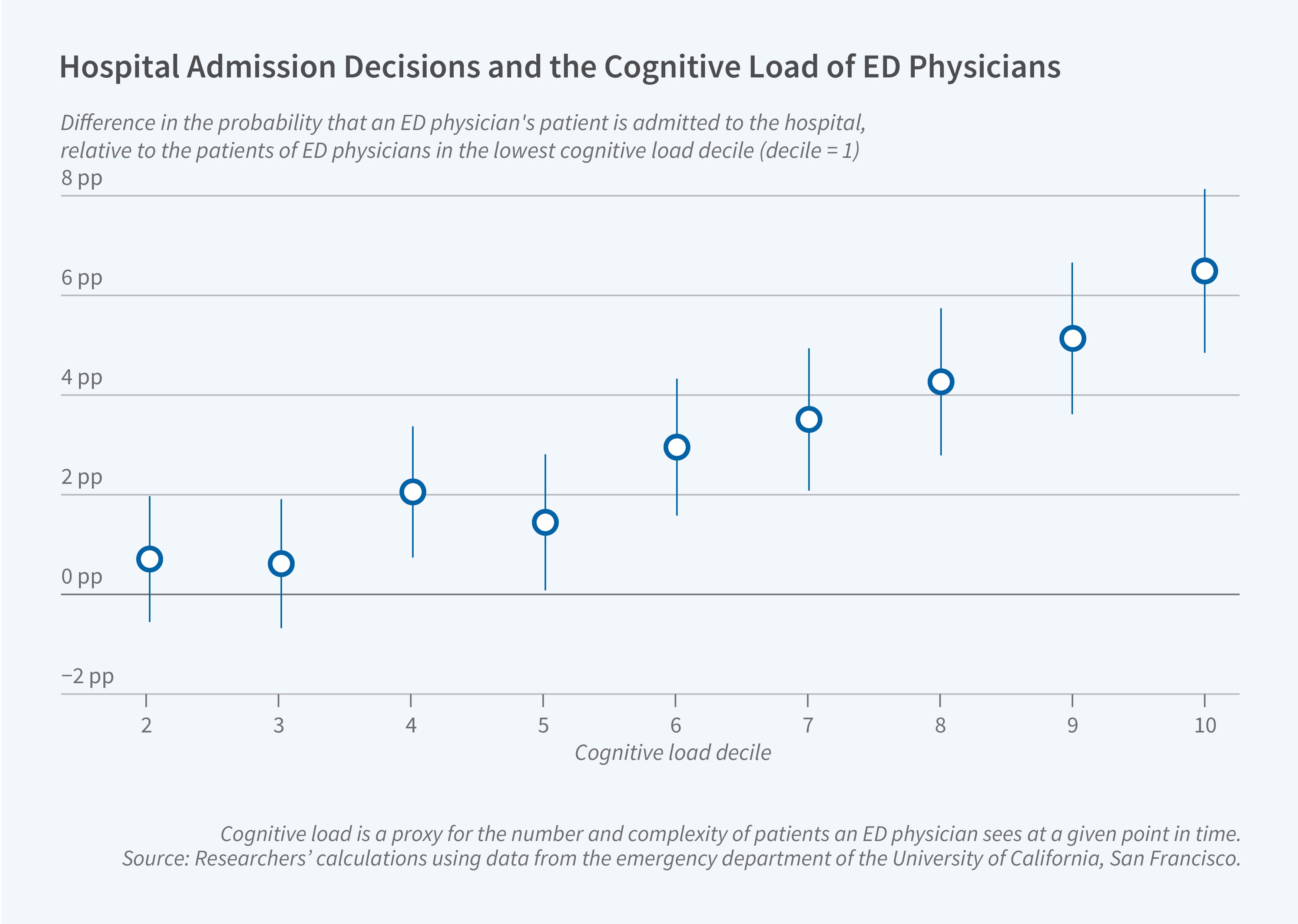
Cognitive load for physicians in the emergency department (ED) can vary substantially depending on the number of patients they are treating and the complexity of those patients. In Thinking Versus Doing: Cognitive Capacity, Decision Making and Medical Diagnosis (NBER Working Paper 35034), researchers Benjamin R. Handel, Louis-Jonas Heizlsperger, Jonas Knecht, Jonathan T. Kolstad, Ulrike Malmendier, and Filip Matějka study how differences in cognitive load affect a provider’s approach to diagnosing and treating patients.
Emergency department doctors order fewer diagnostic tests for, and are less likely to hospitalize, patients who arrive at less stressful times.
The researchers suggest that ED physicians use both diagnostic testing and mental effort—such as thinking or consulting with a colleague—to form and refine their beliefs about potential diagnoses. Mental effort and diagnostic testing are partial substitutes that respond differently to cognitive load. When cognitive load increases, mental effort becomes costlier, but diagnostic testing does not; providers may substitute toward diagnostic testing in this situation. In a similar vein, cognitively loaded physicians may order common tests that reflect more uncertainty about a diagnosis, rather than targeted tests that indicate more certainty. Because they face greater diagnostic uncertainty, cognitively loaded ED physicians who are risk averse may be more likely to admit their patients for inpatient care.
To test their hypotheses about physician behavior, the researchers analyze electronic medical records for 76,000 adults who visited the ED at the University of California, San Francisco, over a two-year period. The records include time-stamped documentation of each provider interaction with the medical records system, such as placing orders and editing notes. The researchers compare the diagnostic decision-making process for patients who arrived at the ED with the same initial characteristics—such as chief medical complaint and vital signs—but were treated by doctors with differing levels of cognitive load.
For each physician action for a given patient, the researchers construct a point-in-time measure of cognitive load based on the number and predicted complexity of other patients that the physician treated in the prior 90 minutes. Over 86 percent of the observed variation in cognitive load is attributable to the number of other patients, while 14 percent arises from the clinical complexity of those patients. The researchers argue that the arrival rate of patients in the ED and their assignment to physicians are plausibly random after controlling for observable factors such as day of the week and time of day. As a result, the cognitive load that a provider faces at any given moment is also plausibly random.
The empirical results are consistent with the researchers’ predictions about the substitution of diagnostic testing for mental effort. ED physicians experiencing 1 standard deviation higher cognitive load order 4 percent more diagnostic tests per order batch. The increase in testing is concentrated among physicians in the top quintile of cognitive load, who place 9 percent more diagnostic orders than those in the middle quintile.
The researchers also document a shift in the profile of orders toward standard diagnostic workups and away from testing that is precisely targeted to a specific diagnosis. Providers with 1 standard deviation greater cognitive load place 8 percent more orders from the set of very common diagnostic tests and 5 percent fewer orders from the less common set. Cognitive load is also associated with more orders for symptomatic treatment, such as pain relievers, and supportive care, such as intravenous fluids.
The researchers also find that ED physicians with 1 standard deviation greater cognitive load are 9 percent more likely to admit a given patient to the hospital. The patients whose admissions are attributable to physician cognitive load are healthier on average, with 50 percent fewer abnormal vital signs at intake. These findings suggest that reallocating ED patients to providers with lower cognitive load could reduce treatment costs through fewer diagnostic tests and hospitalizations.
The researchers acknowledge funding from the National Institute on Aging grant P01AG005842 to the National Bureau of Economic Research and from the European Research Council under the European Union’s Horizon 2020 research and innovation programme (grant No. 101002898).


