Entrepreneurship Training Can Help Founders Learn When to Quit
Entrepreneurship training is generally intended to improve founders’ chances of success. It may also create value by helping entrepreneurs recognize when a venture no longer warrants further investment of time and resources. If so, effective training could cause some startups to shut down sooner even as it improves outcomes for others.
In Learning to Quit? A Multi-Year, Multi-Site Field Experiment with Innovation-Driven Entrepreneurs (NBER Working Paper 34755), Esther Bailey, Daniel Fehder, Eric Floyd, Yael Hochberg, and Daniel J. Lee study this possibility through a randomized experiment involving 553 science- and technology-based startups. The researchers partnered with 12 startup incubators and coworking spaces in 10 US metropolitan areas. None of the participating startups had previously raised institutional funding. Within each site, founders were randomly assigned either to an intensive entrepreneurship course or to a control group. Both groups received a $1,000 participation payment. The researchers then followed participating startups via surveys and commercial data sources for up to three years.
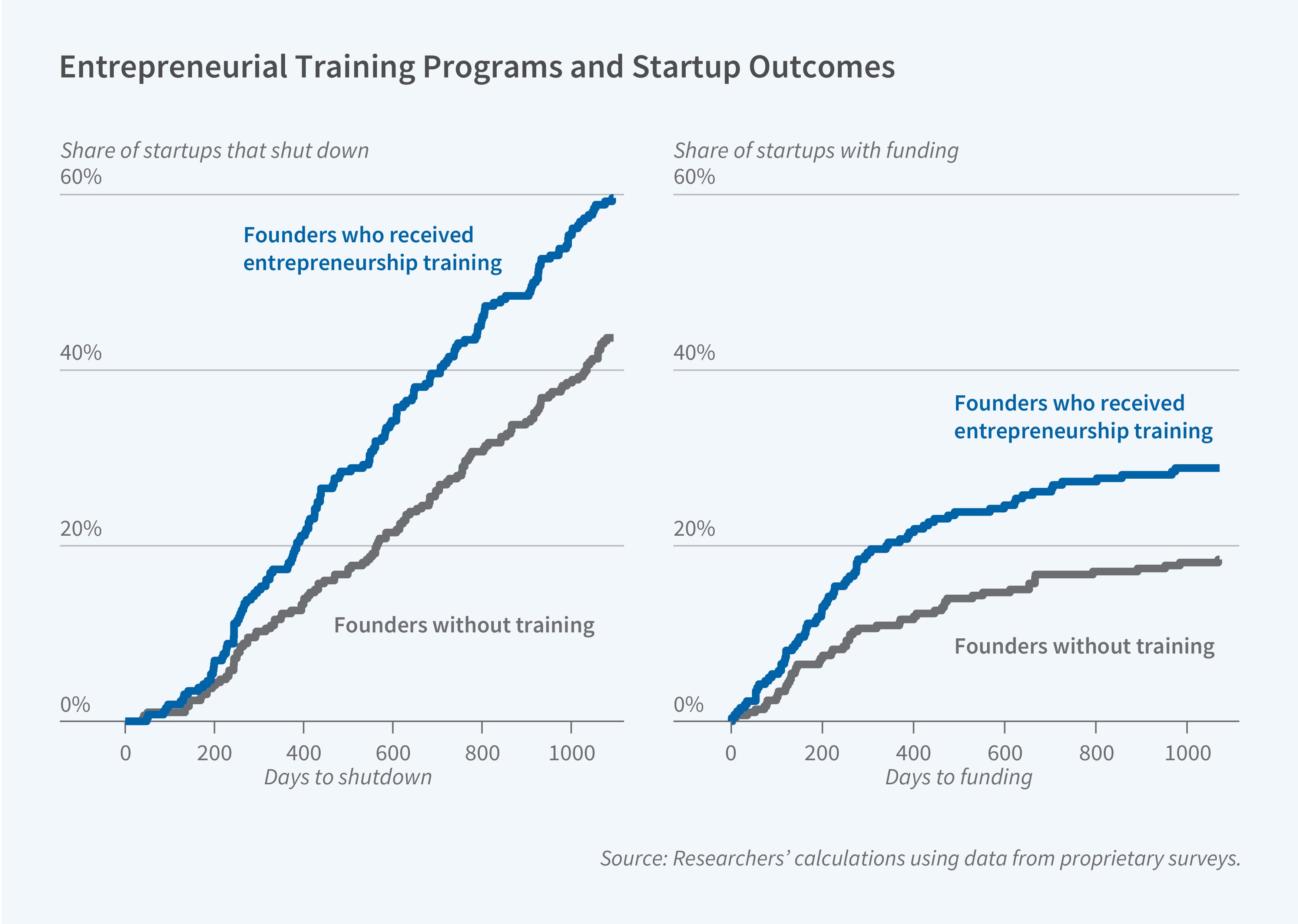
Founders offered intensive entrepreneurship training shut down their startups sooner, while treated startups that did not shut down were more successful on several interim performance measures. The joint pattern is consistent with training helping entrepreneurs decide which ventures warrant continued effort.
Startups assigned to the training program shut down sooner and at higher rates. Three years after enrollment, 41 percent of treated startups were still operating, compared with 56 percent of control startups. Treated startups closed about 99 days sooner on average. The higher shutdown rate was not driven by acquisitions or other positive exits.
While training may have helped founders identify ventures with poorer prospects, an alternative explanation is that it simply discouraged the entrepreneurs. Overall, however, the findings show that the higher shutdown rate was accompanied by a stronger pool of continuing firms on several measures of interim performance. By the end of the study, both unconditionally and accounting for shutdown as a competing risk, treated startups were more likely to have raised external funding. They obtained their first funding sooner and raised substantially more funding over the study period. Treated firms also reported higher employment and revenue while they remained in operation.
Training also changed how founders responded when their initial approach encountered difficulties. Conditional on remaining in operation, treated startups were less likely to pivot to a different customer segment, product, or business model in a given follow-up period. When startups shut down, treated founders were 8.5 to 9.5 percentage points less likely to immediately start another company. These patterns are consistent with training raising the threshold founders apply both to continued investment in their current venture and to reentering entrepreneurship.
Taken together, the results are consistent with training improving selection by helping entrepreneurs learn when quitting is the more productive choice.