Probable Dementia and Health Insurance Choices
Nearly one in ten older Americans lives with dementia, a condition that gradually erodes memory and the cognitive skills needed for complex decision-making. Even though Medicare coverage is nearly universal among this age group, traditional Medicare alone leaves significant gaps as it does not cover dental, vision, or hearing care, and it carries substantial cost-sharing. To fill these gaps, beneficiaries must actively choose among several insurance options—enrolling in Medicare Advantage, adding private supplemental insurance to traditional Medicare, or, for those with sufficiently low income and assets, applying for Medicaid. Beneficiaries may make changes during open enrollment each year and must re-enroll in private supplemental coverage or Medicare Advantage if their plan is no longer offered or they fail to pay premiums. Those who are eligible for Medicaid must recertify each year.
This annual decision-making process, which may involve interacting with multiple agencies, may be especially difficult for individuals whose cognitive abilities are declining. This may leave them with incomplete insurance protection at a time when they need it most. In Supplemental Medicare Insurance Coverage for Older Adults with Probable Dementia (NBER Working Paper 35606), Melissa McInerney, Lorena Moreno, and Jennifer M. Mellor examine whether previously documented gaps in supplemental insurance coverage among those with cognitive impairment actually begin to emerge before individuals meet the criteria for probable dementia.
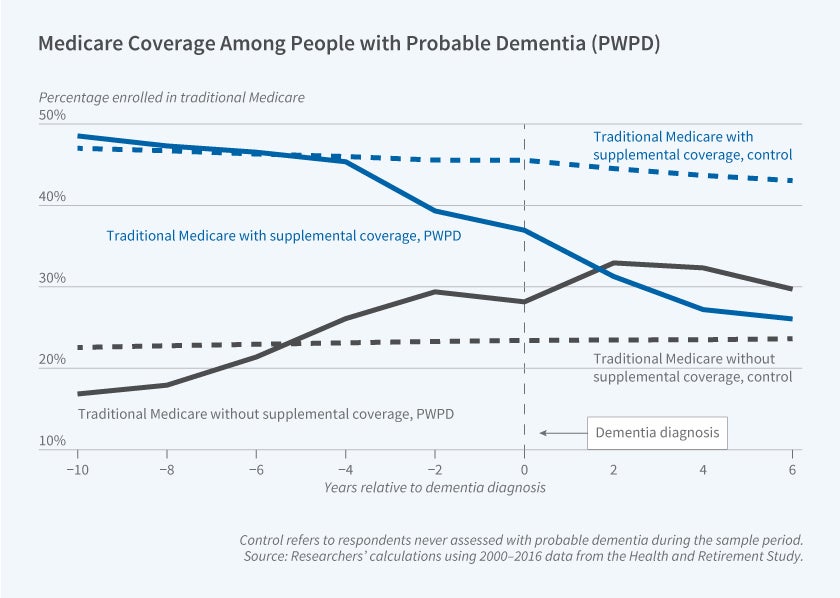
Individuals who develop probable dementia are more likely to have Medicare coverage with no supplemental insurance beginning four years before they first meet the criteria for probable dementia.
The researchers use the 2000–2016 Health and Retirement Study, a nationally representative longitudinal survey of Americans age 50 and older. Probable dementia is identified using the Langa-Weir algorithm, a standard method that scores cognitive function based on tests of memory and other skills. The study sample includes 3,001 Medicare-enrolled adults age 65 and older who eventually meet criteria for probable dementia and 14,055 people who never do. For each respondent with probable dementia, the researchers identify the wave in which they first meet the algorithm's criteria for probable dementia, referred_to_hereafter as onset, and track insurance outcomes from ten years before onset to six years after.
Comparison groups are constructed separately for each time period using propensity score weighting, which adjusts for differences in age, sex, education, and marital status so that people with and without probable dementia are compared to similarly situated peers. Beginning four years before onset, those later classified as having probable dementia are 3 percentage points more likely than matched peers to have no supplemental Medicare coverage. This gap is even larger after onset, peaking at 9.5 percentage points two years later.
This gap in "bare" Medicare coverage reflects the net effect of lower enrollment in Medicare Advantage and traditional Medicare with private supplemental coverage, partly offset by higher Medicaid enrollment.
Individuals who develop probable dementia also become significantly more likely to have income at or below the federal poverty level—a standard proxy for Medicaid eligibility. This gap emerges six years prior to onset and continues to widen. However, among those who meet this income-based eligibility threshold, the rate of Medicaid enrollment does not differ significantly between the two groups in the years before or immediately after onset.
The researchers acknowledge support from the Tufts University Faculty Research Awards Committee.