Inflation and Nominal Wage Adjustment
When US consumer prices rose sharply between mid-2021 and late 2023, consumer sentiment fell to levels not seen since the 2008 financial crisis, even though unemployment remained low. Surveys found that a majority of Americans identified inflation as a major financial problem. Even well after price growth abated, in 2025, roughly 60 percent of Americans still reported that inflation was a pressing issue.
In Sticky Wage Norms and the Real Wage Cost of Unexpected Inflation (NBER Working Paper 35624), Erik Hurst, Christina Patterson, Nela Thomas Richardson, and Ye Liv Wang use administrative payroll records from ADP, covering roughly 16 million US workers at firms with 50 or more employees, to study wage adjustment over the 2016–2025 period. The dataset allows the researchers to observe base-wage changes for nearly every worker within a firm each month, distinguishing annual “on-cycle” raises from other “off-cycle” adjustments, and to separately track workers who remain with the same employer and those who change jobs.
Real wages fell and stayed depressed for more than one-third of workers after the 2021–2023 inflation surge.
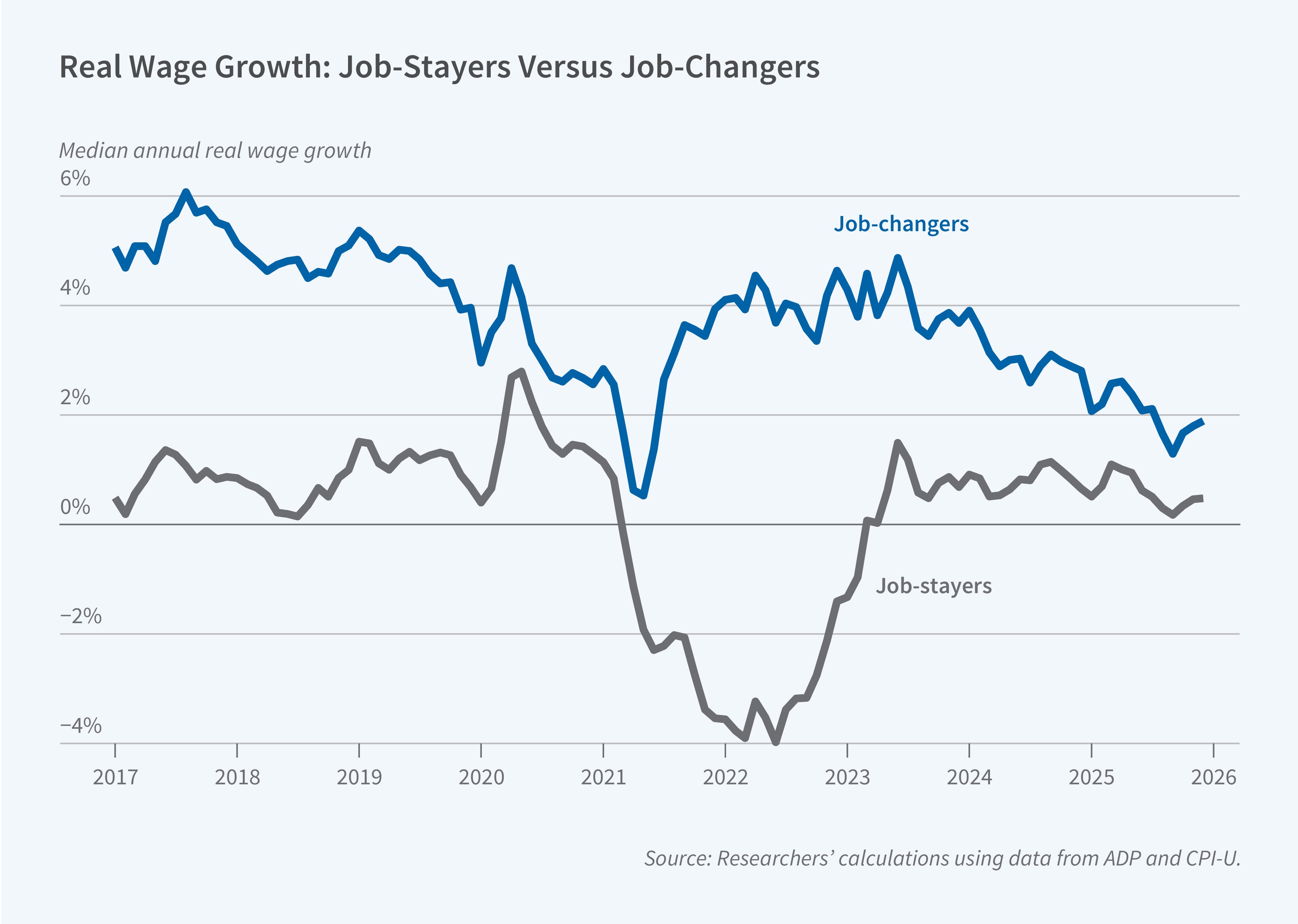
Most firms apply a single nominal wage increase to the majority of their continuing workers. The researchers find that this norm shifted only modestly even when annual inflation rose above 7 percent. Before the pandemic, 89 percent of workers were at firms with a wage norm between 2 and 4 percent; during the 2021–2023 inflation period, that share fell, but only to 76 percent. Some firms shifted toward the 4–5 percent range. Although job-stayers’ median nominal wage growth rose from about 3 percent to nearly 5 percent, this was below the rate needed to keep pace with price increases.
Among workers continuously employed at the same firm from December 2020 through December 2024, 43 percent experienced a real wage decline; within this group, the average loss was about 9 percent. Even after accounting for job-changers, whose nominal wages rose nearly one-for-one with inflation, 37 percent of all workers still saw cumulative real wage declines.
The researchers estimate that if firms had adjusted their modal raises one-for-one with inflation, this would have closed about 40 percent of the real wage shortfall relative to the pre-pandemic wage growth trend. Real wage losses were larger for older workers as 55 percent of workers aged 50 and older experienced a cumulative real wage decline. Older workers are less likely to switch jobs or to receive large off-cycle raises.