Chinese and US Innovation
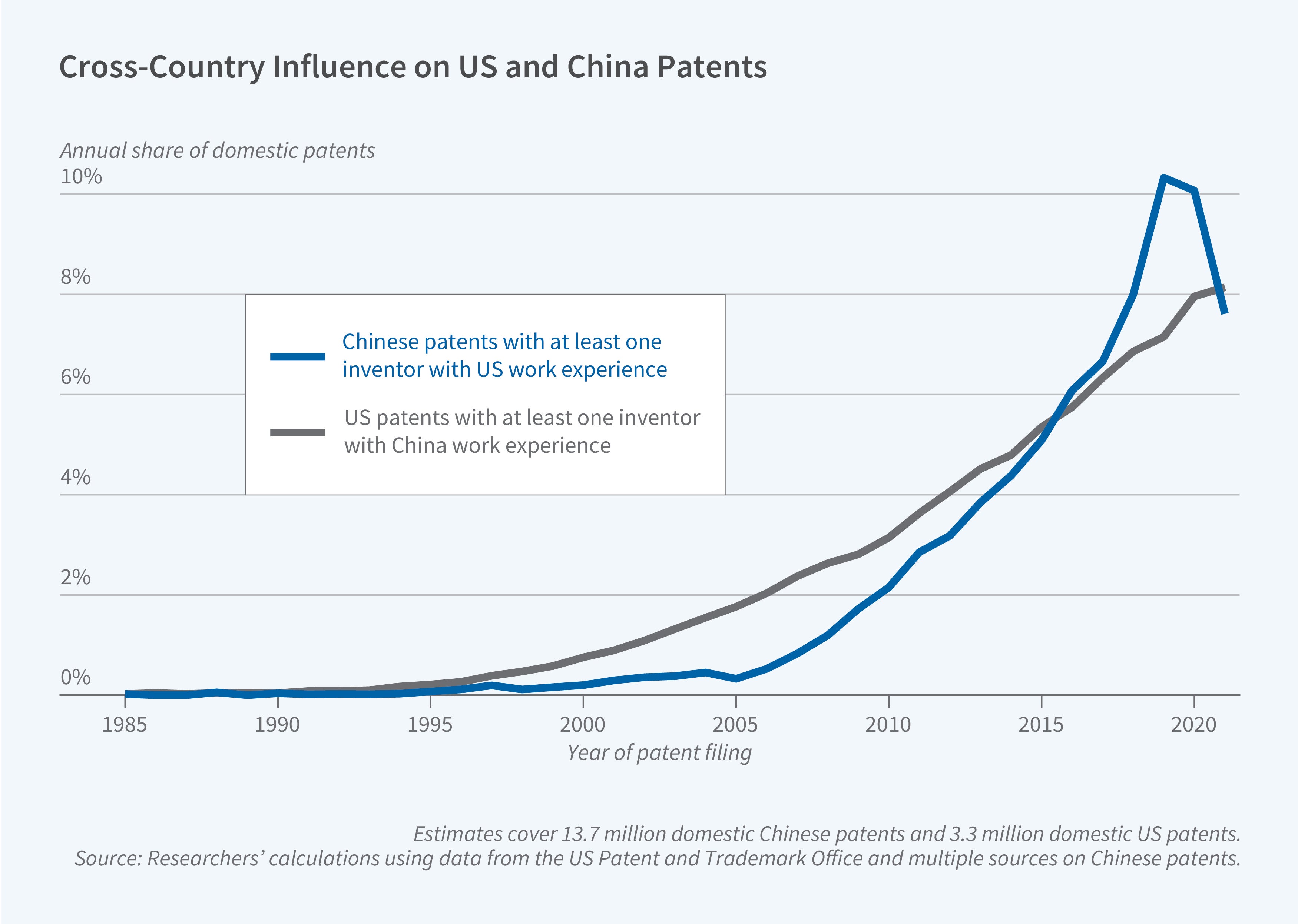
Some observers argue that technological episodes like DeepSeek’s 2025 release of a low-cost, high-performing AI model provide evidence of China’s rapid technological advance. Others claim that headline statistics, such as China’s patent filings outnumbering those in the US by a factor of three, overstate that nation’s real innovative progress. The latter group argues that incentive schemes have led to many incremental patent filings in China, and that progress there is largely a consequence of a reliance on foreign-trained talent and the appropriation of intellectual property from elsewhere, rather than domestic invention. In Chinese Sputnik Moments? (NBER Working Paper 35551), Josh Lerner, Namrata Narain, Dimitris Papanikolaou, Amit Seru, and Zunda Winston Xu explore which narrative better fits the data.
Innovation in China is less concentrated among large firms and more reliant on universities than innovation in the US.
The researchers study nearly 14 million domestic Chinese patent publications, combining records from the China National Intellectual Property Administration (CNIPA), the European Patent Office’s PATSTAT database, and Google Patents. They focus on 14 “critical technology areas” designated by the US Department of Defense, including advanced materials, biotechnology, quantum sciences, and trusted AI and autonomy. The researchers benchmark Chinese patenting against a comparable set of US patents. They report five main findings.
First, the ratio of Chinese patent applications to STEM tertiary graduates is comparable to that in the United States (0.67 versus 0.64), and lower than in Japan or South Korea. Annual patent counts by technology and year also correlate with independently measured high-impact scientific publications, with a stronger relationship in China than in the United States. These facts suggest Chinese patent counts contain meaningful information about underlying innovative activity.
Second, the share of the top 10 Chinese patent assignees in critical technologies fell from roughly 10 percent in the late 1990s to about 4 percent in 2022, compared with a stable US share of nearly 20 percent. Innovation is actually less concentrated in large firms in China.
Third, private firms account for about 58 percent of cumulative Chinese critical-technology patents, while universities account for 27 percent. State-owned enterprises and government entities combined account for less than 6 percent. The university share is more than six times the comparable US university share of 4 percent. The role of Chinese universities in critical fields exceeds that in all domestic patenting, where the share is 18 percent.
Fourth, when the researchers examine the role of US-trained returnees, using LinkedIn-based professional profiles matched to inventors, they find that fewer than 10 percent of Chinese critical-technology patents involve an inventor with US work experience, a share that peaked near 2019 and has since declined. Those with US education remain below 5 percent throughout the sample. By contrast, more than 20 percent of US patents involve an inventor with non-US Western work experience—more than twice the corresponding Chinese peak—indicating the US patent system relies more heavily on foreign-trained inventors than does the Chinese system.
Finally, the researchers assess whether rapid growth in Chinese patenting came at the cost of patent quality. Using four text-based measures of patent quality, they find that the share of Chinese patents with at least one commercially salient word pair (bigram) rose from under 2 percent in the early 1990s to 16 percent in 2022, compared to a US rise from about 4 percent to 20 percent. Chinese patents gained textual importance relative to US patents across several major critical technologies between 2006 and 2021, with no evidence of quality decline accompanying the growth in volume.
The researchers acknowledge support from the Harvard Business School Division of Research, the Hoover Institution, the Private Capital Research Institute, the Smith Richardson Foundation (Award no. 2024-3365), the Stanford Graduate School of Business, the Toulouse Network for Information Technology, and the US National Science Foundation (Award no. 2241237).


