Artificial Intelligence and Hedge Fund Investing
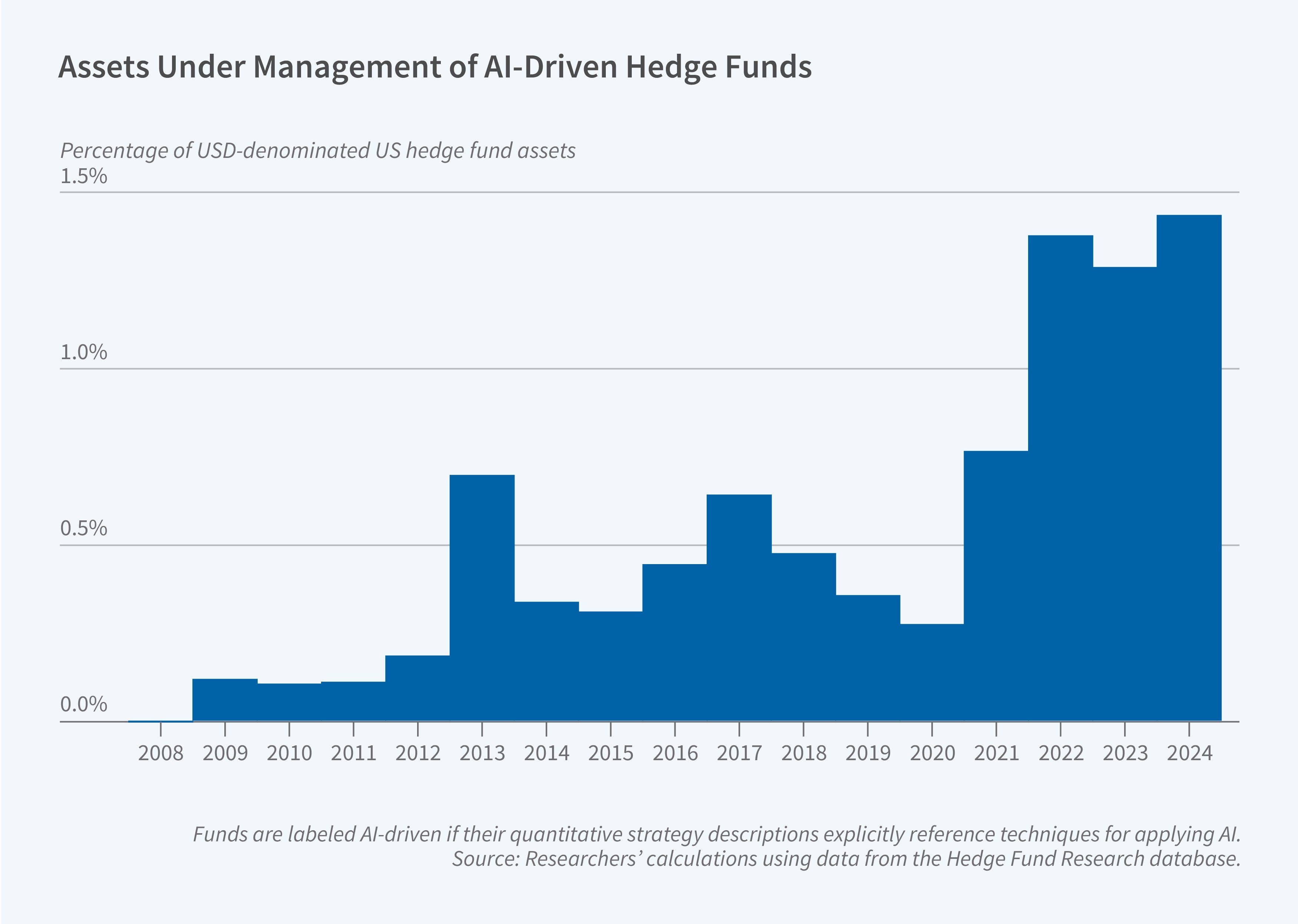
Asset managers are constantly searching for new ways to generate excess returns, since the value created by most existing strategies fades with time and scale. Artificial intelligence (AI) has emerged as one new approach, with managers increasingly applying machine learning and related techniques to predict price movements and generate trading signals. In The Growth and Performance of Artificial Intelligence in Asset Management (NBER Working Paper 35273), Shuang Chen, Clemens Sialm, and David X. Xu construct a large-scale dataset combining investment advisers’ regulatory disclosures, job postings, and fund strategy descriptions to identify funds that use AI in investment decisions, as opposed to research support or operational efficiency.
The researchers analyze over 116,000 investment adviser disclosures filed with the SEC between 2012 and 2024, using a large language model to classify each filing into categories ranging from “AI-Autonomous,” where AI directly drives investment decisions, to “AI Risk Disclosure,” where AI is mentioned only in risk disclaimers. They also link advisers’ regulatory filings to Lightcast job posting data to measure AI-related hiring intensity, and examine fund-level performance using year-by-year historical information from the Hedge Fund Research database spanning 2005 through 2024. They apply similar AI classifications to fund strategy descriptions for 7,896 US hedge funds. Funds are classified as “AI-driven” only if their strategy descriptions explicitly reference techniques for applying AI technologies to predictive modeling and trading signal generation.
AI-driven hedge funds outperformed non-AI funds by approximately 50 basis points per month before 2017, but this outperformance was statistically indistinguishable from zero in later years. The findings are consistent with an annual decline of about 6 basis points in the monthly return advantage of AI-driven funds. Funds that adopted AI early did not retain a lasting advantage: Their outperformance also faded after 2017, suggesting that the decline reflects a trend among all AI funds rather than differences between early and late AI adopters.
The researchers compare AI-driven funds to non-AI “sibling” funds managed by the same adviser, a research design that controls for firm-level characteristics, and find that AI funds outperformed their siblings by approximately 35 basis points per month. This suggests that the documented outperformance is attributable to AI-driven strategies themselves rather than unobserved differences across advisory firms.
Contrary to concerns that AI adoption might increase herding and homogenize investment strategies across funds, AI-driven funds exhibit lower return comovement than non-AI funds within the same strategy category. The average pairwise correlation among AI-driven funds was 0.021, compared with 0.124 among non-AI funds. This suggests that AI-driven funds pursue diverse trading approaches rather than crowd into similar signals.
AI-driven investing is heavily concentrated in hedge funds pursuing diversified macro strategies trading liquid instruments. AI funds represented about 2.7 percent of sample hedge funds in 2023 and held about $12 billion in assets under management in 2024. The researchers find no evidence that investors directed additional capital to funds based on AI disclosures alone, absent demonstrated returns.


