Accounting for the Rise and Fall of Disability Insurance Enrollment
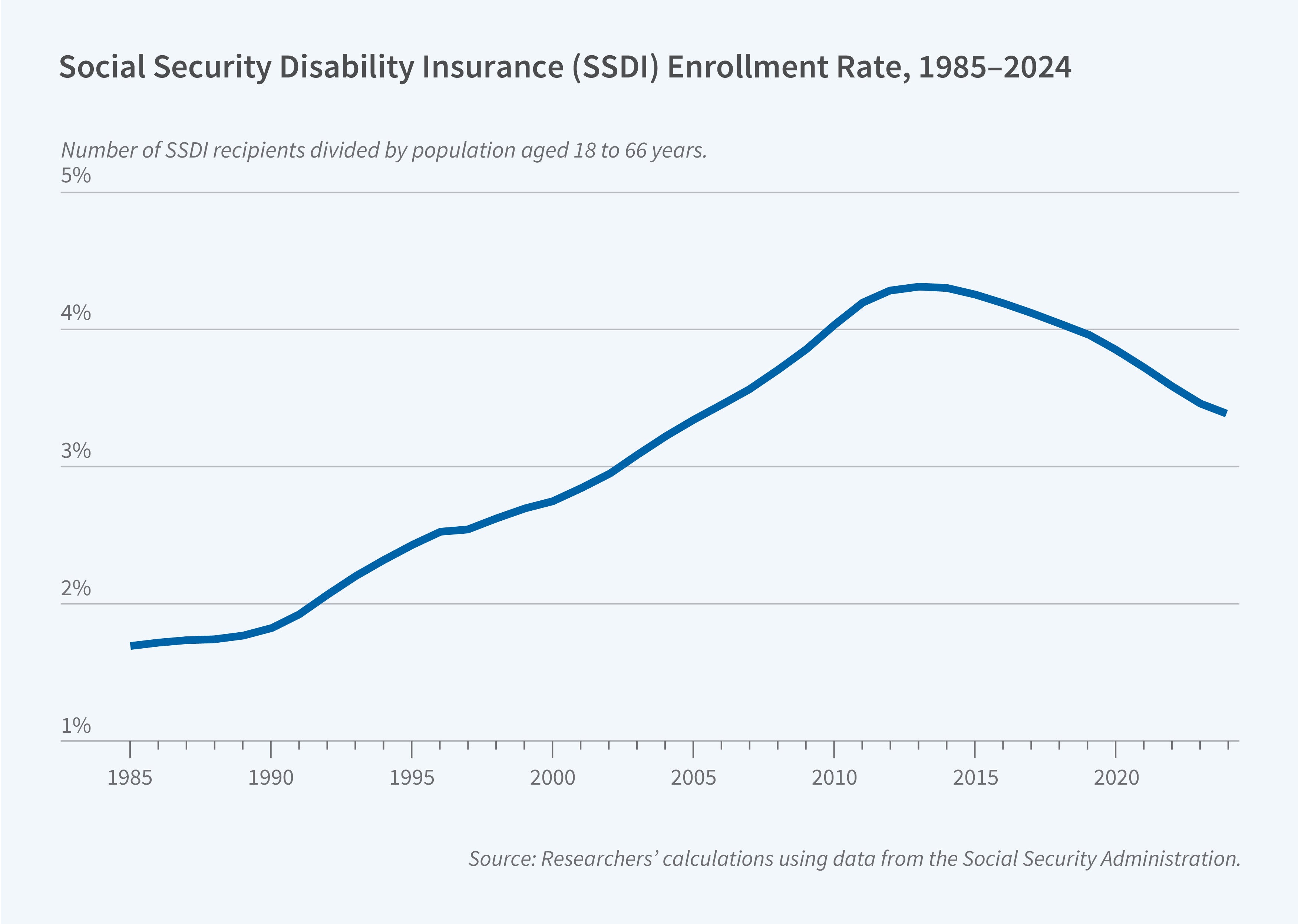
Enrollment in the Social Security Disability Insurance (SSDI) program rose sharply during the 1990s and 2000s, raising concerns among policymakers about program costs and whether benefits discouraged work. Since 2013, however, SSDI enrollment has been falling. Multiple explanations have been proposed for this decline, including the 2008 retraining of administrative law judges, population aging, improved economic conditions, and increased availability of substitute benefit programs.
Explaining the Historical Rise and Recent Decline in Social Security Disability Insurance Enrollment (NBER Working Paper 35300), by Manasi Deshpande, Maxwell Kellogg, Magne Mogstad, and Kuan-Ju Tseng, uses individual-level administrative data from the Social Security Administration to identify the sources of both the increase and decrease in SSDI enrollment. The researchers draw on the Continuous Work History Sample, a 10 percent sample of Social Security records, linked to earnings histories, disability applications, award decisions, and exit records from 1970 through 2022. They track individuals from application through award or denial and observe financial eligibility, demographic characteristics, and exit pathways (death, retirement, recovery) at the individual level. These details are unavailable in aggregated public statistics.
Rising Social Security Disability Insurance enrollment in the 1990s and 2000s was driven mainly by increasing entry rates among low-skilled women, while falling enrollment since 2013 is mainly due to declining application rates among low- to middle-skilled men.
The researchers decompose changes in SSDI enrollment into two components: one due to shifts in population composition, such as age, sex, or earnings, and another due to changes in behavior within demographic groups, including changes in eligibility, application, award, and exit rates. They find that about 55 percent of the increase in enrollment in the 1990s and 2000s was due to higher entry rates, with another 25 percent due to lower exit rates. Population composition changes explain a smaller share, around 20 percent. The increase in entry during this period was driven disproportionately by low-skilled women. The researchers also find that virtually all of the decline in enrollment between 2010 and 2019 is attributable to declining entry rates within demographic groups, rather than to changes in population composition or exit rates. Lower application rates account for between 57 and 69 percent of the overall decrease, while lower award rates account for between 19 and 31 percent. Eligibility changes contribute very little.
The decline in applications is driven disproportionately by men, particularly younger men; older women show no decline. The decline in award rates, by contrast, is concentrated among younger women, a pattern attributed to administrative law judge retraining that reduced award rates more for less-verifiable conditions such as mental health diagnoses.
The researchers find that the decline in applications since 2010 came disproportionately from applicants with moderate-to-severe conditions who were recently attached to the labor force, rather than from those with less-severe disabilities. Among low- to middle-skilled men, earnings rose substantially between 2010 and 2019. Improved employment opportunities for less-skilled men can explain 57 percent of the overall decline in SSDI applications and nearly all of the decline among men specifically.
Relatively little of the decline in applications can be attributed to lower award rates at the appeals level, rising administrative burdens as a result of field office closings, population health improvements, the opioid crisis, expanded access to other benefit programs including Medicaid, or population aging. Population aging actually had a positive effect on applications, since the working-age population shifted toward ages historically associated with higher SSDI receipt.
The researchers acknowledge funding from the Ronzetti Initiative for the Study of Labor Markets and the National Science Foundation (CAREER Grant 1941538).


