Crowd-Out of Employer-Provided Health Insurance by the Affordable Care Act
The Affordable Care Act (ACA) reshaped how Americans obtain health insurance by expanding Medicaid eligibility and creating Marketplace exchanges for subsidized private plans. In How Efficient Was the Affordable Care Act at Reducing Uninsured Rates? (NBER Working Paper 35263), Anuj Gangopadhyaya and Robert Kaestner exploit variation in the timing of ACA implementation and Medicaid expansion across states to assess the impact of access to publicly supported coverage on the fraction of the population that is uninsured and that has employer-sponsored insurance (ESI). The researchers use data from the 2008–2024 American Community Survey, restricting their sample to adults ages 19–64. They focus on four possible insurance coverage categories: uninsured, ESI, Medicaid participants, and individuals purchasing insurance through Marketplace exchanges. They also group individuals into four income categories.
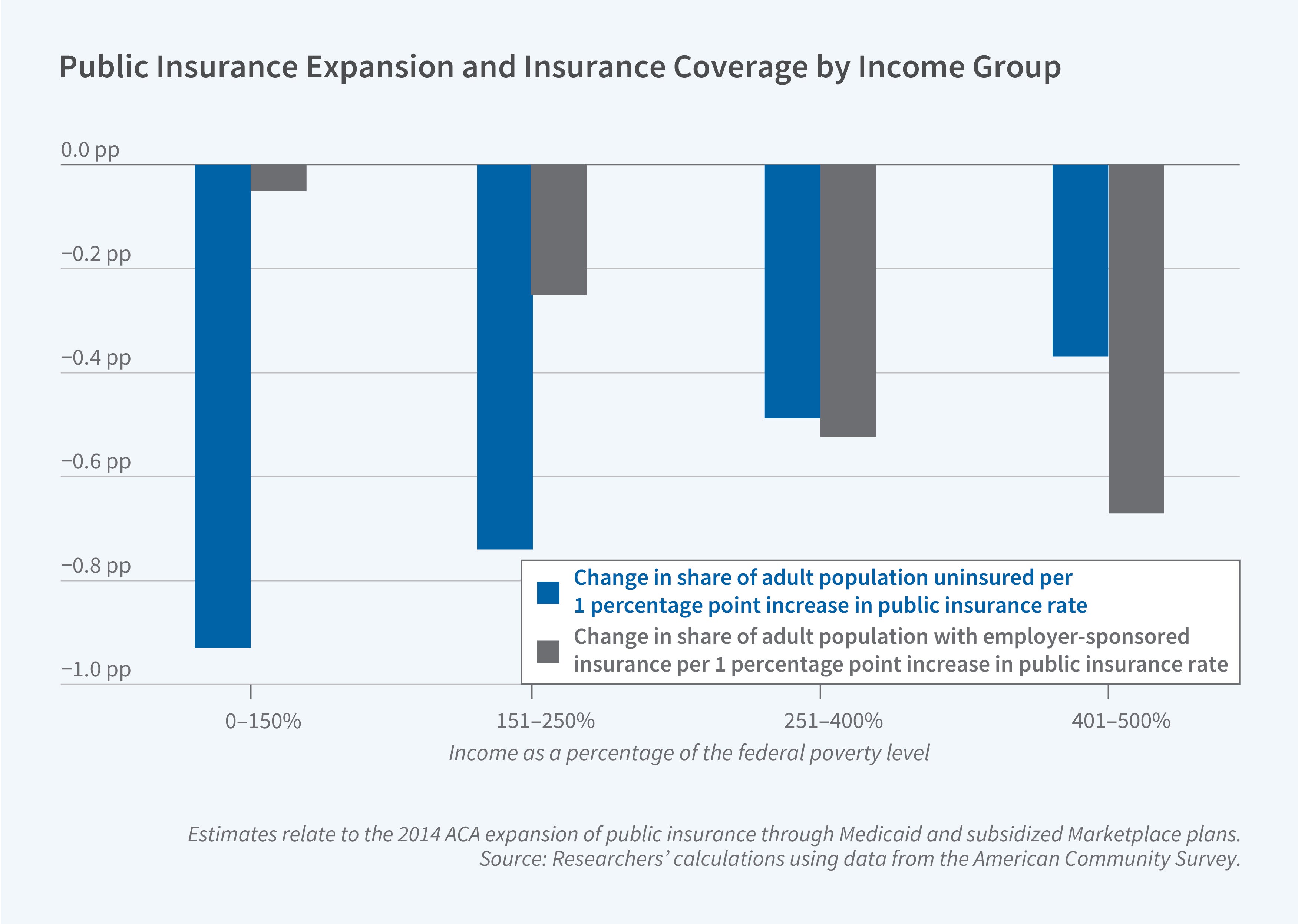
For adults with incomes at or below 150 percent of the federal poverty line (FPL), a 1-percentage-point increase in public coverage, namely Medicaid coverage or insurance purchased through a Marketplace, leads to a 0.93-percentage-point decline in the uninsured rate, with little corresponding decline in ESI. For this income group, nearly all gains in public coverage come from individuals who were previously uninsured.
At higher incomes, however, a larger fraction of those who took up public coverage under the ACA previously had ESI. For those with incomes between 151 and 250 percent of the FPL, a 1-percentage-point increase in public coverage was associated with a 0.7-percentage-point decline in the uninsured rate and a 0.3-percentage-point decline in ESI. For the 251–400 percent of FPL group, the figures were roughly a 0.5-percentage-point reduction in the share without insurance and a 0.5-percentage-point drop in ESI. For the highest income group, those with incomes between 401 and 500 percent of the FPL, the decline in the share without insurance was about 0.3 percentage points and the decline in ESI was about 0.6 percentage points. For higher-income groups, there was more “crowd-out”: A larger share of new public coverage substituted for existing employer coverage.
Crowd-out effects were largest among subgroups with higher pre-ACA ESI rates. For parents with incomes between 250 and 500 percent of the FPL, for example, roughly three people took up publicly supported coverage for every one newly insured person. Crowd-out effects were also more pronounced among married adults relative to single persons, and were larger for older adults (ages 45–64) than their younger counterparts. The researchers emphasize that for measuring crowd-out, it is important to consider all adults who receive ACA-related insurance, not just those who were newly eligible for Medicaid.


