Gender Disparities in College Enrollment and Marriage Patterns
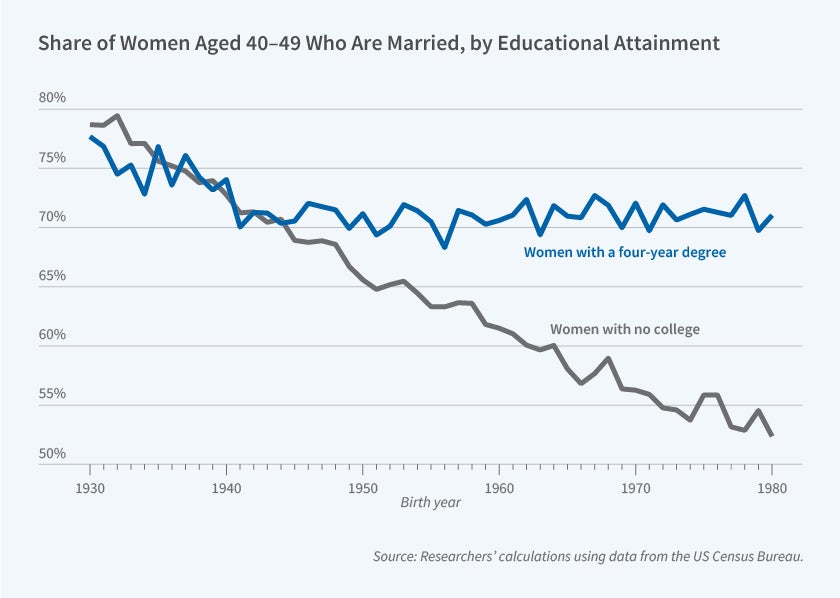
Over the past half-century, the gender composition of American college campuses has shifted from predominantly male to predominantly female. Today, 1.6 million more women than men attend four-year colleges in the US. Over the same time period, the economic status of men without college degrees has deteriorated.
In Bachelors Without Bachelor’s: Gender Gaps in Education and Declining Marriage Rates (NBER Working Paper 35179), Clara Chambers, Benjamin Goldman, and Joseph Winkelmann investigate how these shifts in educational attainment and men’s economic outcomes have altered marriage patterns for college and non-college women. They combine cohort-level data from the Current Population Survey and the American Community Survey with linked census and tax records from the Opportunity Atlas for individuals born between 1930 and 1980.
College-educated women have maintained stable marriage rates by partnering with high-earning non-college men, shrinking the pool of economically viable partners available to non-college women.
College-educated women have largely insulated their marriage rates from the declining relative supply of college-educated men by increasingly partnering with high-earning non-college men. Despite the ratio of college men to college women falling from 1.8 to 0.8 between the 1930 and 1980 birth cohorts, marriage rates among college women declined only modestly, from 77.7 to 71.0 percent. Over the same period, marriage rates among non-college women fell from 78.7 to 52.4 percent.
The researchers estimate that if marriage patterns of college women with regard to college and non-college men had remained stable at their 1930 levels, given the evolution of the pools of college-educated men and women, marriage rates for college women would have declined by 16.7 percentage points. As a result of the shrinking supply of college men and the growing number of college women, more college women would have remained single.
The actual decline in the marriage rate for college women was only 6.7 percentage points. An estimated gap of 10.0 percentage points was offset by a greater-than-predicted rise in marriages between college women and non-college men. The share of Americans in a marriage between college-educated women and non-college men quadrupled from 2.3 percent in the 1930 cohort to 9.6 percent in the 1980 cohort. These marriages typically involve economically successful non-college men. The average annual wage and salary earnings at age 45, measured in 2024 dollars and adjusted for inflation, for non-college men who marry college women rose from $61,400 for the 1930 cohort to $68,400 for the 1980 cohort, while earnings for all other non-college men fell from $56,400 to $46,100 over the same period. As a result, the share of non-college men who both earn above the median and are not married to a college woman fell from 72.9 to 35.3 percent, reducing the pool of economically viable partners available to non-college women.
In areas where non-college men have stronger employment outcomes, the marriage rate gap between college and non-college women is narrower. A 1 standard deviation decline (7.6 percentage points) in the employment-to-population ratio for non-college men is associated with a 4.2 percentage point decline in marriage rates for non-college women, compared to only 2.4 percentage points for college women. In the lowest-employment areas, non-college women’s marriage rates average just 44.5 percent, versus 66.0 percent in the highest-employment areas.
The findings suggest that the educational and economic challenges facing non-college men have been a primary driver of widening class gaps in family formation. The researchers project that Americans born in the mid-1990s are on track to become the first cohort in which fewer than half of non-college women are married at age 45.
The researchers acknowledge support from the American Institute for Boys and Men and Cornell University.


