Employment and Cognitive Decline
Many workers leave the labor force well before the traditional retirement age of 65.
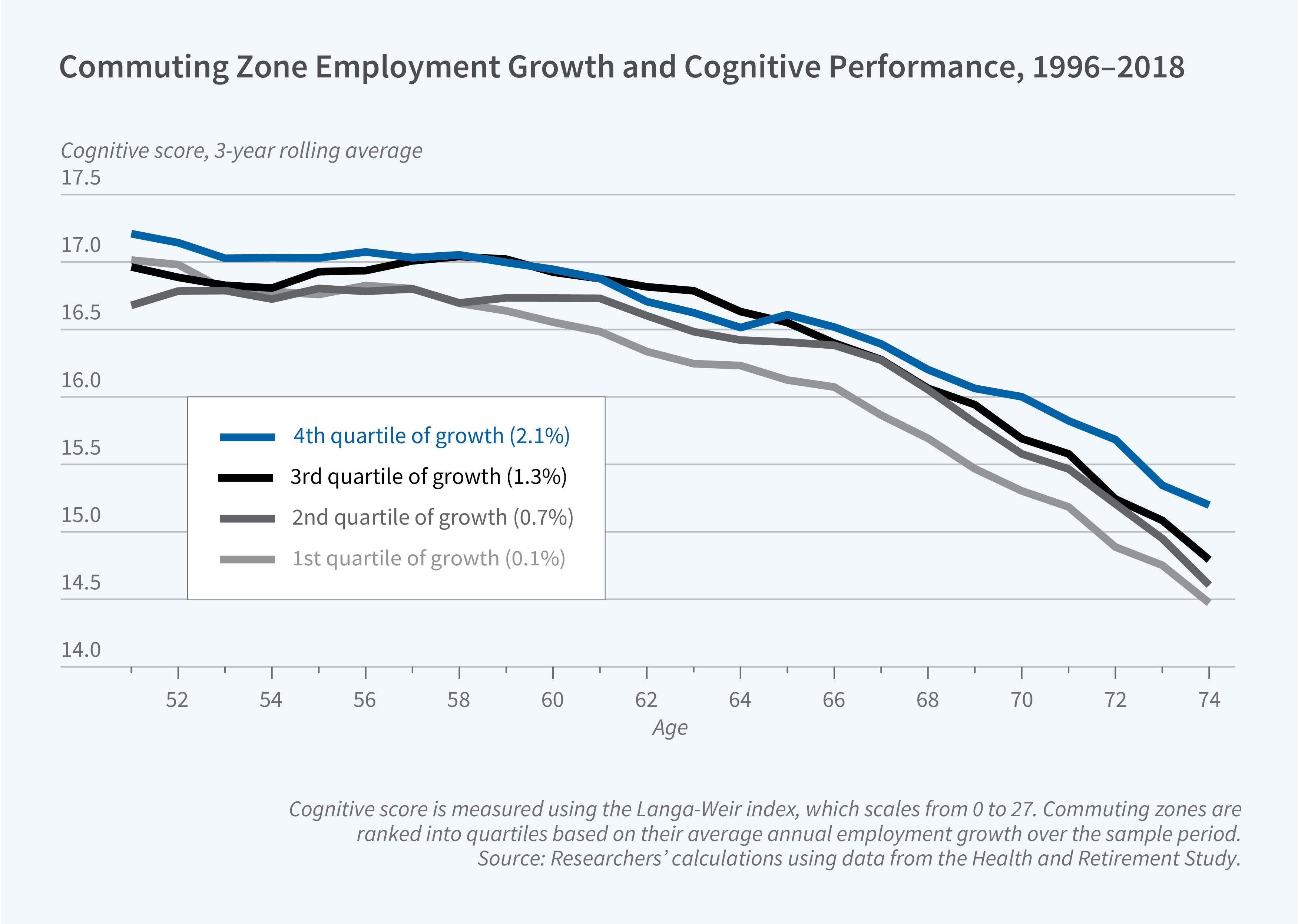
In Does Employment Slow Cognitive Decline? Evidence from Labor Market Shocks (NBER Working Paper 35117), Noah Arman Kouchekinia, David Neumark, and Tim A. Bruckner investigate whether early retirement is associated with an increased risk of cognitive decline. They use data from the Health and Retirement Study, a long-running biennial survey of older Americans, for the period 1996 to 2018. The researchers focus on a four-item measure of memory, mental processing, and working memory known as the global cognitive score, tracking how it changes for the same individuals over time.
Job loss before retirement age accelerates cognitive decline among men aged 51 to 64.
The researchers recognize that cognitive decline may influence whether people keep working. To avoid this reverse causation effect, they predict employment changes by location from each area's preexisting industry mix combined with national industry growth trends. This approach isolates variation in employment that is plausibly not driven by changes in local residents' cognitive health, and it yields a larger estimated effect of employment on cognitive decline than simple comparisons.
Using the full sample of adults aged 51 to 74, the researchers estimate that a 10-percentage-point decrease in the employment-to-population ratio is associated with a decline in cognitive scores equivalent to 0.19 standard deviations. The relationship is concentrated among men below traditional retirement age. When the sample is restricted to those aged 51 to 64, the estimated effect is 27 percent larger than the full-sample estimate.
There is no clear evidence of this impact of employment for individuals in the 65-to-75 age group. This does not imply that employment does not slow their cognitive decline as well. Rather, the approach the authors take may be less informative for this group. For older workers at or past retirement ages, benefit eligibility rules and social norms surrounding retirement play a larger role. In contrast, local economic conditions may exert more influence over employment decisions before retirement ages.
The employment rate for men declines by 18 percentage points between ages 51 and 61. If that decline were cut in half, the authors calculate that the average cognitive score would increase by about one-tenth of a standard deviation—comparable to the average cognitive decline men experience over that same age range.
Estimates remain stable when the researchers control for local exposure to the opioid epidemic, a potential confounding factor since opioid use could independently affect both local employment and cognition. Results are also similarly stable across varying levels of industry classification detail, and diagnostic tests do not show any single industry receiving a disproportionate share of influence. The latter results bolster the validity of the authors’ empirical strategy for isolating exogenous shocks in labor demand to estimate the effects of employment on cognition.
The researchers acknowledge support from the UCI Office of Research Seed Grant program and the Center for Population, Inequality, and Policy at UCI.