National Bureau of Economic Research
Latest from the NBER
A research summary from the monthly NBER Digest

Price Competition and Fraud Among Medicare Equipment Suppliers
article
Before 2011, Medicare paid durable medical equipment (DME) suppliers a fixed, administratively set price that often resulted in high profit margins. In some cases, this price was several times what suppliers paid to acquire the equipment. In 2011, Medicare introduced procurement auctions, requiring suppliers to compete for contracts. In Competition and Fraud in Health Care (NBER Working Paper 34802), Renuka M. Diwan, Paul J. Eliason, Riley League, Jetson Leder-Luis, Ryan C. McDevitt, and…
From the NBER Reporter: Research, program, and conference summaries

Program Report: Development Economics
article
The Development Economics (DEV) program was launched in 2012 and has 190 affiliated researchers. The success the program is enjoying today is in very large part thanks to Duncan Thomas, who led the program for its first six years. A unique aspect of the program is its close connections with BREAD, the Bureau for Research and Economic Analysis of Development, which is an independent group with worldwide membership. Our fall program meeting is held jointly with BREAD every other year.
Development economics is, broadly speaking, the study of two questions. First, why are some countries poor while other countries are wealthy?…
From the NBER Bulletin on Entrepreneurship

Capital Gains Taxation and Startup Founders
article
The US capital gains tax is realization based, which means that taxes are due when appreciated assets are sold. Critics of this approach argue that it allows asset holders, such as corporate founders, to defer their tax obligations, sometimes indefinitely. An alternative approach, taxing gains on accrual, would require asset holders to value their assets periodically and to pay tax on the gain since the last valuation. Critics of this approach argue that it could force founders to surrender ownership stakes just to pay tax bills, potentially discouraging startup formation. In Dilution vs. Risk Taking: Capital Gains Taxes and Entrepreneurship (NBER Working Paper 34512), Eduardo M. Azevedo, Florian Scheuer, Kent Smetters, and Min Yang examine how shifting from realization-based to accrual-based capital gains...
From the NBER Bulletin on Health
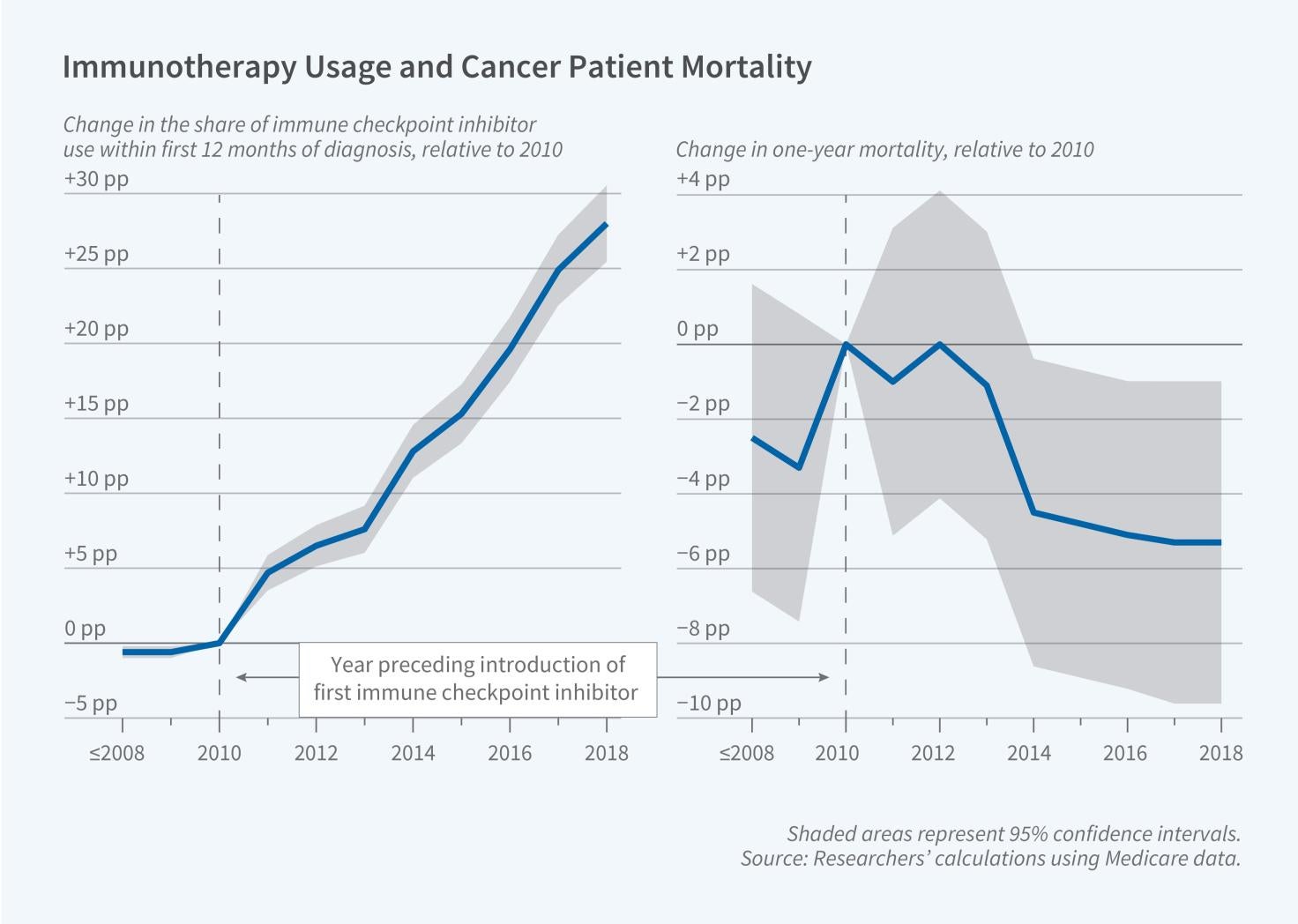
Immunotherapy Increases the Cost of Cancer Care but Reduces Mortality
article
Immune checkpoint inhibitors (ICIs) are immunotherapy drugs that mobilize the patient’s immune system to detect and attack cancer cells. They are considered a breakthrough development in cancer care, but are very expensive, with a full course of treatment costing more than $150,000 per patient. In The Impact of Immunotherapy on Reductions in Cancer Mortality: Evidence from Medicare (NBER Working Paper 34317), Danea Horn, Abby E. Alpert, Mark Duggan, and Mireille Jacobson use Medicare claims data to evaluate the impact of the first ICIs on healthcare use, costs, and mortality among beneficiaries diagnosed with...
Featured Working Papers
In a study of more than 160,000 international acquisitions by Chinese firms over the period 2012 through 2021, target firms increase R&D spending by 6.6 percent but do not generate increased patents, while patent output at the Chinese parent firms doubles following their first developed-economy acquisition, according to Jennie Bai, Luc Laeven, Yaojun Ke, and Hong Ru.
Nicholas Z. Muller estimates that electricity consumption by approximately 2,800 US data centers generated roughly $25 billion in external damages from air pollution and greenhouse gas emissions in 2025.
An unexpected increase in federal borrowing of one percent of GDP during the 1998–2025 period raised 10-year Treasury yields by 1.7 basis points immediately, and even more at peak impact, according to Huixin Bi, Maxime Phillot, and Sarah Zubairy.
Between 2000 and 2023, the average appointment age of US CEOs rose from roughly 48 to 55, five times the age increase seen across the broader college-educated labor force, according to Valentin Kecht, Alessandro Lizzeri, and Farzad Saidi.
In a study of 2.5 million births in Florida, severe maternal complications were 15.8 percent higher in male-only obstetric teams compared to female-only teams, according to Ambar La Forgia and Manasvini Singh.
In the News
Recent citations of NBER research in the media
_______________________________________
Research Projects
Conferences
Books & Chapters
Through a partnership with the University of Chicago Press, the NBER publishes the proceedings of four annual conferences as well as other research studies associated with NBER-based research projects.
Videos
Recordings of presentations, keynote addresses, and panel discussions at NBER conferences are available on the Videos page.