Could Venture Capital Finance Africa’s Startups?
Startups in Africa are increasingly seen as a potential driver of economic transformation, given the continent's young population, growing skilled workforce, and rapid adoption of digital technology. In the US and other advanced economies with deep local capital markets and strong contracting institutions, venture capital—equity-based financing that shares risk with founders and often comes with investor monitoring and governance rights—is the foundation of the startup ecosystem.
In Africa, however, where many local capital markets are thin and institutions are weaker, the sources and allocation of capital for startups are less clear. In Startups in Africa (NBER Working Paper 35261), Emanuele Colonnelli, Marcio Cruz, Mariana Pereira-Lopez, Tommaso Porzio, and Chun Zhao examine these questions using newly assembled data on both the demand for and supply of startup financing across the continent.
Scarce local equity capital and a thin pool of well-connected local entrepreneurs—not a lack of demand for equity—explain the "foreignness" of Africa's startup ecosystem.
The researchers analyze a continent-wide survey in which 4,444 early-stage startup founders across 51 African countries rated randomized investment profiles that vary financing terms and investor characteristics. They also study a dataset of venture capital (VC) deals from 2010 to 2024. They have data on 8,751 VC deals involving 5,470 companies.
In the survey experiment, switching an otherwise identical investment offer from a debt to an equity contract raised founders' interest ratings by 0.718 points on a 1–7 scale—equivalent to 16.8 percent of the average rating and comparable in size to raising the offered funding from covering less than a quarter of the amount sought to covering it in full, or to cutting a debt contract's interest rate by 11 percentage points. At the same time, respondents care about the cost of equity: they prefer lower dilution and react negatively to board-seat requirements. Equity is attractive not because founders ignore ownership and control, but because it provides cash-flow flexibility and gives investors incentives to support the firm's growth.
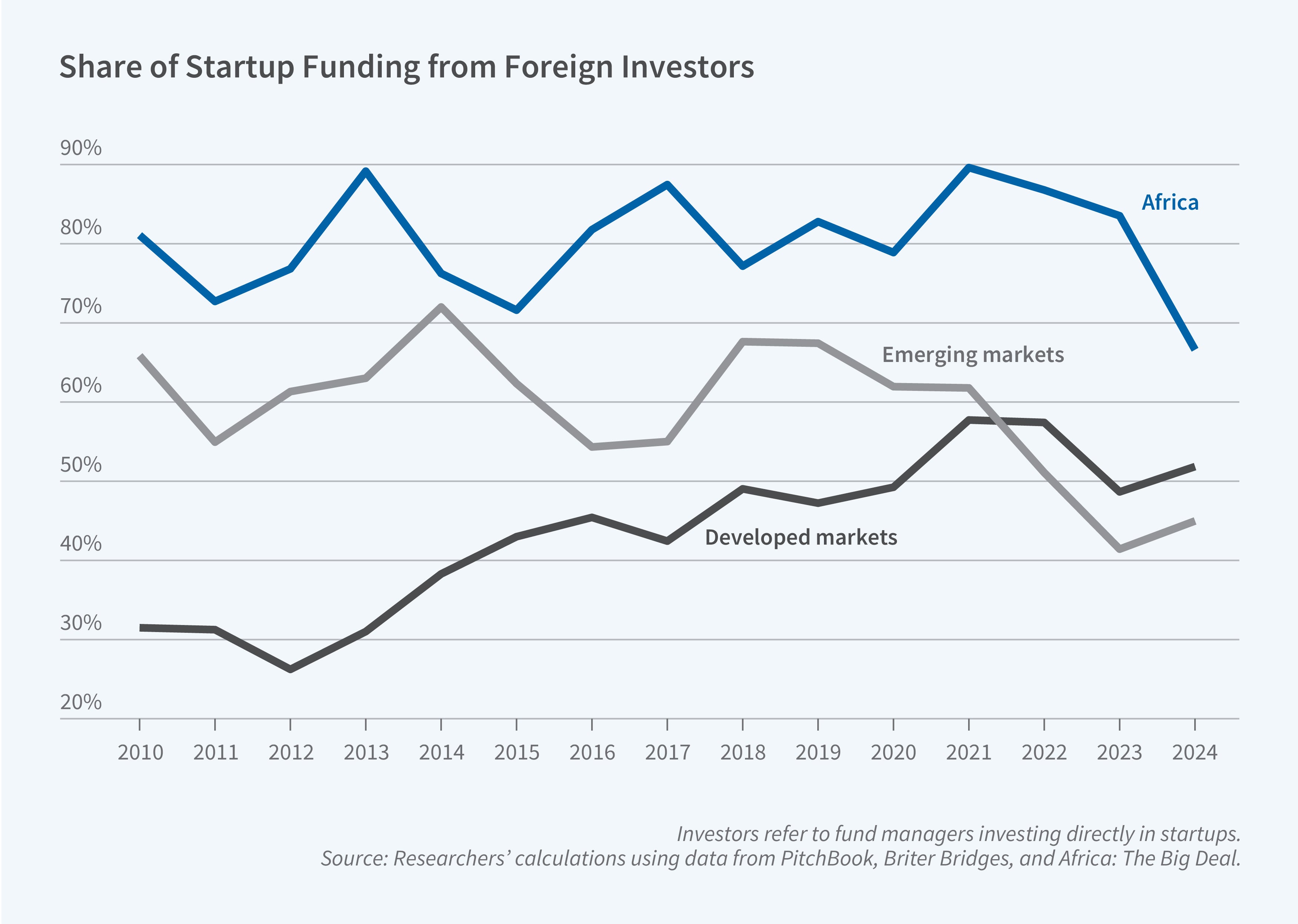
On the supply side, the researchers find that deals involving at least one foreign investor account for roughly 80 percent of African VC deal value, with capital originating mainly from North America and Europe. More than 60 percent of funded entrepreneurs had studied or worked outside Africa. Unmet demand for financing was also substantial: The average surveyed founder sought about $730,000 in external capital but secured only around 32 percent of that amount. Seventy-eight percent of respondents cited access to finance as their primary obstacle to growth.
VC activity in Africa is highly concentrated—the four largest hub countries accounted for 72 percent of deal value in 2024 while representing only 43.5 percent of continental GDP. The median African deal size was $0.9 million, less than half the median in other emerging or developed markets.
The researchers estimate that if local capital markets in Africa were comparable to those in Europe, the local investor share of VC deals would rise from 26 to 42 percent and the local entrepreneur share from 32 to 41 percent. Reducing local capital scarcity would raise startup activity by 13 percent, and equalizing local entrepreneurs' access to foreign investors would raise it by 17 percent while shifting financing further toward foreign capital.
The researchers acknowledge support from the University of Chicago Booth School of Business, including the Fama-Miller Center and the Becker Friedman Institute, the IFC Economic Research Department in partnership with the Government of Japan, the PEDL-BII Research Initiative, the Templeton World Charity Foundation, the International Growth Centre SGB Initiative, Nesta Innovation Growth Lab, and the Polsky Center at the University of Chicago.


